







Question: Test Tensor flow with the below python codes at colab. import tensorflow as tf from keras.layers import Input, Dense from keras.models import Model import matplotlib.pyplot
Test Tensor flow with the below python codes at colab.
import tensorflow as tf
from keras.layers import Input, Dense
from keras.models import Model
import matplotlib.pyplot as plt
Test Tensor flow with linear regressions
import numpy as np
#Linear Regression with TensorFlow
from sklearn.datasets import fetchcaliforniahousing
housing fetchcaliforniahousing
m n housing.data.shape
housingdataplusbias npcnponesm housing.data
X tfconstanthousingdataplusbias, dtypetffloat nameX
y tfconstanthousingtarget.reshape dtypetffloat namey
XT tftransposeX
theta tfmatmultfmatmultflinalg.invtfmatmulXT X XT y
printtheta
Test Tensor flow with MNIST handwriting data set
# Plot ad hoc mnist instances
from keras.datasets import mnist
import matplotlib.pyplot as plt
# load downloaded if needed the MNIST dataset
Xtrain, ytrainXtest, ytest mnist.loaddata
# plot images as gray scale
pltsubplot
pltimshowXtrain cmappltgetcmapgray
pltsubplot
pltimshowXtrain cmappltgetcmapgray
pltsubplot
pltimshowXtrain cmappltgetcmapgray
pltsubplot
pltimshowXtrain cmappltgetcmapgray
# show the plot
pltshow
from keras.datasets import mnist
from keras.models import Sequential
from keras.layers import Dense
from keras.layers import Dropout
from keras.utils import tocategorical
# fix random seed for reproducibility
seed
nprandom.seedseed
# load data
Xtrain, ytrainXtest, ytest mnist.loaddata
# flatten images to a vector for each image
numpixels Xtrain.shape Xtrain.shape
Xtrain Xtrain.reshapeXtrain.shape numpixelsastypefloat
Xtest Xtest.reshapeXtest.shape numpixelsastypefloat
# normalize inputs from to
Xtrain Xtrain
Xtest Xtest
# one hot encode outputs
ytrain tocategoricalytrain
ytest tocategoricalytest
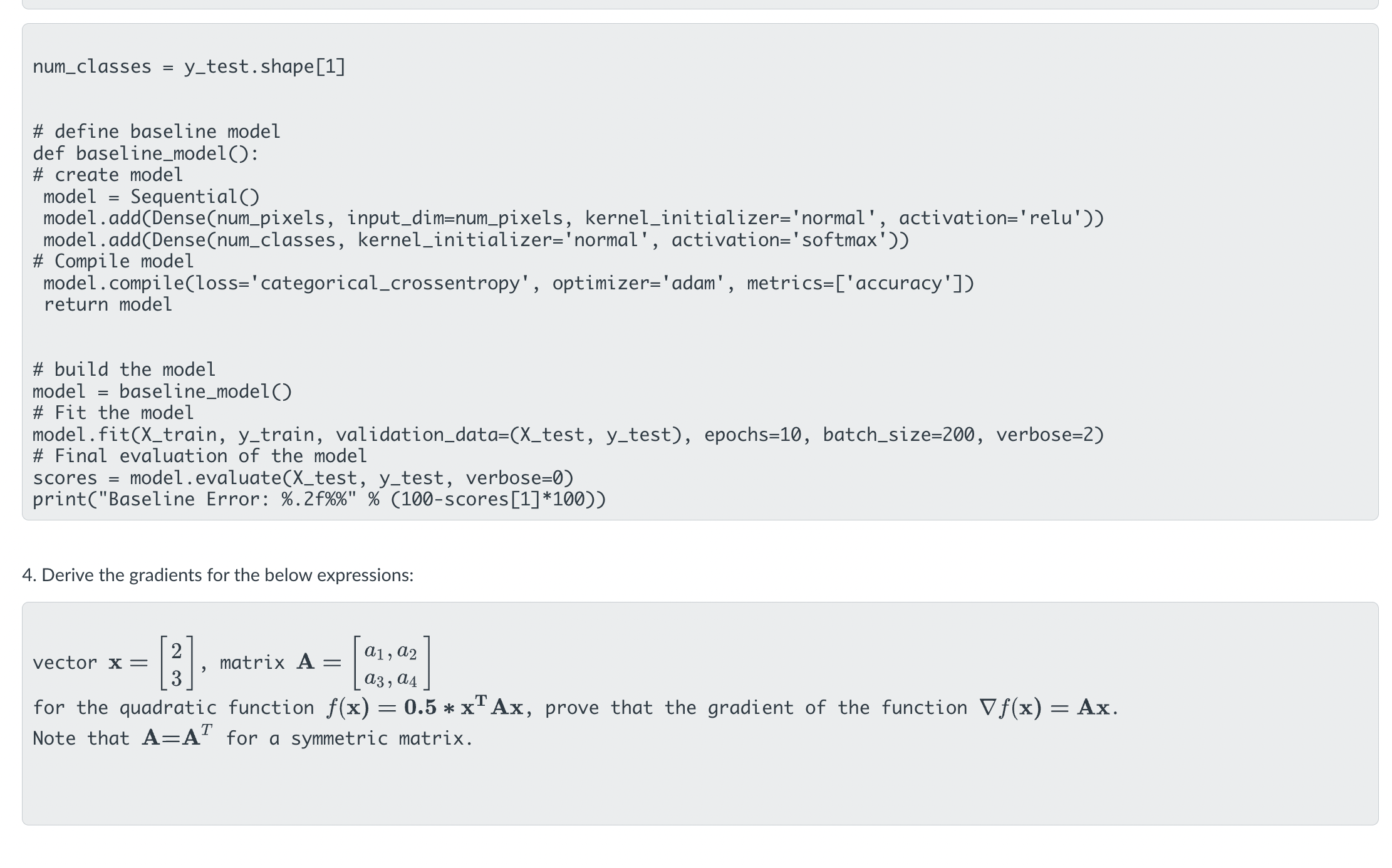
numclasses ytest.shape
# define baseline model
def baselinemodel:
# reate model
model Sequential
model.addDensenumpixels, inputdimnumpixels, kernelinitializer'normal', activation'relu'
model.addDensenumclasses, kernelinitializer'normal', activation'softmax'
# Compile model
model compileloss'categoricalcrossentropy' optimizer'adam' metricsaccuracy
return model
# build the model
model baselinemodel
# Fit the model
model.fitXtrain, ytrain, validationdataXtest, ytest epochs batchsize verbose
# Final evaluation of the model
scores model.evaluateXtest, ytest, verbose
printBaseline Error: fscores
TO DO:
Derive the gradients for the below expressions:
vector matrix
for the quadratic function prove that the gradient of the function gradf
Note that for a symmetric matrix.
ONLY step has to be done!!
Step by Step Solution
There are 3 Steps involved in it
1 Expert Approved Answer
Step: 1 Unlock

Question Has Been Solved by an Expert!
Get step-by-step solutions from verified subject matter experts
Step: 2 Unlock
Step: 3 Unlock
 Study Help