







Question: Text Data Classification - In this question, we will dry-run the Nave Bayes' (parts (b)-(d)) classification algorithm to predict if the sentiment of the text
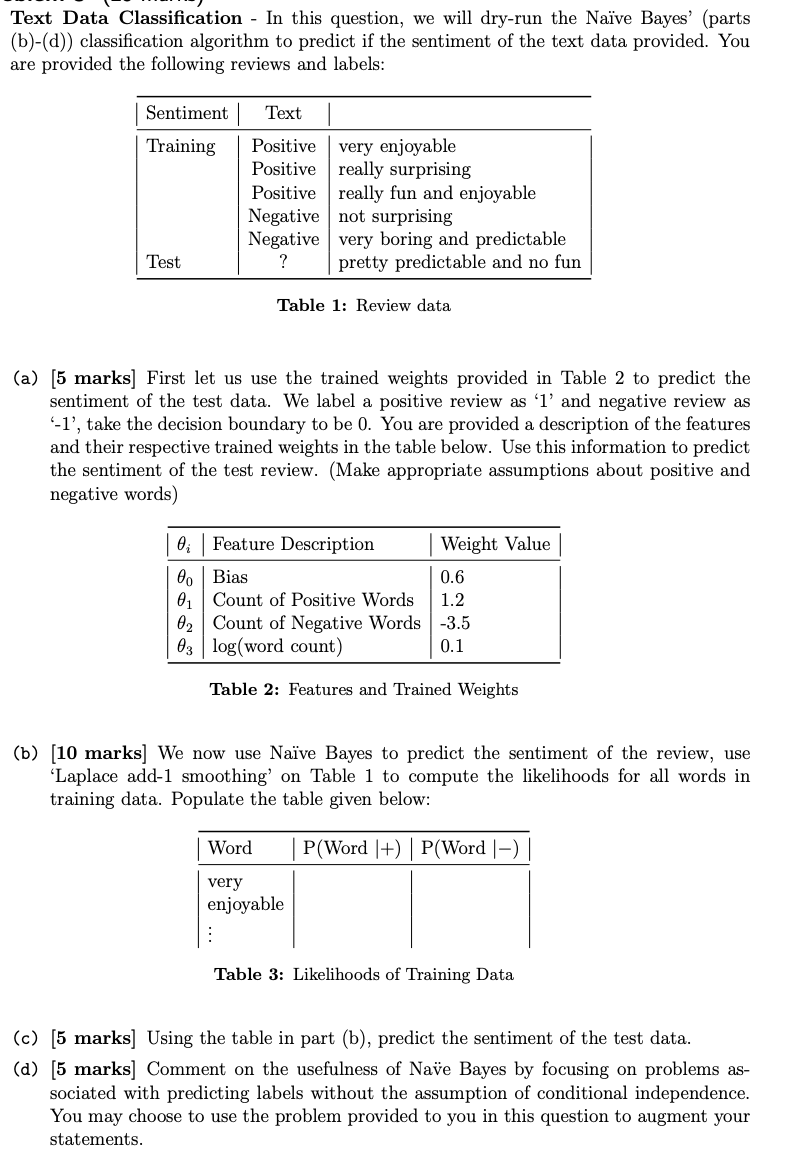
Text Data Classification - In this question, we will dry-run the Nave Bayes' (parts (b)-(d)) classification algorithm to predict if the sentiment of the text data provided. You are provided the following reviews and labels: Text Sentiment Training Positive very enjoyable Positive really surprising Positive really fun and enjoyable Negative not surprising Negative very boring and predictable ? pretty predictable and no fun Test Table 1: Review data (a) [5 marks] First let us use the trained weights provided in Table 2 to predict the sentiment of the test data. We label a positive review as 'l' and negative review as -1', take the decision boundary to be 0. You are provided a description of the features and their respective trained weights in the table below. Use this information to predict the sentiment of the test review. (Make appropriate assumptions about positive and negative words) 0 Feature Description Weight Value 00 Bias 01 Count of Positive Words 02 Count of Negative Words 03 log(word count) 0.6 1.2 -3.5 0.1 Table 2: Features and Trained Weights (b) (10 marks] We now use Nave Bayes to predict the sentiment of the review, use Laplace add-1 smoothing' on Table 1 to compute the likelihoods for all words in training data. Populate the table given below: Word P(Word + P(Word very enjoyable Table 3: Likelihoods of Training Data (c) [5 marks] Using the table in part (b), predict the sentiment of the test data. (a) [5 marks] Comment on the usefulness of Nave Bayes by focusing on problems as- sociated with predicting labels without the assumption of conditional independence. You may choose to use the problem provided to you in this question to augment your statements. Text Data Classification - In this question, we will dry-run the Nave Bayes' (parts (b)-(d)) classification algorithm to predict if the sentiment of the text data provided. You are provided the following reviews and labels: Text Sentiment Training Positive very enjoyable Positive really surprising Positive really fun and enjoyable Negative not surprising Negative very boring and predictable ? pretty predictable and no fun Test Table 1: Review data (a) [5 marks] First let us use the trained weights provided in Table 2 to predict the sentiment of the test data. We label a positive review as 'l' and negative review as -1', take the decision boundary to be 0. You are provided a description of the features and their respective trained weights in the table below. Use this information to predict the sentiment of the test review. (Make appropriate assumptions about positive and negative words) 0 Feature Description Weight Value 00 Bias 01 Count of Positive Words 02 Count of Negative Words 03 log(word count) 0.6 1.2 -3.5 0.1 Table 2: Features and Trained Weights (b) (10 marks] We now use Nave Bayes to predict the sentiment of the review, use Laplace add-1 smoothing' on Table 1 to compute the likelihoods for all words in training data. Populate the table given below: Word P(Word + P(Word very enjoyable Table 3: Likelihoods of Training Data (c) [5 marks] Using the table in part (b), predict the sentiment of the test data. (a) [5 marks] Comment on the usefulness of Nave Bayes by focusing on problems as- sociated with predicting labels without the assumption of conditional independence. You may choose to use the problem provided to you in this question to augment your statements
Step by Step Solution
There are 3 Steps involved in it

Get step-by-step solutions from verified subject matter experts
 Study Help