







Question: Text : Question: Claussen essentially designed the program on his own, with very little research into goal setting and motivation. Based on your text, how
Text :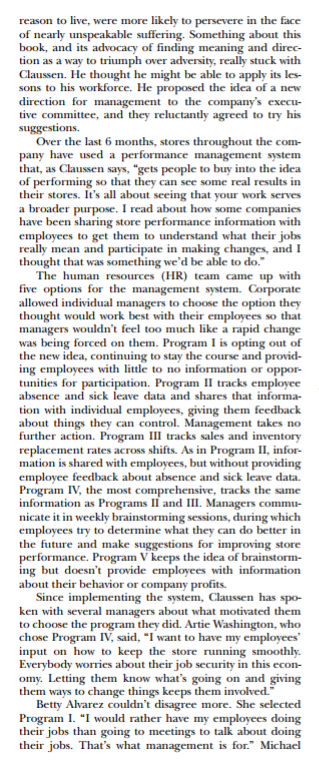
Question: Claussen essentially designed the program on his own, with very little research into goal setting and motivation. Based on your text, how well has he done? Which parts of the program appear to fit well with research evidence on goal setting? What parts would you change to get more substantial improvements in employee motivation?
plz try to help me ,it's very easy but my problem is with english i have so much difficulties to understand.
reason to live, were more likely to persevere in the face of nearly unspeakable suffering. Something about this book, and its advocacy of finding meaning and direc tion as a way to triumph over adversity, really stuck with Claussen. He thought he might be able to apply its les- sons to his workforce. He proposed the idea of a new direction for management to the company's execu- tive committee, and they reluctantly agreed to try his suggestions. Over the last 6 months, stores throughout the com- pany have used a performance management system that, as Claussen says, "gets people to buy into the idea of performing so that they can see some real results in their stores. It's all about seeing that your work serves a broader purpose. I read about how some companies have been sharing store performance information with employees to get them to understand what their jobs really mean and participate in making changes, and I thought that was something we'd be able to do." The human resources (HR) team came up with five options for the management system. Corporate allowed individual managers to choose the option they thought would work best with their employees so that managers wouldn't feel too much like a rapid change was being forced on them. Program I is opting out of the new idea, continuing to stay the course and provid- ing employees with little to no information or oppor- tunities for participation. Program II tracks employee absence and sick leave data and shares that informa- tion with individual employees, giving them feedback about things they can control. Management takes no further action. Program III tracks sales and inventory replacement rates across shifts. As in Program II, infor- mation is shared with employees, but without providing employee feedback about absence and sick leave data. Program IV, the most comprehensive, tracks the same information as Programs II and III. Managers commu- nicate it in weekly brainstorming sessions, during which employees try to determine what they can do better in the future and make suggestions for improving store performance. Program V keeps the idea of brainstorm- ing but doesn't provide employees with information about their behavior or company profits. Since implementing the system, Claussen has spo- ken with several managers about what motivated them to choose the program they did. Artie Washington, who chose Program IV, said, "I want to have my employees input on how to keep the store running smoothly. Everybody worries about their job security in this econ- omy. Letting them know what's going on and giving them ways to change things keeps them involved." Betty Alvarez couldn't disagree more. She selected Program I. "I would rather have my employees doing their jobs than going to meetings to talk about doing their jobs. That's what management is for. MichaelStep by Step Solution
There are 3 Steps involved in it
1 Expert Approved Answer
Step: 1 Unlock

Question Has Been Solved by an Expert!
Get step-by-step solutions from verified subject matter experts
Step: 2 Unlock
Step: 3 Unlock
 Study Help