







Question: Thank you. a) Statistical inference may be divided into two major areas: and b) In practice, we can use sample data to compute a number
Thank you.
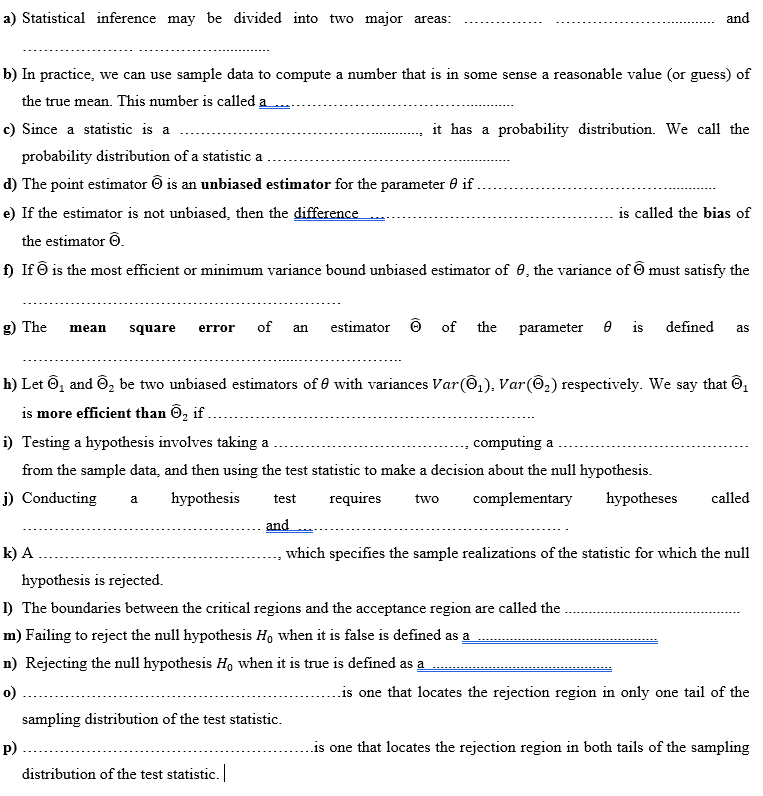
a) Statistical inference may be divided into two major areas: and b) In practice, we can use sample data to compute a number that is in some sense a reasonable value (or guess) of the true mean. This number is called a c) Since a statistic is a it has a probability distribution. We call the probability distribution of a statistic a. d) The point estimator is an unbiased estimator for the parameter 6 if e) If the estimator is not unbiased, then the difference is called the bias of the estimator . f) If is the most efficient or minimum variance bound unbiased estimator of the variance of must satisfy the g) The mean square error of an estimator of the parameter is defined as a test two h) Let , and , be two unbiased estimators of 0 with variances Var(1), Var(2) respectively. We say that . is more efficient than , if. i) Testing a hypothesis involves taking a computing a from the sample data, and then using the test statistic to make a decision about the null hypothesis. j) Conducting hypothesis requires complementary hypotheses called and k) A which specifies the sample realizations of the statistic for which the null hypothesis is rejected. 1) The boundaries between the critical regions and the acceptance region are called the m) Failing to reject the null hypothesis H, when it is false is defined as a n) Rejecting the null hypothesis H, when it is true is defined as a o) ...is one that locates the rejection region in only one tail of the sampling distribution of the test statistic. P) ..is one that locates the rejection region in both tails of the sampling distribution of the test statistic. |Step by Step Solution
There are 3 Steps involved in it
1 Expert Approved Answer
Step: 1 Unlock

Question Has Been Solved by an Expert!
Get step-by-step solutions from verified subject matter experts
Step: 2 Unlock
Step: 3 Unlock
 Study Help