







Question: Thank you so much! 1. Consider the function f (:5) = 3:2 - em . This problem will help you understand the difference between absolute
Thank you so much!
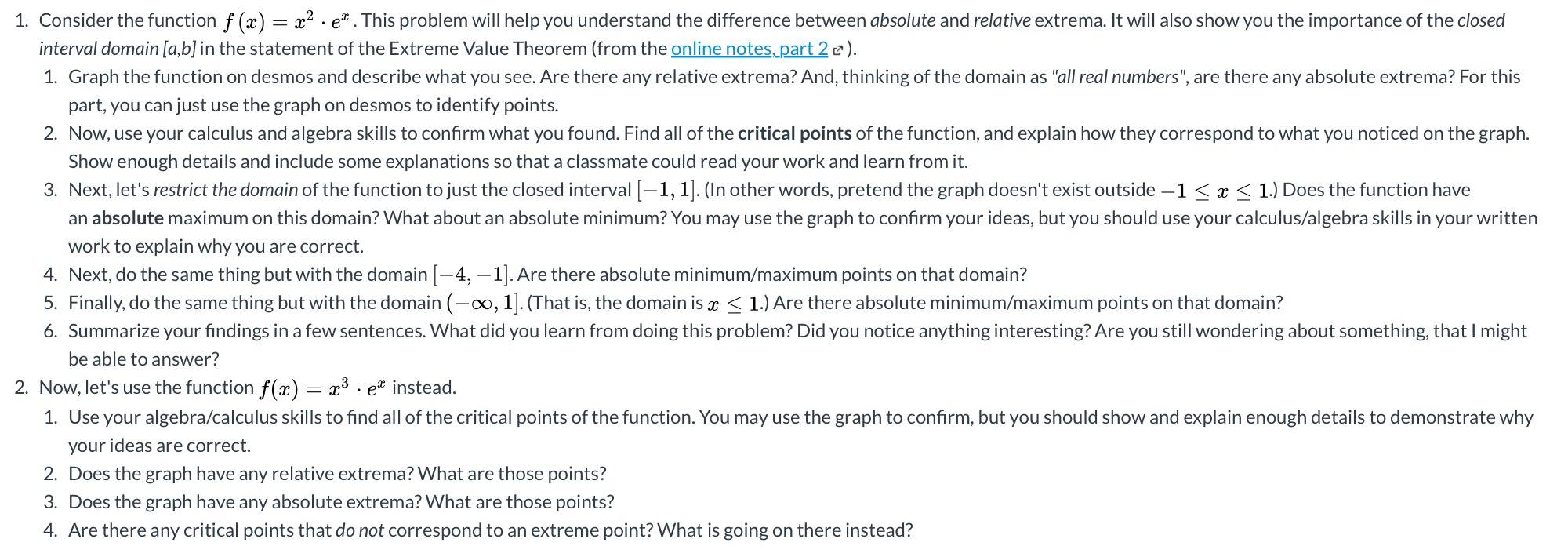
1. Consider the function f (:5) = 3:2 - em . This problem will help you understand the difference between absolute and relative extrema. It will also show you the importance of the closed interval domain [ab] in the statement of the Extreme Value Theorem (from the online notes,_par_tZ a ). 1. Graph the function on desmos and describe what you see. Are there any relative extrema? And, thinking ofthe domain as "all real numbers", are there anyabsolute extrema? For this part, you canjust use the graph on desmos to identify points. 2. Now, use your calculus and algebra skills to conrm what you found. Find all of the critical points ofthe function, and explain how they correspond to what you noticed on the graph. Show enough details and include some explanations so that a classmate could read your work and learn from it. 3. Next, let's restrict thedomain ofthe function tojust the closed interval [1, 1]. (In otherwords, pretend the graph doesn't exist outside 1 g r g 1.) Does the function have an absolute maximum on this domain? What about an absolute minimum?You may use the graph to conrm your ideas, but you should use your calculus/algebra skills in your written work to explain why you are correct. 4. Next, do the same thing but with the domain [4, 1]. Are there absolute minimum/maximum points on that domain? Finally, do the same thing but with the domain (00, 1]. (That is, the domain is :1: g 1.) Are there absolute minimum/maximum points on that domain? 6. Summarize your ndings in a few sentences. What did you learn from doingthis problem? Did you notice anything interesting7Are you still wondering about something, that I might be able to answer? 2. Now, let's use the function f(m) = m3 . 8" instead. 5" 1. Use your algebra/calculus skills to find all of the critical points of the function. You may use the graph to confi rm, but you should show and explain enough details to demonstrate why your ideas are correct. 2. Does the graph have any relative extrema? What are those points? Does the graph have any absolute extrema? What are those points? 4. Are there any critical points that do not correspond to an extreme point? What is going on there instead? 9
Step by Step Solution
There are 3 Steps involved in it

Get step-by-step solutions from verified subject matter experts
 Study Help