







Question: Thanks for any help Note: To avoid round-off error, retain at least six decimal places in all of your calculations. . Assume the function f
Thanks for any help
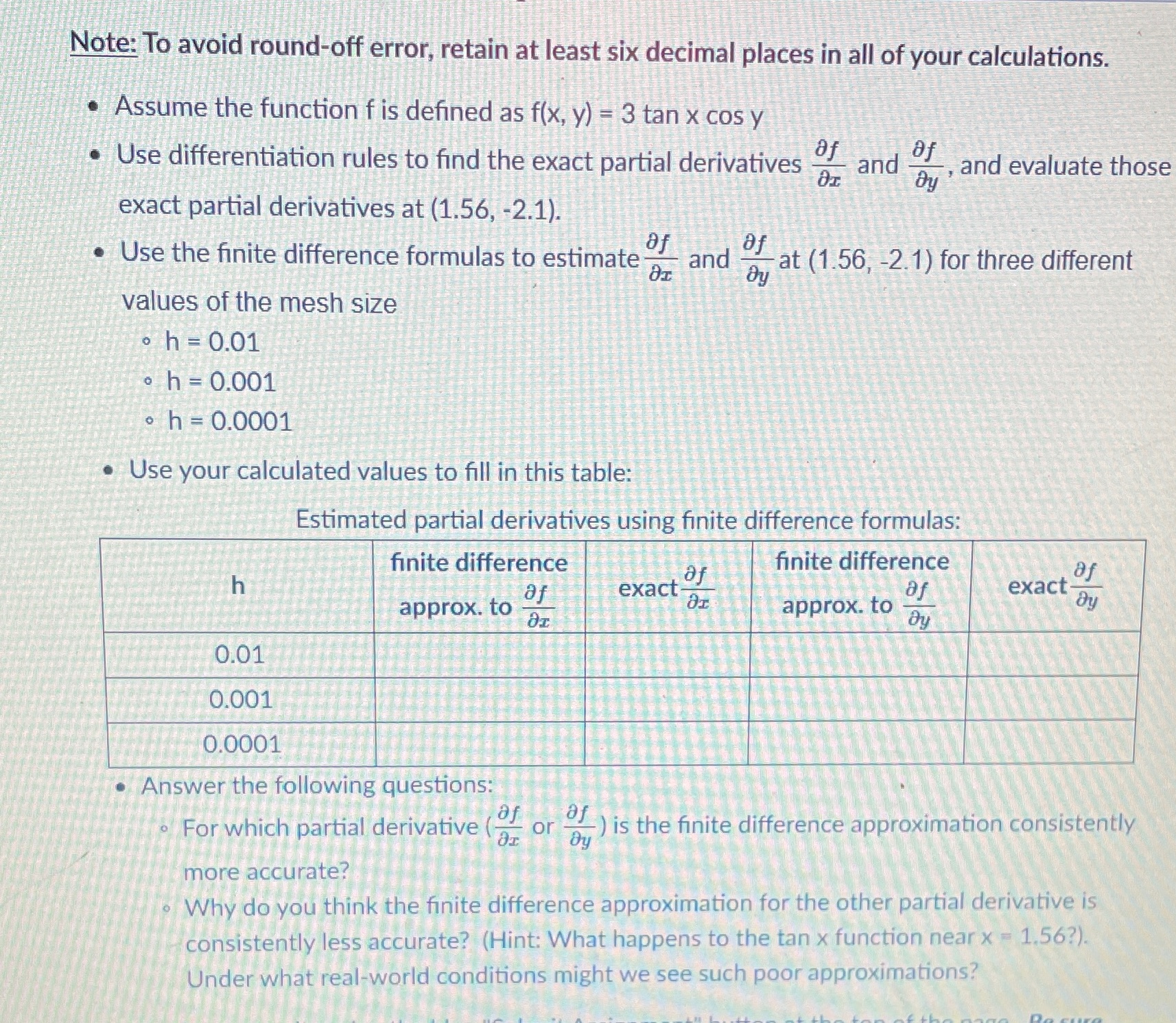
Note: To avoid round-off error, retain at least six decimal places in all of your calculations. . Assume the function f is defined as f(x, y) = 3 tan x cos y . Use differentiation rules to find the exact partial derivatives of and dy , and evaluate those exact partial derivatives at (1.56, -2.1). . Use the finite difference formulas to estimate of of and dy " at (1.56, -2.1) for three different values of the mesh size o h = 0.01 o h = 0.001 . h = 0.0001 . Use your calculated values to fill in this table: Estimated partial derivatives using finite difference formulas: finite difference finite difference h exact of approx. to of of approx. to 9 exact ay 0.01 0.001 0.0001 . Answer the following questions: For which partial derivative (a or or of) is the finite difference approximation consistently more accurate? Why do you think the finite difference approximation for the other partial derivative is consistently less accurate? (Hint: What happens to the tan x function near x = 1.56?). Under what real-world conditions might we see such poor approximations
Step by Step Solution
There are 3 Steps involved in it

Get step-by-step solutions from verified subject matter experts
 Study Help