







Question: That was the much information provided Just skip it 9. In our discussion of the Bistro-to-Go case, we wrestled with what to do about the
That was the much information provided
Just skip it
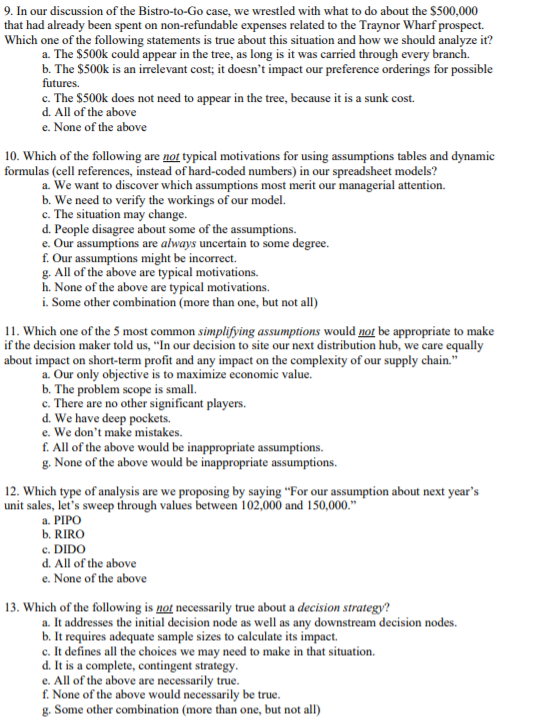
9. In our discussion of the Bistro-to-Go case, we wrestled with what to do about the $500,000 that had already been spent on non-refundable expenses related to the Traynor Wharf prospect. Which one of the following statements is true about this situation and how we should analyze it? a. The $500k could appear in the tree, as long is it was carried through every branch. b. The $500k is an imrelevant cost; it doesn't impact our preference orderings for possible futures. c. The $500k does not need to appear in the tree, because it is a sunk cost. d. All of the above e. None of the above 10. Which of the following are not typical motivations for using assumptions tables and dynamic formulas (cell references, instead of hard-coded numbers) in our spreadsheet models? a. We want to discover which assumptions most merit our managerial attention. b. We need to verify the workings of our model. c. The situation may change. d. People disagree about some of the assumptions. e. Our assumptions are always uncertain to some degree. f. Our assumptions might be incorrect. g. All of the above are typical motivations. h. None of the above are typical motivations. i. Some other combination (more than one, but not all) 11. Which one of the 5 most common simplifying assumptions would not be appropriate to make if the decision maker told us, In our decision to site our next distribution hub, we care equally about impact on short-term profit and any impact on the complexity of our supply chain." a. Our only objective is to maximize economic value. b. The problem scope is small. c. There are no other significant players. d. We have deep pockets. e. We don't make mistakes. f. All of the above would be inappropriate assumptions. g. None of the above would be inappropriate assumptions. 12. Which type of analysis are we proposing by saying "For our assumption about next year's unit sales, let's sweep through values between 102,000 and 150,000." a. PIPO b. RIRO c. DIDO d. All of the above e. None of the above 13. Which of the following is not necessarily true about a decision strategy? a. It addresses the initial decision node as well as any downstream decision nodes. b. It requires adequate sample sizes to calculate its impact. c. It defines all the choices we may need to make in that situation. d. It is a complete, contingent strategy. e. All of the above are necessarily true. f. None of the above would necessarily be true. g. Some other combination (more than one, but not all)Step by Step Solution
There are 3 Steps involved in it
1 Expert Approved Answer
Step: 1 Unlock

Question Has Been Solved by an Expert!
Get step-by-step solutions from verified subject matter experts
Step: 2 Unlock
Step: 3 Unlock
 Study Help