







Question: thats all that is given Part A 25 Marks) Calculate the value of a nine-month European call option on a soybean futures contract (note: One
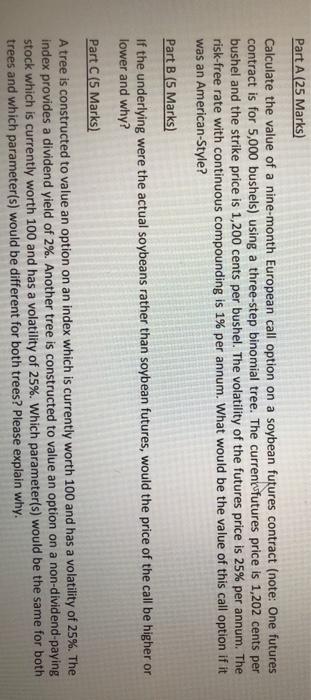
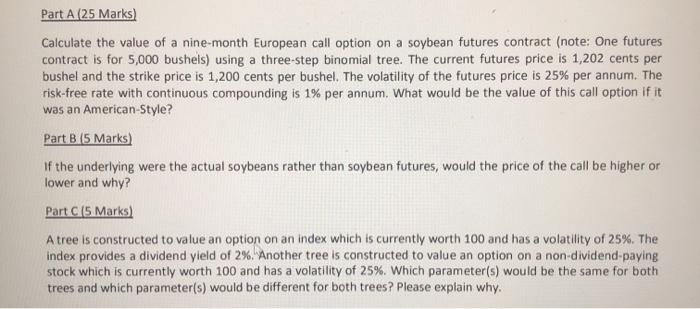
Part A 25 Marks) Calculate the value of a nine-month European call option on a soybean futures contract (note: One futures contract is for 5,000 bushels) using a three-step binomial tree. The currencvfutures price is 1,202 cents per bushel and the strike price is 1,200 cents per bushel. The volatility of the futures price is 25% per annum. The risk-free rate with continuous compounding is 1% per annum. What would be the value of this call option if it was an American-Style? Part B/5 Marks) If the underlying were the actual soybeans rather than soybean futures, would the price of the call be higher or lower and why? Part C(5 Marks) A tree is constructed to value an option on an index which is currently worth 100 and has a volatility of 25%. The index provides a dividend yield of 2%. Another tree is constructed to value an option on a non-dividend paying stock which is currently worth 100 and has a volatility of 25%. Which parameter(s) would be the same for both trees and which parameter(s) would be different for both trees? Please explain why. Part A (25 Marks) Calculate the value of a nine-month European call option on a soybean futures contract (note: One futures contract is for 5,000 bushels) using a three-step binomial tree. The current futures price is 1,202 cents per bushel and the strike price is 1,200 cents per bushel. The volatility of the futures price is 25% per annum. The risk-free rate with continuous compounding is 1% per annum. What would be the value of this call option if it was an American-Style? Part B (5 Marks) If the underlying were the actual soybeans rather than soybean futures, would the price of the call be higher or lower and why? Part C (5 Marks) A tree is constructed to value an option on an index which is currently worth 100 and has a volatility of 25%. The index provides a dividend yield of 2%. Another tree is constructed to value an option on a non-dividend paying stock which is currently worth 100 and has a volatility of 25%. Which parameter(s) would be the same for both trees and which parameter(s) would be different for both trees? Please explain why. Part A 25 Marks) Calculate the value of a nine-month European call option on a soybean futures contract (note: One futures contract is for 5,000 bushels) using a three-step binomial tree. The currencvfutures price is 1,202 cents per bushel and the strike price is 1,200 cents per bushel. The volatility of the futures price is 25% per annum. The risk-free rate with continuous compounding is 1% per annum. What would be the value of this call option if it was an American-Style? Part B/5 Marks) If the underlying were the actual soybeans rather than soybean futures, would the price of the call be higher or lower and why? Part C(5 Marks) A tree is constructed to value an option on an index which is currently worth 100 and has a volatility of 25%. The index provides a dividend yield of 2%. Another tree is constructed to value an option on a non-dividend paying stock which is currently worth 100 and has a volatility of 25%. Which parameter(s) would be the same for both trees and which parameter(s) would be different for both trees? Please explain why. Part A (25 Marks) Calculate the value of a nine-month European call option on a soybean futures contract (note: One futures contract is for 5,000 bushels) using a three-step binomial tree. The current futures price is 1,202 cents per bushel and the strike price is 1,200 cents per bushel. The volatility of the futures price is 25% per annum. The risk-free rate with continuous compounding is 1% per annum. What would be the value of this call option if it was an American-Style? Part B (5 Marks) If the underlying were the actual soybeans rather than soybean futures, would the price of the call be higher or lower and why? Part C (5 Marks) A tree is constructed to value an option on an index which is currently worth 100 and has a volatility of 25%. The index provides a dividend yield of 2%. Another tree is constructed to value an option on a non-dividend paying stock which is currently worth 100 and has a volatility of 25%. Which parameter(s) would be the same for both trees and which parameter(s) would be different for both trees? Please explain why
Step by Step Solution
There are 3 Steps involved in it

Get step-by-step solutions from verified subject matter experts
 Study Help