







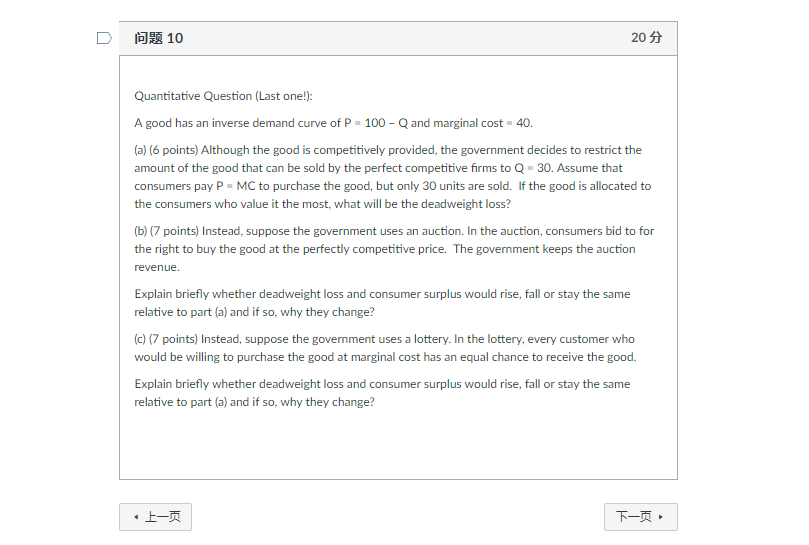
Question: thats the question D 1 10 20 $3 Quantitative Question (Last one!): A good has an inverse demand curve of P = 100 - Q
thats the question
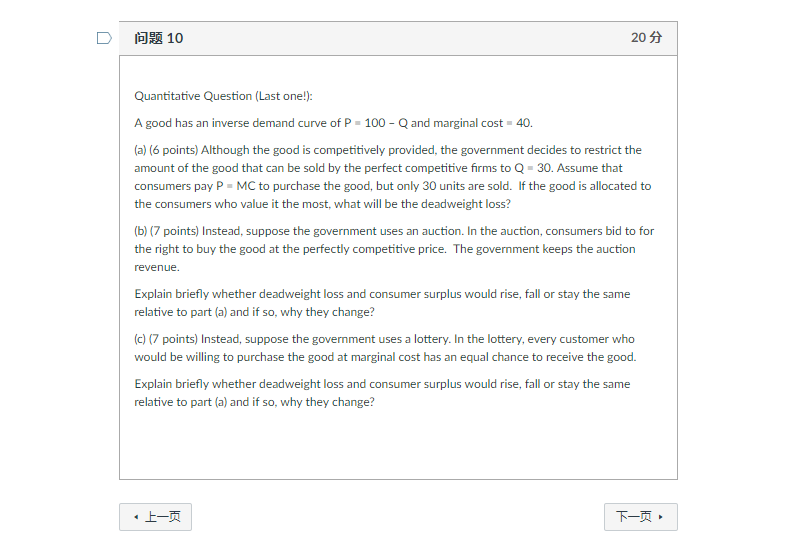
D 1 10 20 $3 Quantitative Question (Last one!): A good has an inverse demand curve of P = 100 - Q and marginal cost = 40. (a) (6 points) Although the good is competitively provided, the government decides to restrict the amount of the good that can be sold by the perfect competitive firms to Q = 30. Assume that consumers pay P = MC to purchase the good, but only 30 units are sold. If the good is allocated to the consumers who value it the most, what will be the deadweight loss? (b) (7 points) Instead, suppose the government uses an auction. In the auction, consumers bid to for the right to buy the good at the perfectly competitive price. The government keeps the auction revenue. Explain briefly whether deadweight loss and consumer surplus would rise, fall or stay the same relative to part (a) and if so, why they change? (c) (7 points) Instead, suppose the government uses a lottery. In the lottery, every customer who would be willing to purchase the good at marginal cost has an equal chance to receive the good. Explain briefly whether deadweight loss and consumer surplus would rise, fall or stay the same relative to part (a) and if so, why they change
Step by Step Solution
There are 3 Steps involved in it

Get step-by-step solutions from verified subject matter experts
 Study Help