Question: The 2005 Canada Games: A Case for PMI's Volunteer Driven Project Management Model The character of the Canada Games has changed little since the first
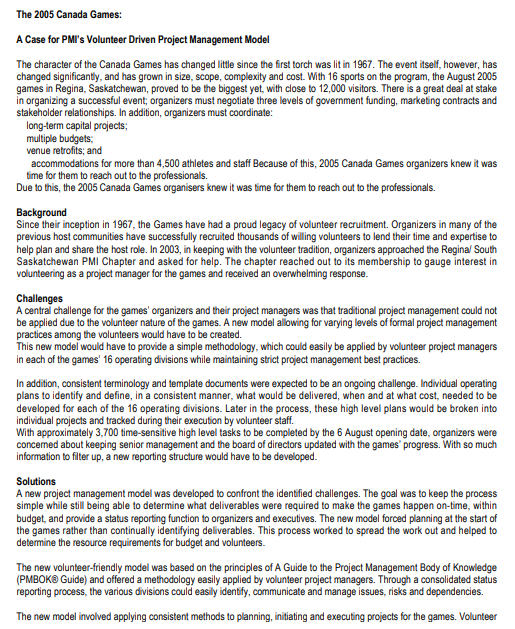
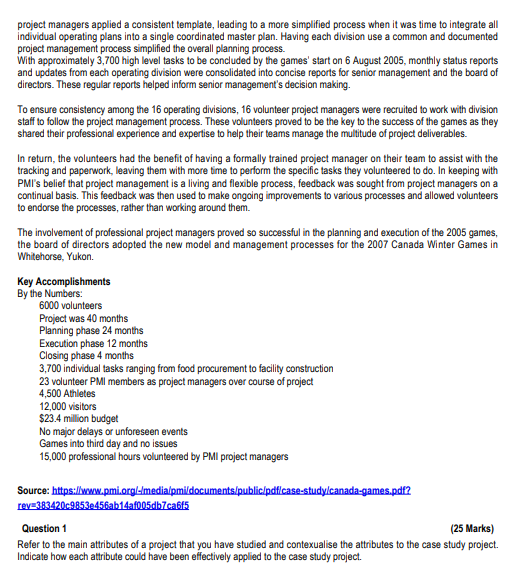
The 2005 Canada Games: A Case for PMI's Volunteer Driven Project Management Model The character of the Canada Games has changed little since the first torch was lit in 1967. The event itself, however, has changed significantly, and has grown in size, scope, complexity and cost. With 16 sports on the program, the August 2005 games in Regina, Saskatchewan, proved to be the biggest yet, with close to 12,000 visitors. There is a great deal at stake In organizing a successful event; organizers must negotiate three levels of government funding, marketing contracts and stakeholder relationships. In addition, organizers must coordinate: long-term capital projects; multiple budgets, venue retrofits; and accommodations for more than 4,500 athletes and staff Because of this, 2005 Canada Games organizers knew it was time for them to reach out to the professionals. Due to this, the 2005 Canada Games organisers knew it was time for them to reach out to the professionals. Background Since their inception in 1967, the Games have had a proud legacy of volunteer recruitment. Organizers in many of the previous host communities have successfully recruited thousands of willing volunteers to lend their time and expertise to help plan and share the host role. In 2003, in keeping with the volunteer tradition, organizers approached the Reginal South Saskatchewan PMI Chapter and asked for help. The chapter reached out to its membership to gauge interest in volunteering as a project manager for the games and received an overwhelming response. Challenges A central challenge for the games' organizers and their project managers was that traditional project management could not be applied due to the volunteer nature of the games. A new model allowing for varying levels of formal project management practices among the volunteers would have to be created. This new model would have to provide a simple methodology, which could easily be applied by volunteer project managers in each of the games' 16 operating divisions while maintaining strict project management best practices. In addition, consistent terminology and template documents were expected to be an ongoing challenge. Individual operating plans to identify and define, in a consistent manner, what would be delivered, when and at what cost, needed to be developed for each of the 16 operating divisions. Later in the process, these high level plans would be broken into individual projects and tracked during their execution by volunteer staff. With approximately 3,700 time-sensitive high level tasks to be completed by the 6 August opening date, organizers were concerned about keeping senior management and the board of directors updated with the games' progress. With so much information to filter up, a new reporting structure would have to be developed. Solutions A new project management model was developed to confront the identified challenges. The goal was to keep the process simple while still being able to determine what deliverables were required to make the games happen on-time, within budget, and provide a status reporting function to organizers and executives. The new model forced planning at the start of the games rather than continually identifying deliverables. This process worked to spread the work out and helped to determine the resource requirements for budget and volunteers. The new volunteer-friendly model was based on the principles of A Guide to the Project Management Body of Knowledge (PMBOK@ Guide) and offered a methodology easily applied by volunteer project managers. Through a consolidated status reporting process, the various divisions could easily identify, communicate and manage issues, risks and dependencies. The new model involved applying consistent methods to planning, initiating and executing projects for the games. Volunteerproject managers applied a consistent template, leading to a more simplified process when it was time to integrate all individual operating plans into a single coordinated master plan. Having each division use a common and documented project management process simplified the overall planning process. With approximately 3,700 high level tasks to be concluded by the games' start on 6 August 2005, monthly status reports and updates from each operating division were consolidated inte concisa reports for senior management and the board of directors. These regular reports helped inform senior management's decisian making. To ensure consistency among the 16 operating divisions, 16 volunteer project managers were recruited to work with division staff to follow the project management process. These volunteers proved to be the key to the success of the games as they shared their professional experiance and expertise to help their teams manage the multitude of project deliverables. In return, the volunteers had the benefit of having a formally trained project manager on their team to assist with the tracking and paperwork leaving them with more time to perform the specific tasks they volunteered to do. In keeping with PMI's belief that project management is a living and flexible process, feedback was sought from projact managers on a continual basis. This feedback was then used to make ongoing improvements to various processes and allowed volunteers to endorse the processes, rather than working around them. Tha involvement of professional projact managers proved so successful in the planning and execution of the 2005 games, tha board of directors adopted tha new model and managamant processes for the 2007 Canada Winter Gamas in Whitehorse, Yukon. Key Accomplishments By the Numbers: 6000 volunteers Project was 40 months Planning phase 24 months Execution phase 12 months Closing phase 4 months 3,700 individual tasks ranging from food procurement to facility construction 23 volunteer PMI members as project managers over course of project 4,500 Athletes 12,000 visitors $23.4 million budget No major delays or unforeseen events Games into third day and no issues 15,000 professional hours voluntearad by PMI project managers Question t (25 Marks) Refer to the main attributes of a project that you have studied and contexualise the attributes to the case study project. Indicate how each attribute could have been effectively applied to the case study project
Step by Step Solution
There are 3 Steps involved in it
1 Expert Approved Answer
Step: 1 Unlock
Question Has Been Solved by an Expert!
Get step-by-step solutions from verified subject matter experts
Step: 2 Unlock
Step: 3 Unlock
Students Have Also Explored These Related General Management Questions!