



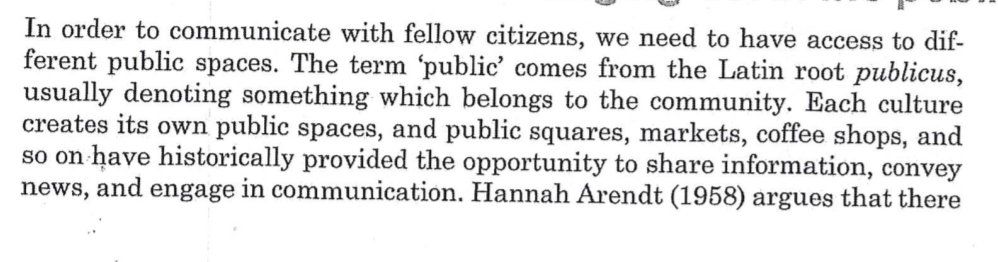
Question: The above is a case study and the question is at the bottom. Thank you In order to communicate with fellow citizens, we need to

The above is a case study and the question is at the bottom. Thank you
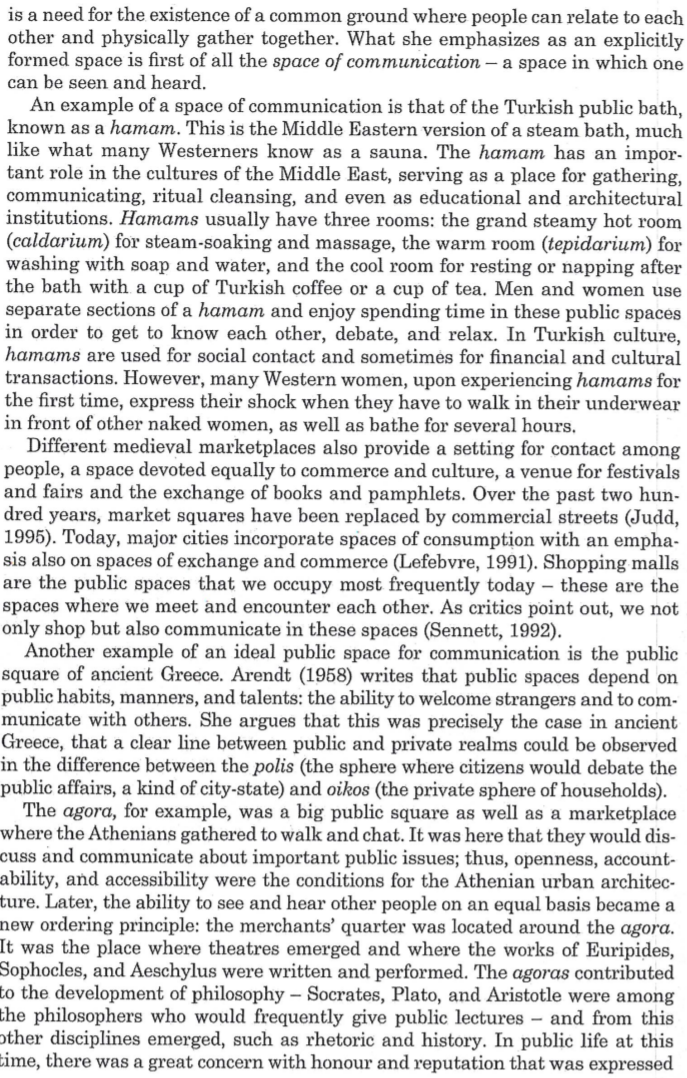
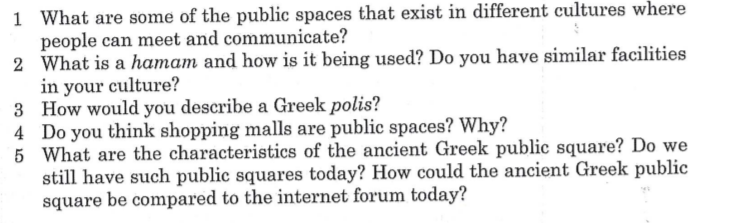
In order to communicate with fellow citizens, we need to have access to dif- ferent public spaces. The term 'public' comes from the Latin root publicus, usually denoting something which belongs to the community. Each culture creates its own public spaces, and public squares, markets, coffee shops, and so on have historically provided the opportunity to share information, convey news, and engage in communication. Hannah Arendt (1958) argues that there is a need for the existence of a common ground where people can relate to each other and physically gather together. What she emphasizes as an explicitly formed space is first of all the space of communication - a space in which one can be seen and heard. An example of a space of communication is that of the Turkish public bath, known as a hamam. This is the Middle Eastern version of a steam bath, much like what many Westerners know as a sauna. The hamam has an impor- tant role in the cultures of the Middle East, serving as a place for gathering, communicating, ritual cleansing, and even as educational and architectural institutions. Hamams usually have three rooms: the grand steamy hot room (caldarium) for steam-soaking and massage, the warm room (tepidarium) for washing with soap and water, and the cool room for resting or napping after the bath with a cup of Turkish coffee or a cup of tea. Men and women use separate sections of a hamam and enjoy spending time in these public spaces in order to get to know each other, debate, and relax. In Turkish culture, hamams are used for social contact and sometimes for financial and cultural transactions. However, many Western women, upon experiencing hamams for the first time, express their shock when they have to walk in their underwear in front of other naked women, as well as bathe for several hours. Different medieval marketplaces also provide a setting for contact among people, a space devoted equally to commerce and culture, a venue for festivals and fairs and the exchange of books and pamphlets. Over the past two hun- dred years, market squares have been replaced by commercial streets (Judd, 1995). Today, major cities incorporate spaces of consumption with an empha- sis also on spaces of exchange and commerce (Lefebvre, 1991). Shopping malls are the public spaces that we occupy most frequently today - these are the spaces where we meet and encounter each other. As critics point out, we not only shop but also communicate in these spaces (Sennett, 1992). Another example of an ideal public space for communication is the public square of ancient Greece. Arendt (1958) writes that public spaces depend on public habits, manners, and talents: the ability to welcome strangers and to com- municate with others. She argues that this was precisely the case in ancient Greece, that a clear line between public and private realms could be observed in the difference between the polis (the sphere where citizens would debate the public affairs, a kind of city-state) and oikos (the private sphere of households). The agora, for example, was a big public square as well as a marketplace where the Athenians gathered to walk and chat. It was here that they would dis- cuss and communicate about important public issues; thus, openness, account- ability, and accessibility were the conditions for the Athenian urban architec- ture. Later, the ability to see and hear other people on an equal basis became a new ordering principle: the merchants' quarter was located around the agora. It was the place where theatres emerged and where the works of Euripides, Sophocles, and Aeschylus were written and performed. The agoras contributed to the development of philosophy - Socrates, Plato, and Aristotle were among the philosophers who would frequently give public lectures - and from this other disciplines emerged, such as rhetoric and history. In public life at this time, there was a great concern with honour and reputation that was expressed in a vital and vibrant public communication in which all citizens were expected to participate. This was the assembly that established the laws of the land. 1 What are some of the public spaces that exist in different cultures where people can meet and communicate? 2 What is a hamam and how is it being used? Do you have similar facilities in your culture? 3 How would you describe a Greek polis? 4. Do you think shopping malls are public spaces? Why? 5 What are the characteristics of the ancient Greek public square? Do we still have such public squares today? How could the ancient Greek public square be compared to the internet forum todayStep by Step Solution
There are 3 Steps involved in it
1 Expert Approved Answer
Step: 1 Unlock

Question Has Been Solved by an Expert!
Get step-by-step solutions from verified subject matter experts
Step: 2 Unlock
Step: 3 Unlock