







Question: The Assignment: Vending Machines in a Break Room This assignment is about objects, instance variables, methods and encapsulation. You will create two classes to simulate
The Assignment: Vending Machines in a Break Room
This assignment is about objects, instance variables, methods and encapsulation. You will create two
classes to simulate a "break room" containing two vending machines.
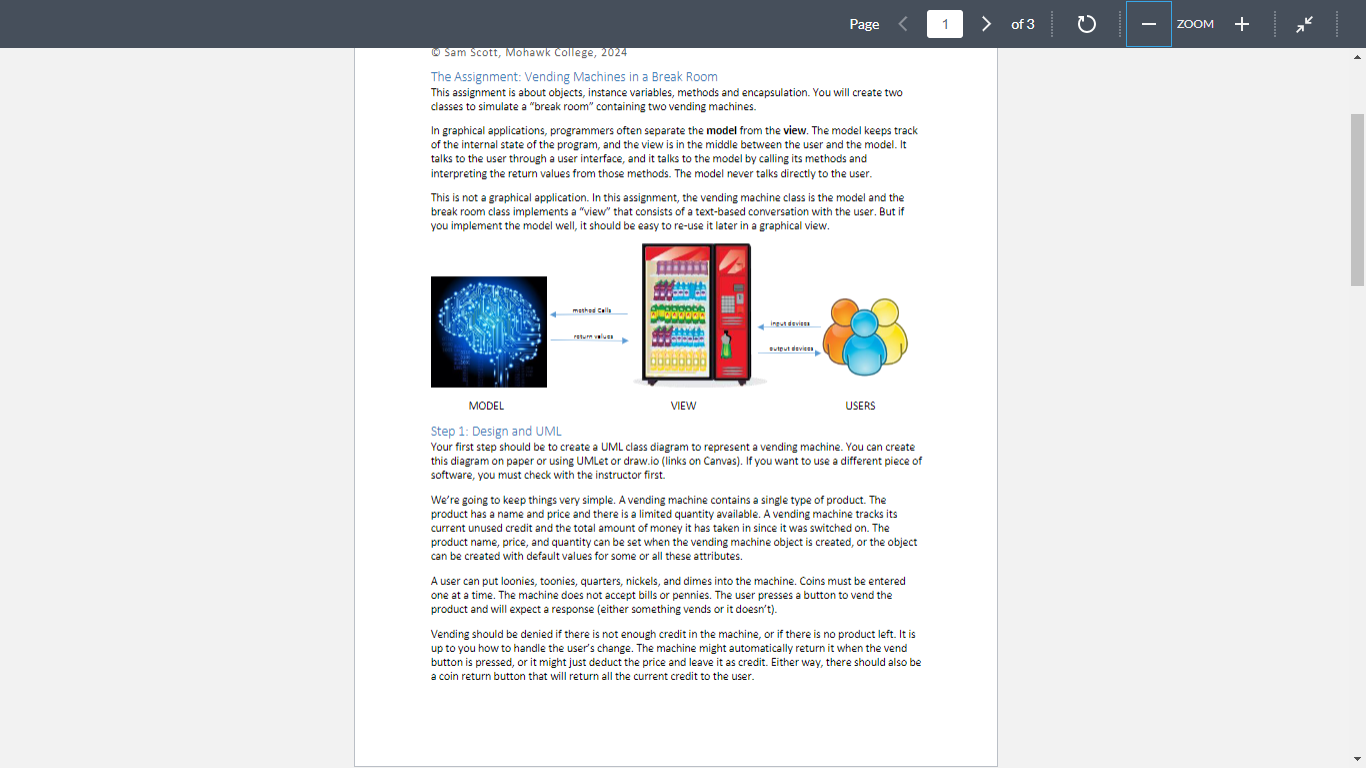
In graphical applications, programmers often separate the model from the view. The model keeps track
of the internal state of the program, and the view is in the middle between the user and the model. It
talks to the user through a user interface, and it talks to the model by calling its methods and
interpreting the return values from those methods. The model never talks directly to the user.
This is not a graphical application. In this assignment, the vending machine class is the model and the
break room class implements a "view" that consists of a textbased conversation with the user. But if
vou imolement the model well, it should be easv to reuse it later in a graphical view.
Step : Design and UML
Your first step should be to create a UML class diagram to represent a vending machine. You can create
this diagram on paper or using UMLet or
draw.io links on Canvas If you want to use a different piece of
software, you must check with the instructor first.
We're going to keep things very simple. A vending machine contains a single type of product. The
product has a name and price and there is a limited quantity available. A vending machine tracks its
current unused credit and the total amount of money it has taken in since it was switched on The
product name, price, and quantity can be set when the vending machine object is created, or the object
can be created with default values for some or all these attributes.
A user can put loonies, toonies, quarters, nickels, and dimes into the machine. Coins must be entered
one at a time. The machine does not accept bills or pennies. The user presses a button to vend the
product and will expect a response either something vends or it doesn't
Vending should be denied if there is not enough credit in the machine, or if there is no product left. It is
up to you how to handle the user's change. The machine might automatically return it when the vend
button is pressed, or it might just deduct the price and leave it as credit. Either way, there should also be
a coin return button that will return all the current credit to the user. When the machine is first turned on it is initialized with the name, price, and quantity of the product it
contains. There are no restrictions on how the user can use the machine. They can insert their money
before they press buttons, after they press buttons, or while pressing buttons.
There should be a toString function that returns a full report, something like this: VendingMachine:
chocolate bars left, $ each, $ credit, balance $
IMPORTANT BASIC RULE #: The vending machine is the model ie the brain of an actual vending
machine The model should never talk to the user. It should do no input and produce no output.
Instead, it should operate only through method calls.
Step : Implement the Vending Machine and Break Room Classes
Once the class diagram is finished, implement your vending machine in Java code. Then write a main
method in a different class to simulate a user interacting with the machines in a break room. This
method should create two vending machine objects and allow a user to interact with each one using a
menu interface. Its up to you how you structure this, but one possibility is shown in the example dialog
below.
Welcome to the Break Room!
There are two vending machines here:
VendingMachine: chocolate, $ $ $
VendingMachine: iPad mini, $ $ $
What would you like to do
Enter money
Get change back
Vend an item
Leave the break room
Your Choice?
VEND AN ITEM
Which machine?
VEND FAILED: Not Enough Credit
Welcome to the Break Room. There are two vending machines here:
VendingMachine: chocolate, $ $ $
VendingMachine: iPad mini, $ $ $
What would you like to do
Enter money
Get change back
Vend an item
Leave the break room
Your Choice?
Goodbye!
IMPORTANT BASIC RULE #: The main method is the view. It talks to the user, calls the appropriate
vending machine methods in response to the users input, and displays the results. It does not
determine the results of a users actions or keep track of money. Thats the job of the vending machine
objects.
Step by Step Solution
There are 3 Steps involved in it
1 Expert Approved Answer
Step: 1 Unlock

Question Has Been Solved by an Expert!
Get step-by-step solutions from verified subject matter experts
Step: 2 Unlock
Step: 3 Unlock
 Study Help