







Question: The asymptotic analysis of an algorithm determines the running time in Big O( ) notation. Say we have an algorithm, named arrayMax, that executes at
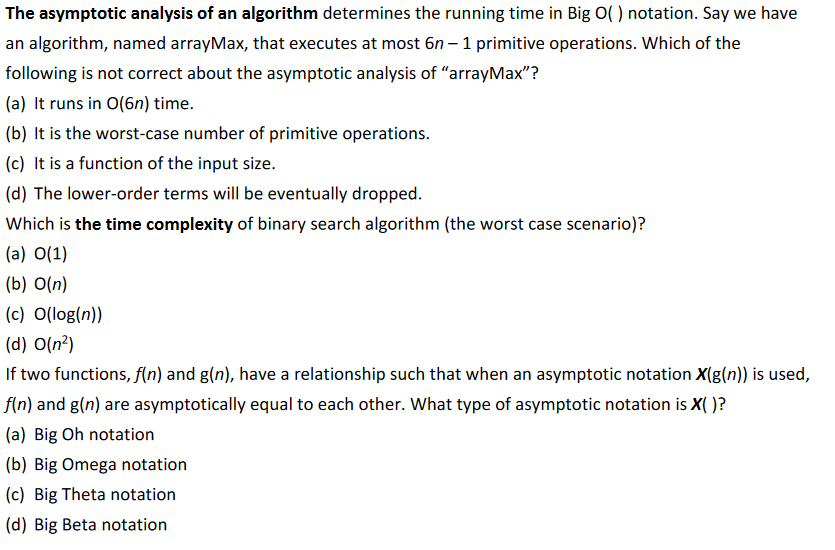
The asymptotic analysis of an algorithm determines the running time in Big O( ) notation. Say we have an algorithm, named arrayMax, that executes at most 6n1 primitive operations. Which of the following is not correct about the asymptotic analysis of "arrayMax"? (a) It runs in O(6n) time. (b) It is the worst-case number of primitive operations. (c) It is a function of the input size. (d) The lower-order terms will be eventually dropped. Which is the time complexity of binary search algorithm (the worst case scenario)? (a) O(1) (b) O(n) (c) O(log(n)) (d) O(n2) If two functions, f(n) and g(n), have a relationship such that when an asymptotic notation X(g(n)) is used, f(n) and g(n) are asymptotically equal to each other. What type of asymptotic notation is X() ? (a) Big Oh notation (b) Big Omega notation (c) Big Theta notation (d) Big Beta notation
Step by Step Solution
There are 3 Steps involved in it

Get step-by-step solutions from verified subject matter experts
 Study Help