







Question: The below is for a hypothetical study demonstrating the application of the concepts for superiority and non-inferiority testing. A study investigated a new agent for
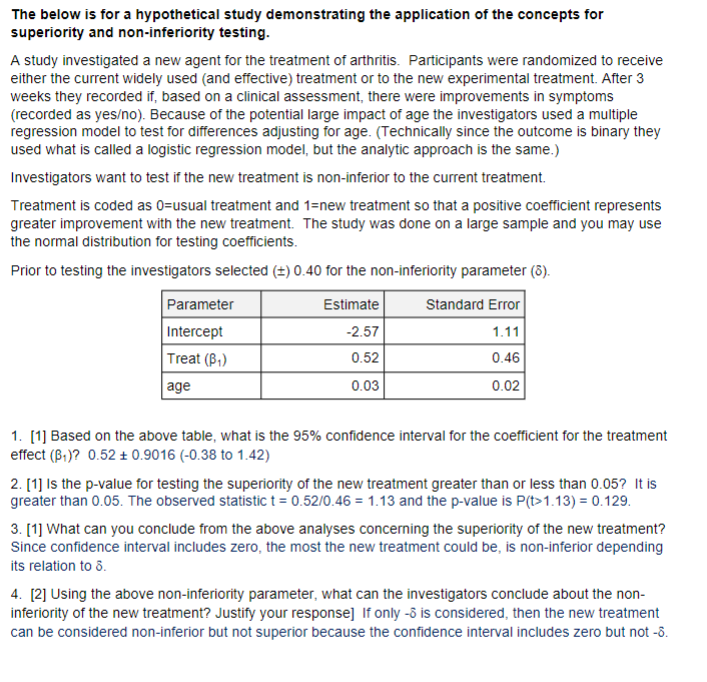
The below is for a hypothetical study demonstrating the application of the concepts for superiority and non-inferiority testing. A study investigated a new agent for the treatment of arthritis. Participants were randomized to receive either the current widely used (and effective) treatment or to the new experimental treatment. After 3 weeks they recorded if, based on a clinical assessment, there were improvements in symptoms (recorded as yeso). Because of the potential large impact of age the investigators used a multiple regression model to test for differences adjusting for age. (Technically since the outcome is binary they used what is called a logistic regression model, but the analytic approach is the same.) Investigators want to test if the new treatment is non-inferior to the current treatment. Treatment is coded as 0=usual treatment and 1=new treatment so that a positive coefficient represents greater improvement with the new treatment. The study was done on a large sample and you may use the normal distribution for testing coefficients. Prior to testing the investigators selected (#) 0.40 for the non-inferiority parameter (5). Parameter Estimate Standard Error Intercept 2.57 1.11 Treat (B,) 0.52 0.46 age 0.03 0.02 1. [1] Based on the above table, what is the 95% confidence interval for the coefficient for the treatment effect (B1)? 0.52 + 0.9016 (-0.38 to 1.42) 2. [1] Is the p-value for testing the superiority of the new treatment greater than or less than 0.05? It is greater than 0.05. The observed statistic t = 0.52/0.46 = 1.13 and the p-value is P(t>1.13) = 0.129. 3. [1] What can you conclude from the above analyses concerning the superiority of the new treatment? Since confidence interval includes zero, the most the new treatment could be, is non-inferior depending its relation to 8. 4. [2] Using the above non-inferiority parameter, what can the investigators conclude about the non- inferiority of the new treatment? Justify your response] If only -6 is considered, then the new treatment can be considered non-inferior but not superior because the confidence interval includes zero but not -6
Step by Step Solution
There are 3 Steps involved in it

Get step-by-step solutions from verified subject matter experts
 Study Help