







Question: The bivariate analyses considered for this project 1. The relationship between expenditure on Starbucks drinks and the income of Langara students registered in the 2019
 The bivariate analyses considered for this project
1. The relationship between expenditure on Starbucks drinks and the income of Langara students registered in the 2019 Fall semester.
Money (Dependent variable) - The amount of money spent on purchasing drinks from Starbucks by all langara students.
Income (Independent variable) - The monthly income earned by all Langara students.
2. The opinion of the quality of Starbucks drinks between male and female students registered in the 2019 Fall semester.
Opinion (Dependent) - The opinion of the quality of the drinks purchased from Starbucks by all Langara students.
Gender (Independent) - The gender of all Langara students
1) Justify clearly for the choice of the two categorical variables. 2) Insert a side-by-side bar graph. 3) Provide a description of the side-by-side bar graph in the context. 4) Insert a two-way table with observed frequencies and expected frequencies. 5) Conduct the chi-square analysis. (the 3-step-procedure) 6) State the conclusion of chi-square analysis in laymans terms. Note: - You want to extract and include useful information only from StatGraphics output to include in your report, do not include the StatGraphics output that you do not understand or where the information is not discussed in your analyses. - No hand calculations are needed and only Statgraphics output are required, along with your interpretations of the results. - You should use Statgraphics to generate the outputs discussed above.
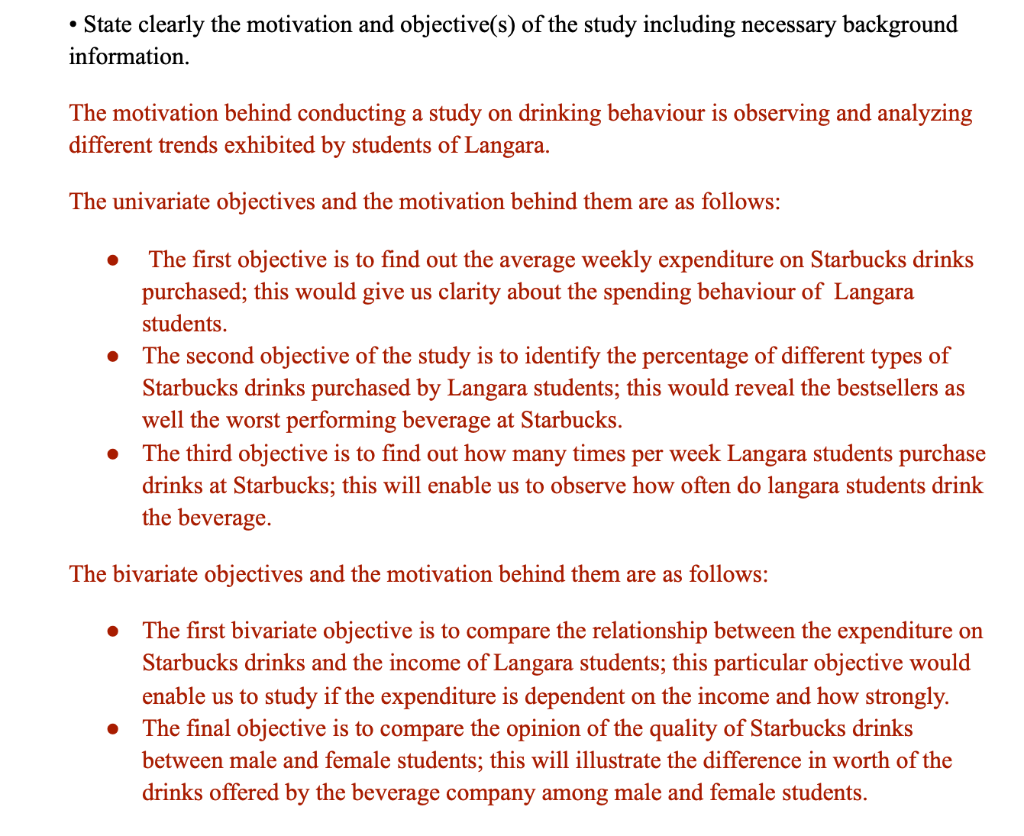
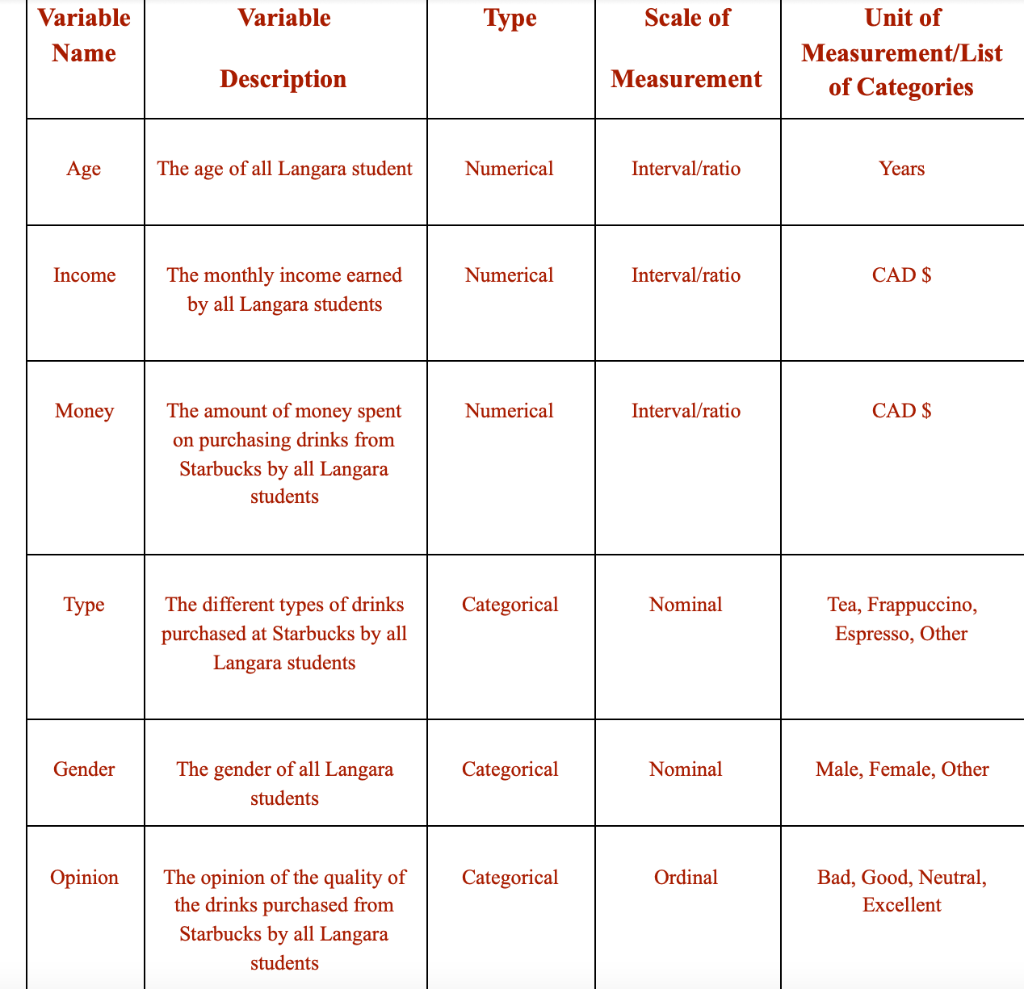
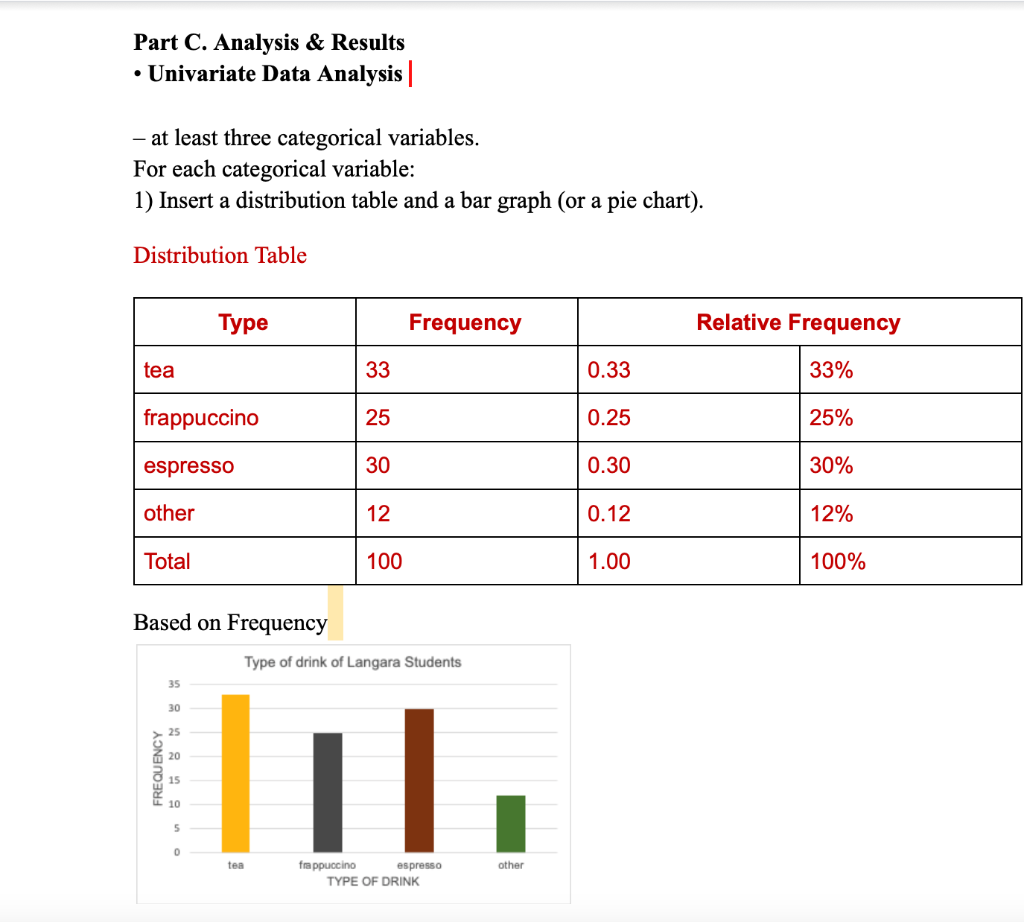
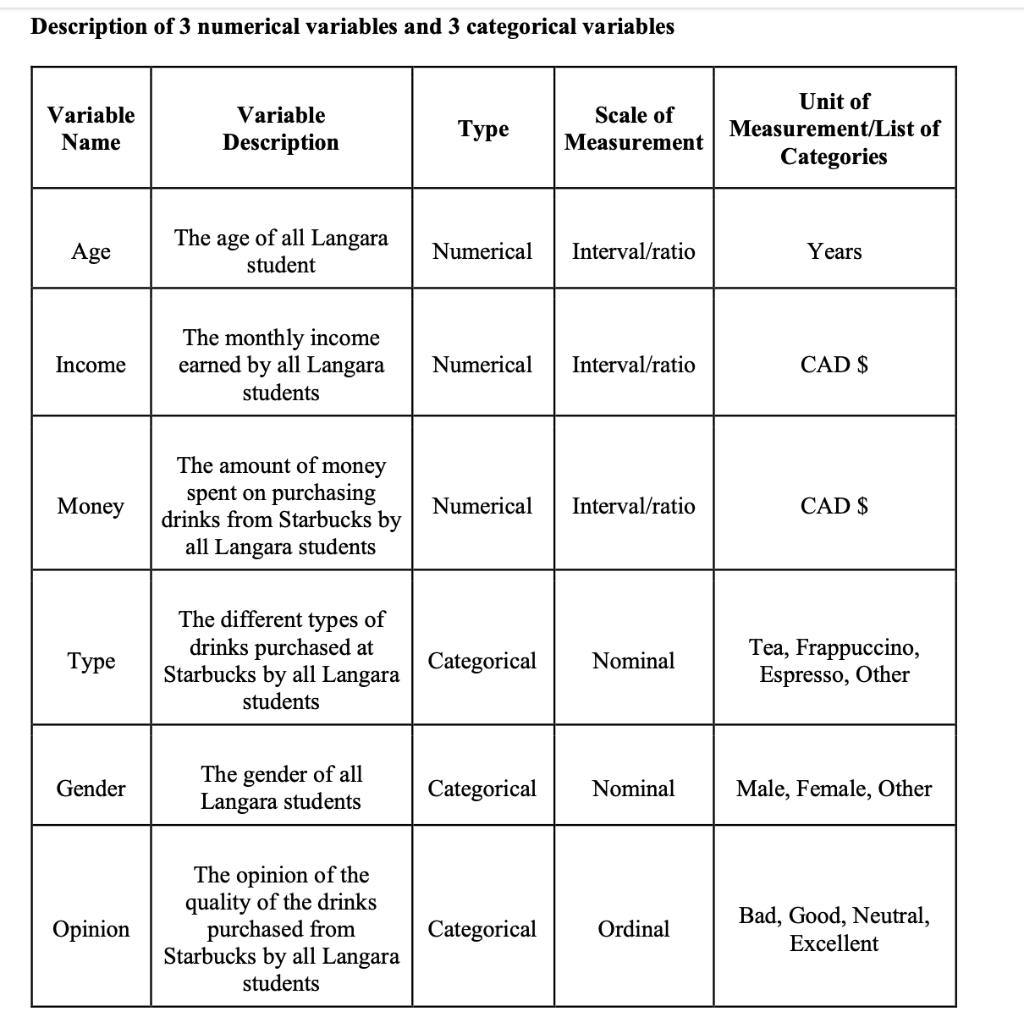
State clearly the motivation and objective(s) of the study including necessary background information. The motivation behind conducting a study on drinking behaviour is observing and analyzing different trends exhibited by students of Langara. The univariate objectives and the motivation behind them are as follows: . The first objective is to find out the average weekly expenditure on Starbucks drinks purchased; this would give us clarity about the spending behaviour of Langara students. The second objective of the study is to identify the percentage of different types of Starbucks drinks purchased by Langara students; this would reveal the bestsellers as well the worst performing beverage at Starbucks. The third objective is to find out how many times per week Langara students purchase drinks at Starbucks; this will enable us to observe how often do langara students drink the beverage. . The bivariate objectives and the motivation behind them are as follows: The first bivariate objective is to compare the relationship between the expenditure on Starbucks drinks and the income of Langara students; this particular objective would enable us to study if the expenditure is dependent on the income and how strongly. The final objective is to compare the opinion of the quality of Starbucks drinks between male and female students; this will illustrate the difference in worth of the drinks offered by the beverage company among male and female students. Variable Variable Name Type Scale of Unit of Measurement/List of Categories Description Measurement Age The age of all Langara student Numerical Interval/ratio Years Income Numerical Interval/ratio CAD $ The monthly income earned by all Langara students Money Numerical Interval/ratio CAD $ The amount of money spent on purchasing drinks from Starbucks by all Langara students Type Categorical Nominal The different types of drinks purchased at Starbucks by all Langara students Tea, Frappuccino, Espresso, Other Gender Categorical Nominal Male, Female, Other The gender of all Langara students Opinion Categorical Ordinal Bad, Good, Neutral, Excellent The opinion of the quality of the drinks purchased from Starbucks by all Langara students Part C. Analysis & Results Univariate Data Analysis | - at least three categorical variables. For each categorical variable: 1) Insert a distribution table and a bar graph (or a pie chart). Distribution Table Type Frequency Relative Frequency tea 33 0.33 33% frappuccino 25 0.25 25% espresso 30 0.30 30% other 12 0.12 12% Total 100 1.00 100% Based on Frequency Type of drink of Langara Students 35 30 25 20 FREQUENO 15 il 10 0 tea other frappuccino espresso TYPE OF DRINK Description of 3 numerical variables and 3 categorical variables Variable Name Variable Description Type Scale of Measurement Unit of Measurement/List of Categories Age The age of all Langara student Numerical Interval/ratio Years Income The monthly income earned by all Langara students Numerical Interval/ratio CAD $ Money The amount of money spent on purchasing drinks from Starbucks by all Langara students Numerical Interval/ratio CAD $ Type The different types of drinks purchased at Starbucks by all Langara students Categorical Nominal Tea, Frappuccino, Espresso, Other Gender The gender of all Langara students Categorical Nominal Male, Female, Other Opinion The opinion oft quality of the drinks purchased from Starbucks by all Langara students Categorical Ordinal Bad, Good, Neutral, Excellent State clearly the motivation and objective(s) of the study including necessary background information. The motivation behind conducting a study on drinking behaviour is observing and analyzing different trends exhibited by students of Langara. The univariate objectives and the motivation behind them are as follows: . The first objective is to find out the average weekly expenditure on Starbucks drinks purchased; this would give us clarity about the spending behaviour of Langara students. The second objective of the study is to identify the percentage of different types of Starbucks drinks purchased by Langara students; this would reveal the bestsellers as well the worst performing beverage at Starbucks. The third objective is to find out how many times per week Langara students purchase drinks at Starbucks; this will enable us to observe how often do langara students drink the beverage. . The bivariate objectives and the motivation behind them are as follows: The first bivariate objective is to compare the relationship between the expenditure on Starbucks drinks and the income of Langara students; this particular objective would enable us to study if the expenditure is dependent on the income and how strongly. The final objective is to compare the opinion of the quality of Starbucks drinks between male and female students; this will illustrate the difference in worth of the drinks offered by the beverage company among male and female students. Variable Variable Name Type Scale of Unit of Measurement/List of Categories Description Measurement Age The age of all Langara student Numerical Interval/ratio Years Income Numerical Interval/ratio CAD $ The monthly income earned by all Langara students Money Numerical Interval/ratio CAD $ The amount of money spent on purchasing drinks from Starbucks by all Langara students Type Categorical Nominal The different types of drinks purchased at Starbucks by all Langara students Tea, Frappuccino, Espresso, Other Gender Categorical Nominal Male, Female, Other The gender of all Langara students Opinion Categorical Ordinal Bad, Good, Neutral, Excellent The opinion of the quality of the drinks purchased from Starbucks by all Langara students Part C. Analysis & Results Univariate Data Analysis | - at least three categorical variables. For each categorical variable: 1) Insert a distribution table and a bar graph (or a pie chart). Distribution Table Type Frequency Relative Frequency tea 33 0.33 33% frappuccino 25 0.25 25% espresso 30 0.30 30% other 12 0.12 12% Total 100 1.00 100% Based on Frequency Type of drink of Langara Students 35 30 25 20 FREQUENO 15 il 10 0 tea other frappuccino espresso TYPE OF DRINK Description of 3 numerical variables and 3 categorical variables Variable Name Variable Description Type Scale of Measurement Unit of Measurement/List of Categories Age The age of all Langara student Numerical Interval/ratio Years Income The monthly income earned by all Langara students Numerical Interval/ratio CAD $ Money The amount of money spent on purchasing drinks from Starbucks by all Langara students Numerical Interval/ratio CAD $ Type The different types of drinks purchased at Starbucks by all Langara students Categorical Nominal Tea, Frappuccino, Espresso, Other Gender The gender of all Langara students Categorical Nominal Male, Female, Other Opinion The opinion oft quality of the drinks purchased from Starbucks by all Langara students Categorical Ordinal Bad, Good, Neutral, ExcellentStep by Step Solution
There are 3 Steps involved in it

Get step-by-step solutions from verified subject matter experts
 Study Help