







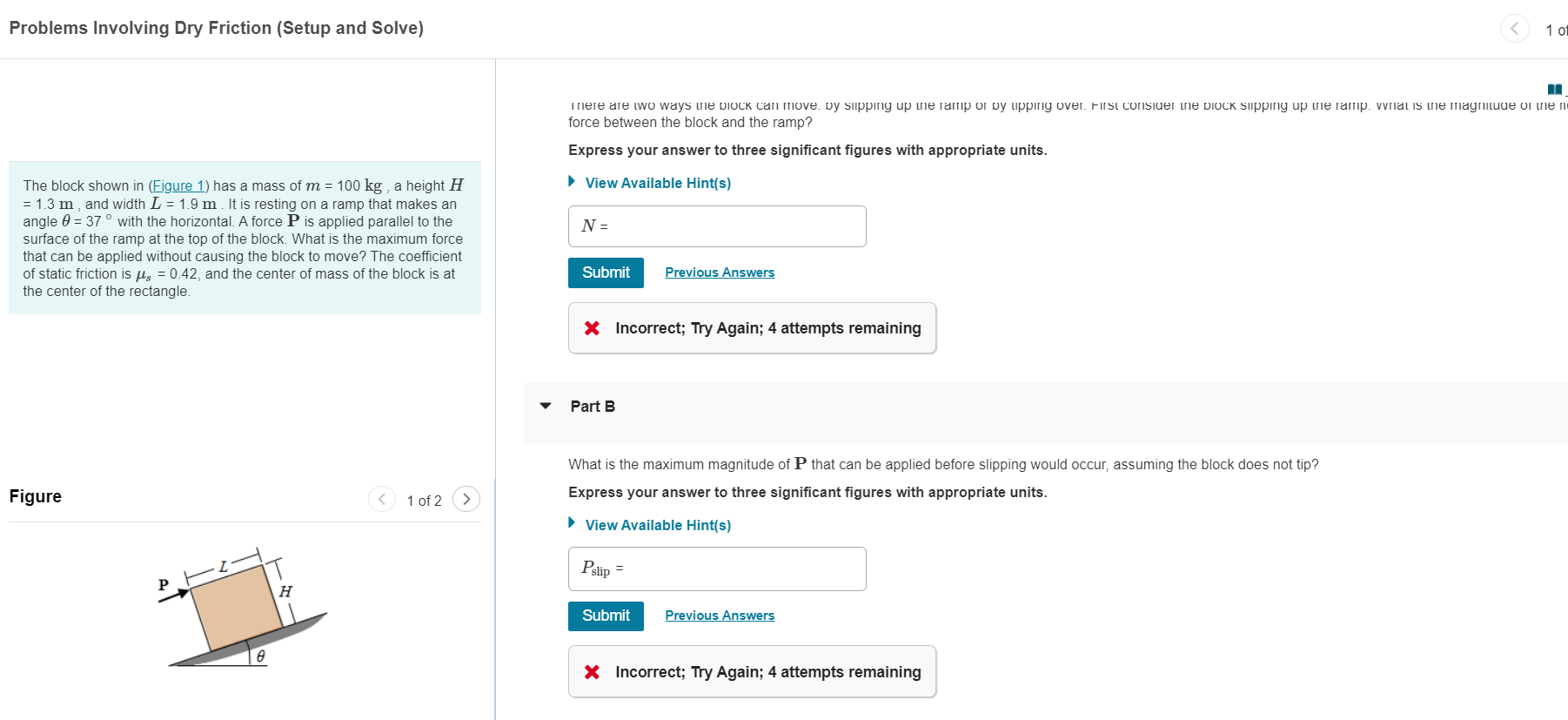
Question: The block shown in ( Figure 1 ) has a mass of m = 1 0 0 k g , a height H = 1
The block shown in Figure has a mass of a height
and width It is resting on a ramp that makes an
angle with the horizontal. A force is applied parallel to the
surface of the ramp at the top of the block. What is the maximum force
that can be applied without causing the block to move? The coefficient
of static friction is and the center of mass of the block is at
the center of the rectangle.
Figure
of
force between the block and the ramp?
Express your answer to three significant figures with appropriate units.
View Available Hints
Incorrect; Try Again; attempts remaining
Part B
What is the maximum magnitude of that can be applied before slipping would occur, assuming the block does not tip?
Express your answer to three significant figures with appropriate units.
View Available Hints
Part D
Use the freebody diagram shown in Figure and write the equilibrium equation for the moments about the point of contact.
Express your answer in terms of one or more of P
W
H
L
N
F
and theta
MO
Request Answer
Part E
What is the maximum magnitude of P
that can be applied before tipping would occur, assuming the block does not slip?
Express your answer to three significant figures with appropriate units.
Ptip
Request Answer
Part F
What is the maximum magnitude of P
that does not cause motion of the block?
Express your answer to three significant figures with appropriate units.
Pmax
Step by Step Solution
There are 3 Steps involved in it
1 Expert Approved Answer
Step: 1 Unlock

Question Has Been Solved by an Expert!
Get step-by-step solutions from verified subject matter experts
Step: 2 Unlock
Step: 3 Unlock
 Study Help