







Question: The Branson Sports Complex Case Study needs to be summarized. All NECESSARY DETAILS The Who, what, When, Where, and How, needs to be found, in
The Branson Sports Complex Case Study needs to be summarized. All NECESSARY DETAILS The Who, what, When, Where, and How, needs to be found, in paragraph format. 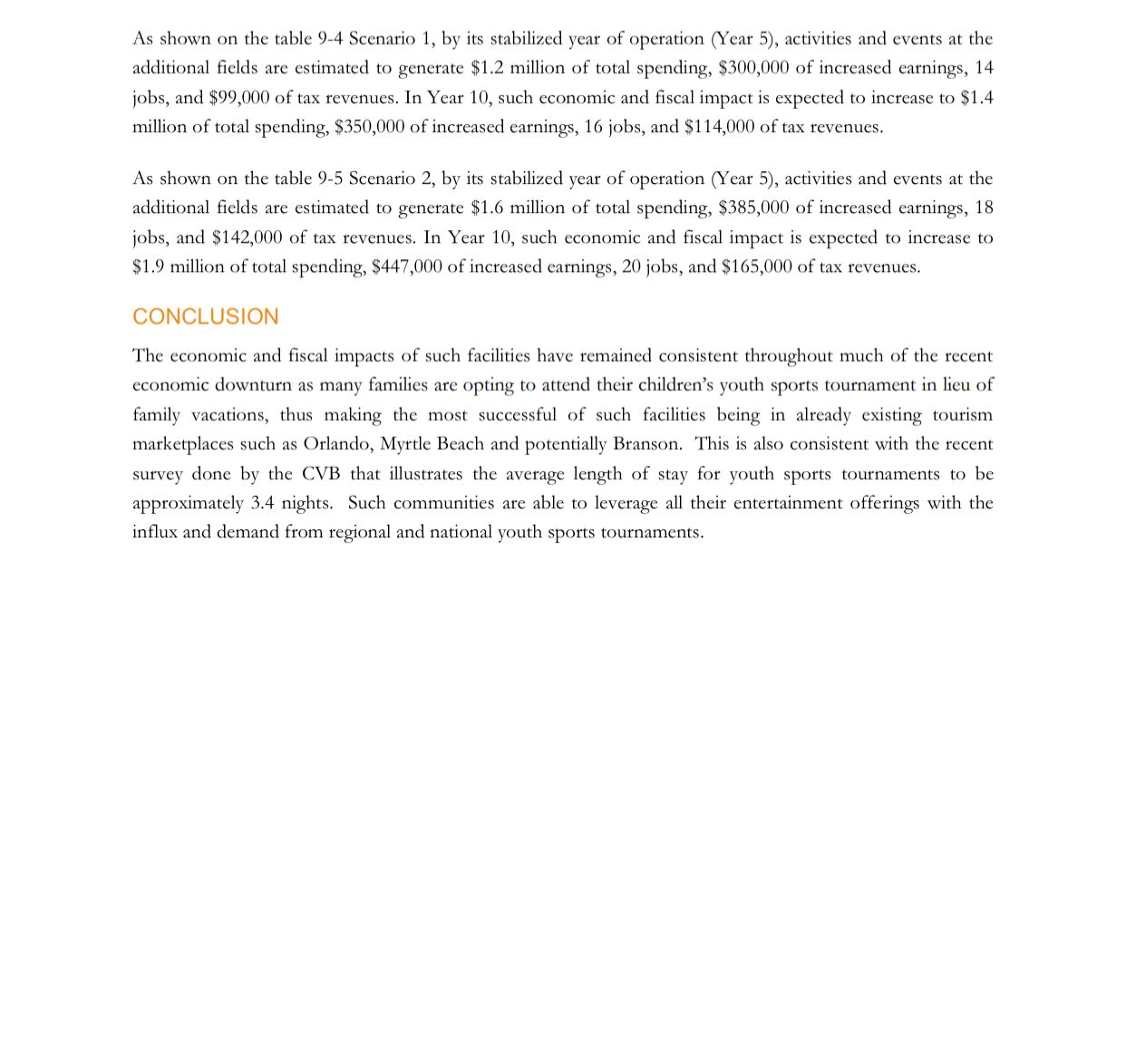
For my Facilities Management class, please and thank you.
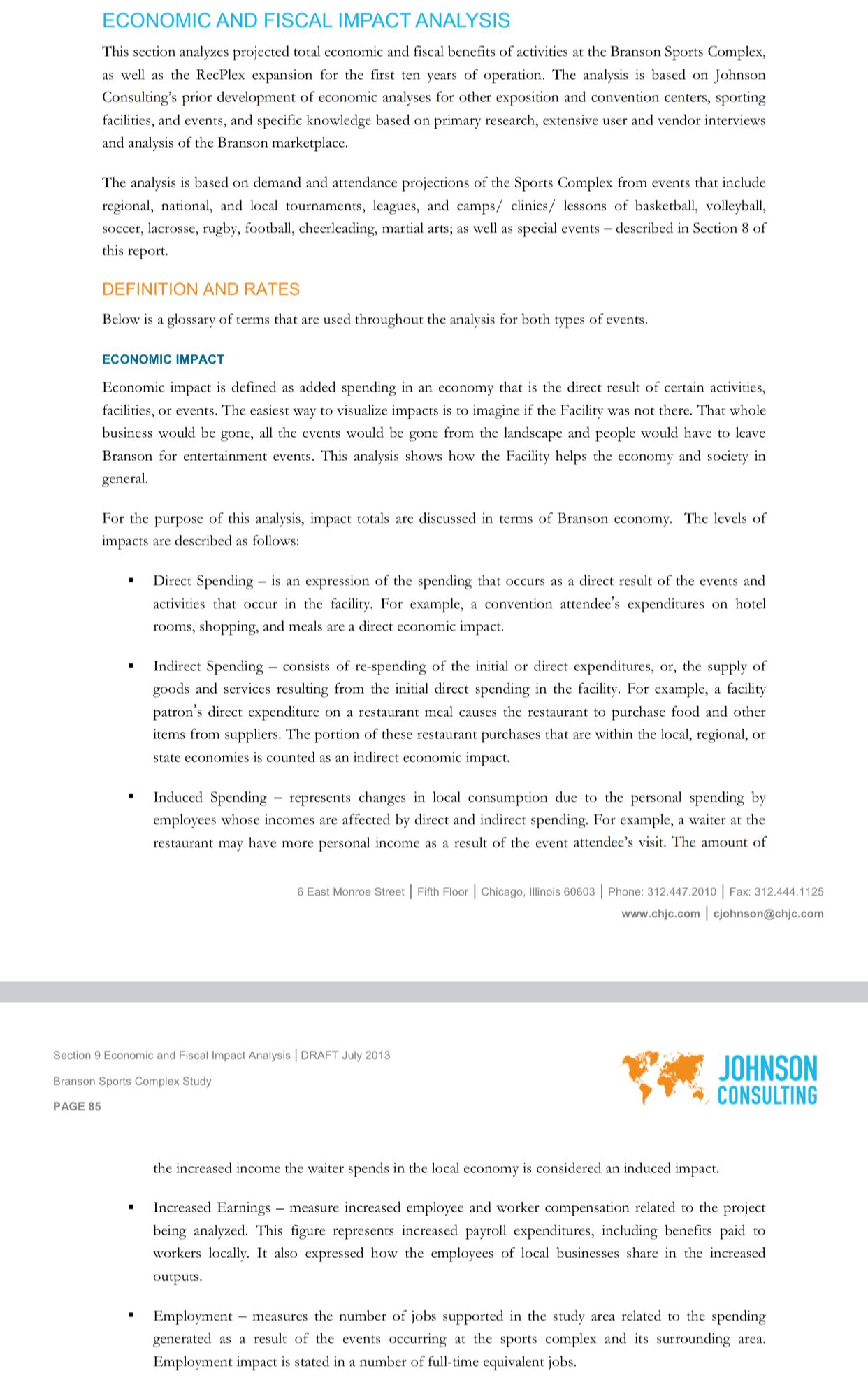
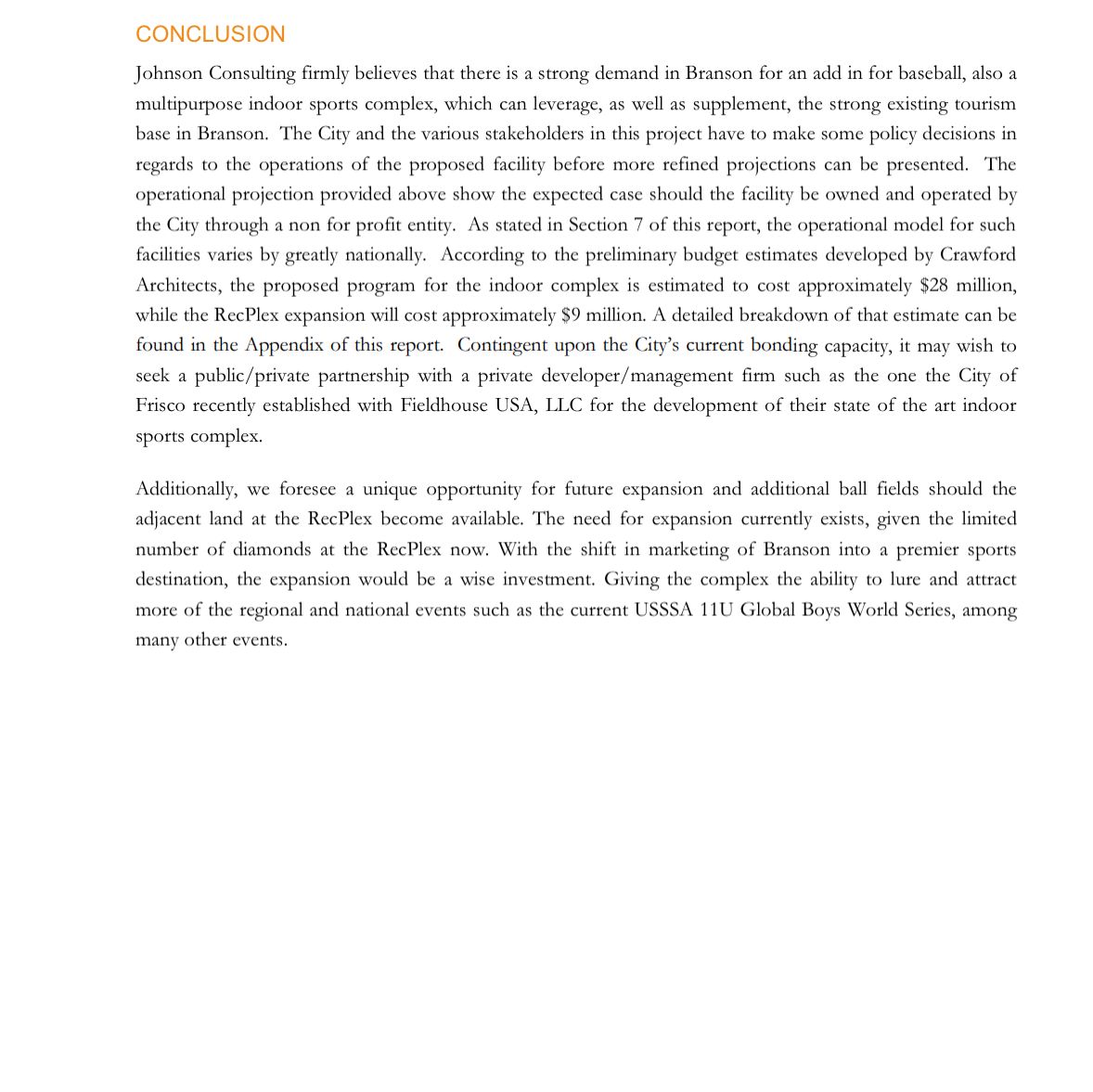
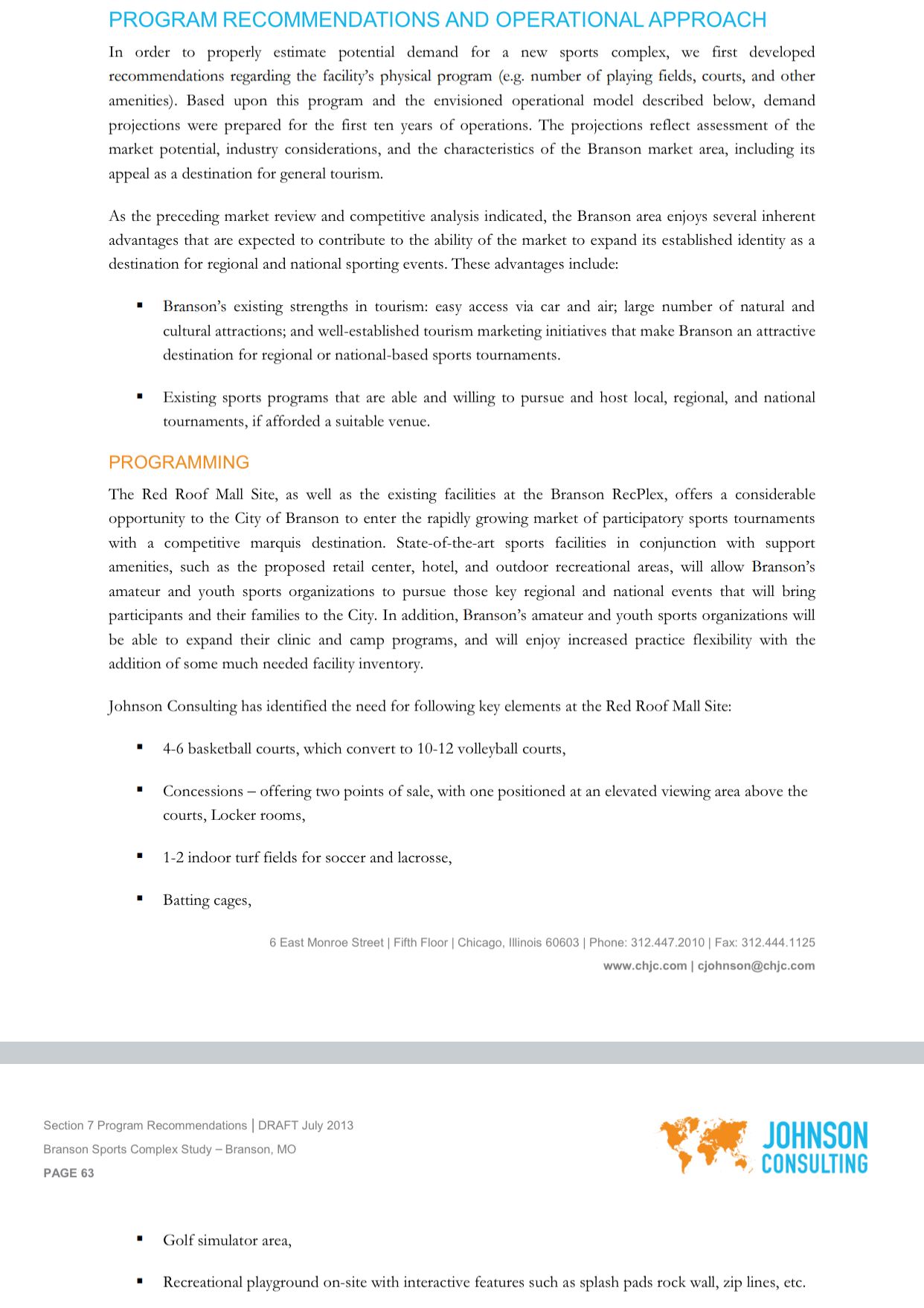
As shown on the table 9-4 Scenario 1, by its stabilized year of operation (Year 5), activities and events at the additional fields are estimated to generate $1.2 million of total spending, $300,000 of increased earnings, 14 jobs, and $99,000 of tax revenues. In Year 10 , such economic and fiscal impact is expected to increase to $1.4 million of total spending, $350,000 of increased earnings, 16 jobs, and $114,000 of tax revenues. As shown on the table 9-5 Scenario 2, by its stabilized year of operation (Year 5), activities and events at the additional fields are estimated to generate $1.6 million of total spending, $385,000 of increased earnings, 18 jobs, and $142,000 of tax revenues. In Year 10, such economic and fiscal impact is expected to increase to $1.9 million of total spending, $447,000 of increased earnings, 20 jobs, and $165,000 of tax revenues. CONCLUSION The economic and fiscal impacts of such facilities have remained consistent throughout much of the recent economic downturn as many families are opting to attend their children's youth sports tournament in lieu of family vacations, thus making the most successful of such facilities being in already existing tourism marketplaces such as Orlando, Myrtle Beach and potentially Branson. This is also consistent with the recent survey done by the CVB that illustrates the average length of stay for youth sports tournaments to be approximately 3.4 nights. Such communities are able to leverage all their entertainment offerings with the influx and demand from regional and national youth sports tournaments. ECONOMIC AND FISCAL IMPACT ANALYSIS This section analyzes projected total economic and fiscal benefits of activities at the Branson Sports Complex, as well as the RecPlex expansion for the first ten years of operation. The analysis is based on Johnson Consulting's prior development of economic analyses for other exposition and convention centers, sporting facilities, and events, and specific knowledge based on primary research, extensive user and vendor interviews and analysis of the Branson marketplace. The analysis is based on demand and attendance projections of the Sports Complex from events that include regional, national, and local tournaments, leagues, and camps/ clinics/ lessons of basketball, volleyball, soccer, lacrosse, rugby, football, cheerleading, martial arts; as well as special events - described in Section 8 of this report. DEFINITION AND RATES Below is a glossary of terms that are used throughout the analysis for both types of events. ECONOMIC IMPACT Economic impact is defined as added spending in an economy that is the direct result of certain activities, facilities, or events. The easiest way to visualize impacts is to imagine if the Facility was not there. That whole business would be gone, all the events would be gone from the landscape and people would have to leave Branson for entertainment events. This analysis shows how the Facility helps the economy and society in general. For the purpose of this analysis, impact totals are discussed in terms of Branson economy. The levels of impacts are described as follows: - Direct Spending - is an expression of the spending that occurs as a direct result of the events and activities that occur in the facility. For example, a convention attendee's expenditures on hotel rooms, shopping, and meals are a direct economic impact. - Indirect Spending - consists of re-spending of the initial or direct expenditures, or, the supply of goods and services resulting from the initial direct spending in the facility. For example, a facility patron's direct expenditure on a restaurant meal causes the restaurant to purchase food and other items from suppliers. The portion of these restaurant purchases that are within the local, regional, or state economies is counted as an indirect economic impact. - Induced Spending - represents changes in local consumption due to the personal spending by employees whose incomes are affected by direct and indirect spending. For example, a waiter at the restaurant may have more personal income as a result of the event attendee's visit. The amount of 6 East Monroe Street |Fifth Floor | Chicago, Illinois 60603 | Phone: 312.447.2010 | Fax: 312.444.11 www.chjc.com | cjohnson@chjc.co ection 9 Economic and Fiscal Impact Analysis | DRAFT July 2013 anson Sports Complex Study AGE 85 the increased income the waiter spends in the local economy is considered an induced impact. - Increased Earnings - measure increased employee and worker compensation related to the project being analyzed. This figure represents increased payroll expenditures, including benefits paid to workers locally. It also expressed how the employees of local businesses share in the increased outputs. - Employment - measures the number of jobs supported in the study area related to the spending generated as a result of the events occurring at the sports complex and its surrounding area. Employment impact is stated in a number of full-time equivalent jobs. Johnson Consulting firmly believes that there is a strong demand in Branson for an add in for baseball, also a multipurpose indoor sports complex, which can leverage, as well as supplement, the strong existing tourism base in Branson. The City and the various stakeholders in this project have to make some policy decisions in regards to the operations of the proposed facility before more refined projections can be presented. The operational projection provided above show the expected case should the facility be owned and operated by the City through a non for profit entity. As stated in Section 7 of this report, the operational model for such facilities varies by greatly nationally. According to the preliminary budget estimates developed by Crawford Architects, the proposed program for the indoor complex is estimated to cost approximately $28 million, while the RecPlex expansion will cost approximately $9 million. A detailed breakdown of that estimate can be found in the Appendix of this report. Contingent upon the City's current bonding capacity, it may wish to seek a public/private partnership with a private developer/management firm such as the one the City of Frisco recently established with Fieldhouse USA, LLC for the development of their state of the art indoor sports complex. Additionally, we foresee a unique opportunity for future expansion and additional ball fields should the adjacent land at the RecPlex become available. The need for expansion currently exists, given the limited number of diamonds at the RecPlex now. With the shift in marketing of Branson into a premier sports destination, the expansion would be a wise investment. Giving the complex the ability to lure and attract more of the regional and national events such as the current USSSA 11U Global Boys World Series, among many other events. PROGRAM RECOMMENDATIONS AND OPERATIONAL APPROACH In order to properly estimate potential demand for a new sports complex, we first developed recommendations regarding the facility's physical program (e.g. number of playing fields, courts, and other amenities). Based upon this program and the envisioned operational model described below, demand projections were prepared for the first ten years of operations. The projections reflect assessment of the market potential, industry considerations, and the characteristics of the Branson market area, including its appeal as a destination for general tourism. As the preceding market review and competitive analysis indicated, the Branson area enjoys several inherent advantages that are expected to contribute to the ability of the market to expand its established identity as a destination for regional and national sporting events. These advantages include: - Branson's existing strengths in tourism: easy access via car and air; large number of natural and cultural attractions; and well-established tourism marketing initiatives that make Branson an attractive destination for regional or national-based sports tournaments. - Existing sports programs that are able and willing to pursue and host local, regional, and national tournaments, if afforded a suitable venue. PROGRAMMING The Red Roof Mall Site, as well as the existing facilities at the Branson RecPlex, offers a considerable opportunity to the City of Branson to enter the rapidly growing market of participatory sports tournaments with a competitive marquis destination. State-of-the-art sports facilities in conjunction with support amenities, such as the proposed retail center, hotel, and outdoor recreational areas, will allow Branson's amateur and youth sports organizations to pursue those key regional and national events that will bring participants and their families to the City. In addition, Branson's amateur and youth sports organizations will be able to expand their clinic and camp programs, and will enjoy increased practice flexibility with the addition of some much needed facility inventory. Johnson Consulting has identified the need for following key elements at the Red Roof Mall Site: - 4-6 basketball courts, which convert to 10-12 volleyball courts, - Concessions - offering two points of sale, with one positioned at an elevated viewing area above the courts, Locker rooms, - 1-2 indoor turf fields for soccer and lacrosse, - Batting cages, 6 East Monroe Street | Fifth Floor | Chicago, Illinois 60603 |Phone: 312.447.2010|Fax: 312.444.1125 www.chjc.com | cjohnson@chjc.com 7 Program Recommendations | DRAFT July 2013 on Sports Complex Study - Branson, MO 63 - Golf simulator area, - Recreational playground on-site with interactive features such as splash pads rock wall, zip lines, etc. SITE ANALYSIS In this section we present an analysis of site alternatives related to the proposed multi-use sports facility. This evaluation process uses our team's experience with similar projects and results in a site analysis according to best practices urban planning principles. This is critical to establishing a hierarchy for more detailed technical analyses of individual sites and provides a framework to assess other sites, if they come forward. It is also a key process in determining, and then confirming, the development goals and sensitivities for completing a potential youth sports facility. Site selection is a crucial decision, and a myriad of factors, both objective and subjective, influence the potential performance and contribution of a facility. The choice of a site that is poor for a sports facility can inhibit the ultimate success of a project and affect its performance for generations. Far too often, communities locate a facility on a site not because it is the most advantageous spot or in the location that will best contribute to the overall objectives of the community, but out of immediacy, availability, cost or other factors that speak to convenience over market strategy and product positioning. The following site parameters are necessary considerations for successful development of the proposed sports facility: - Provision of a site large enough to allow for the project, subsequent expansion, and adequate parking - A site that has destination appeal to patrons for pre- and post-event activities, and is convenient to access and is visible - A site that leverages the spending and visitor impacts, rather than wastes them - Consideration of zoning, streetscape, transit connections, design standards, and land use around the facility that is conducive not just to the proposed sports facility, but to the development of a regionwide identity. Further, when considering potential sites for a new sports facility, there are a number of civic goals that should be identified, and pursued in selecting the most advantageous site. Some of these goals are subjective in nature and may appeal to the intuition or emotions in a way that cannot be quantified. The act of defining common goals of various proponents helps to build familiarity with, and consensus, for the project. Ultimately, the preferred site is the one that exhibits the best overall mix of attributes, with broad recognition by all stakeholders that tradeoffs are required as it is highly unlikely that a single site embodies the best of each attribute. Among the goals and attributes to be considered: - A primary goal should be to make the sports facility environment a recognized district, a unique destination, regional draw, and a necessary part of the Branson experience for facility attendees and PARTICIPATORY SPORTS TRENDS Over the last two decades, sports facilities have and can become destination tourism generators if marketing strategies are targeted that way. Whereas two decades ago the common tactic was to develop single-purpose facilities with the intent to serve as a local community resource, today's facilities are often developed with the intent of attracting a multipurpose niche of visitors to an area. As a result, they are portrayed based on their ability to induce economic activity through an increasingly diversified demand. As this has occurred, society has also become more mobile and time constraints for families much greater, which has translated to the rise of short duration, purpose-driven trips that coincide with tournament and competition lengths. For communities, entertainment and sports market has led to changes in development strategies and the emergence of facilities and attractions that offer either niche focused venues or multipurpose multisport venues, and fee-for-service amenities that appeal to everyone. In addition to the factors mentioned above, the following characteristics have also contributed to this evolution: - Heightened expectations that facilities or programs demonstrate some degree of "return." Historically, facilities were built by Parks and Recreation and other municipal departments for civic and social service. For sports facilities that are typically not self-supporting, the rationale for development is often infused with discussion of the value it creates for the community through increased visitation, and thus, fiscal return based on increased lodging, restaurants, or retail spending. In this instance, sports facilities are positioned or portrayed as an economic development vehicle, rather than a community resource. - Increasing expectation by elected officials that selected public sector functions can be operated as enterprise accounts (e.g. use fees to minimize operating support). This trend is most notable in sports facility operations where recent fiscal constraints have led to increased reliance on revenue selfgeneration for programs ranging from leagues to tournaments to skills training sessions. - The changing dynamics of the sectors that use these facilities, as well as the changed expectations of participants. Tournament and league organizers are looking to maximize the yield for staging events and, as such, look for the facility that offers the best mix of concessions, rental rates, capacity, and hotel packages. - A more competitive environment has been fueled by an increased range of facility types. As the development of private recreation offerings has increased so to have the range of options available to the users. In the instance of sports, the community recreation center or YMCA were once the only options, today there may be numerous options. In the instance of zoos for example, the emergence of private game reserves, themed destinations, and the infusion of "entertainment" into natural attractions has changed the landscape. As such, each facility works hard to distinguish itself in a 6 East Monroe Street | Fifth Floor | Chicago, Illinois 60603 | Phone: 312.447.2010 | Fax: 312.444.1125 www.chjc.com | cjohnson@chjc.com EXECUTIVE SUMMARY The City of Branson is situated in Southwest Missouri. The Springfield-Branson Metropolitan Statistical Area (MSA) is composed of 2 counties - Taney and Stone Counties. Its mild yearlong climate makes it a suitable year-round destination for sporting events, tournaments and conventions. Branson's solid population growth and diverse economy combined with an established service industry that supports tourism are a few of the key characteristics and requirements to support a multi-use sports facility. After a recent decline in theater tourism, city officials began looking to diversify Branson's tourism appeal. Given Branson's success in many indoor and outdoor sports efforts, it is reasonable to conclude sports tourism could be enhanced with the proper facilities and is a viable opportunity for the market. Sports tourists looking for entertainment outside of their respective sports events will find a variety of attractions in Branson to compliment a new sports complex, including Silver Dollar City, White Water and Branson's theatres, in addition to a variety of other attractions and entertainment options. Given the number of cities entering the sports tourism industry, there should be more than just impressive facilities to attract travel teams to a destination. Entertainment options can also be leveraged to enhance a city's appeal when competing for regional and national tournaments. While there is a certain amount of local demand for sports facilities, the existing Branson RecPlex is adequate to accommodate that demand. The RecPlex opened in 2005 at a total cost of $12.9 million and is operated by the Branson Parks and Recreation Department. Since the facility opened, there has been steady growth in the number of events and number of participants each year. Since it opened the RecPlex has hosted over 100 state and regional events for swimming, baseball, basketball, martial arts and tennis. In 2012, the Branson Parks and Recreation Department hosted 36 events, featuring over 133,000 participants on over 1,000 teams for a total economic impact of $9,350,320. The facility has suffered from recent programming requirements to host large basketball and volleyball events, however many of those same sanctioning bodies and organizations have committed a return to the Branson marketplace should an upgrade in facility size and amenities were addressed to meet the current day requirements In order to justify the proposed sports complex, the City would have to attract travel sports teams from across the region as well as nationally. Since Branson has already established itself as a top travel destination-noted for shopping, entertainment, outdoor sports and hospitality-we believe strongly the well-established service and hospitality industries could elevate Branson among the top sports tourism destinations in the country. Our data, combined with data from the Branson CVB identifying the sporting events currently attracting tourists to Branson, suggests that there would be sufficient demand for basketball courts, volleyball courts, indoor soccer fields and additional baseball/softball diamonds. In order to be as flexible as possible, the hard ECONOMIC AND DEMOGRAPHIC INDICATORS OF THE BRANSON MARKET Demographic indicators such as population and income are not strict predictors of market support for multiuse sports facilities, but they do provide valuable insight into the overall capacity of a market to support such facilities and events. In addition, other economic indicators such as a region's employment and business market can affect the performance of facilities developed for a particular market. This section provides an overview of the Branson region's economic and demographic characteristics, and will provide a foundation for other analyses that appear later in this report. THE MARKET AREA The City of Branson is located in Taney County, situated in Southwest Missouri; Branson is surrounded by mountains and lakes. Its mild yearlong climate makes it a year-round destination for events such as sports and conventions. The Springfield-Branson Metropolitan Statistical Area (MSA) is composed of 2 counties - Taney and Stone Counties. An MSA is the federal government's designation of a market's boundaries for numerous geographic and comparison purposes; however, in many cases, an actual market, for example, of potential event attendees, will be larger or smaller than an official MSA, and these variations are discussed in more detail later in this report. Figure 3-1 shows the location of Branson in relation to other cities in Missouri and surrounding states. - Conducted an assessment programming and utilization of peer sports and entertainment facilities - Conducted interviews with potential tenants of the complex to understand long-term needs, facility requirements, and support amenities - Prepared an inventory of the current and proposed array of sports, entertainment and tourismrelated facilities, and identified specific "gaps" which the proposed development can effectively fill ABOUT THE CONSULTING TEAM C.H. Johnson Consulting (Johnson Consulting) is a nationally recognized authority on sports venues, stadiums, arenas, and mixed-use development projects. The firm works nationally and internationally for cities, counties, universities and private sector developers. Crawford Architects has a record of accomplishment in the planning, design, and operation/management of recreation/training facilities, and sports facilities, including both indoor and outdoor facilities. Crawford is noted for their design and planning work for the Branson Landings development. We have or are working on very similar projects with the same set of services in Champaign, IL, Lee's Summit, MO, Lake of the Ozarks, MO and Northwest Arkansas on sports facility and mixed-use development projects. Nationally, the firm has worked on several sports and mixed-use complexes including Rockford, IL, Howell, MI and Warren County, OH. In addition, the firm is noted for its success on youth sports, recreation and sports facility developments. Our strength is the ability to be creative and effectively help structure clear business plans for complex projects. We are able to integrate information from multiple parties into a single tool for use by private developers and governmental agencies to help execute complex real estate projects. TERMS OF ASSIGNMENT This report is based on estimates, assumptions, actual operating data and other information obtained from our research, our prior experience with similar assignments, and information received from the City of Branson, Crawford Architects and other sources. The sources of information and basis of estimates and assumptions are stated herein. Projections of facility demand, attendance presented within this report are based Johnson Consulting's assessment of various data, market characteristics, discussions with project stakeholders, and documented assumptions. We cannot represent our projections as results that will actually be achieved. INTRODUCTION The need for this study arose from the decline of the once thriving theater market in Branson. City officials set out to identify Branson's assets and how to leverage them into redeveloping the City and diversifying the visitor profile. After realizing the Branson RecPlex was one of its greatest assets, City officials set out to utilize the existing hospitality and entertainment resources to grow sports tourism in Branson. The following report provides a market and financial analysis for the proposed mixed-use development at the Branson Sports Complex. The City of Branson, and design and finance team members will use this report to evaluate the merits of the project and its overall appropriateness for the community. OBJECTIVES OF THE STUDY Johnson Consulting has undertaken a program of services designed to accomplish the following major objectives: - To provide an evaluation of potential demand and market support for a mixed-use sports and entertainment development, including regional support, national events, and long-term tenants - To independently estimate achievable demand potential from all potential sources for the recommended program elements In addition to this introduction and methodology review, the report contains the following sections: - Section 3 - Presents an economic and demographic overview of Branson and the regional market. The information in this section is an essential component in understanding the economic and market framework that will support a new development. - Section 4 - Presents an overview of the characteristics and trends in the participatory sports market. It also presents the results from the sports organizations web based survey. - Section 5 - Presents an analysis of comparable markets and a case study analysis of comparable sports and entertainment facilities located in these markets that offer emerging or successful programming that could serve as models for development for the City. - Section 6 - Provides an analysis of potential sites for the proposed sports complex, as well as detailed designs of the recommended sites and programming. - Section 7 - This presents the specific recommended program elements within the proposed sports complex. Additionally, this section provides the various types of operational models for sports complexes across the United States, as well as the recommended approach for Branson. 6 East Monroe Street | Fifth Floor | Chicago, Illinois 60603 | Phone: 312.447.2010 | Fax: 312.444.1125 www.chic.com | ciohnson@chic.com Section 2 Introduction | DRAFT July 2013 Branson Sports Complex Study - Branson, MO PAGE 2 - Section 8 - This section presents preliminary demand estimates of use for each element of the complex and offers a descriptive discussion of the types of events that make up demand potential. The estimated revenues and expenses that are projected to occur are also described in detail. - Section 9 - This section provides estimates of the potential economic impact the sports complex could have on the City of Branson and the greater region. THE PROPOSED MIXED-USE DEVELOPMENT Johnson Consulting has identified the need for following key elements which will both complement existing sports facilities and fill the gaps in the market
Step by Step Solution
There are 3 Steps involved in it

Get step-by-step solutions from verified subject matter experts
 Study Help