







Question: The capital asset pricing model (CAPM) is an important model in the field of finance. It explains variations in the rate of return on
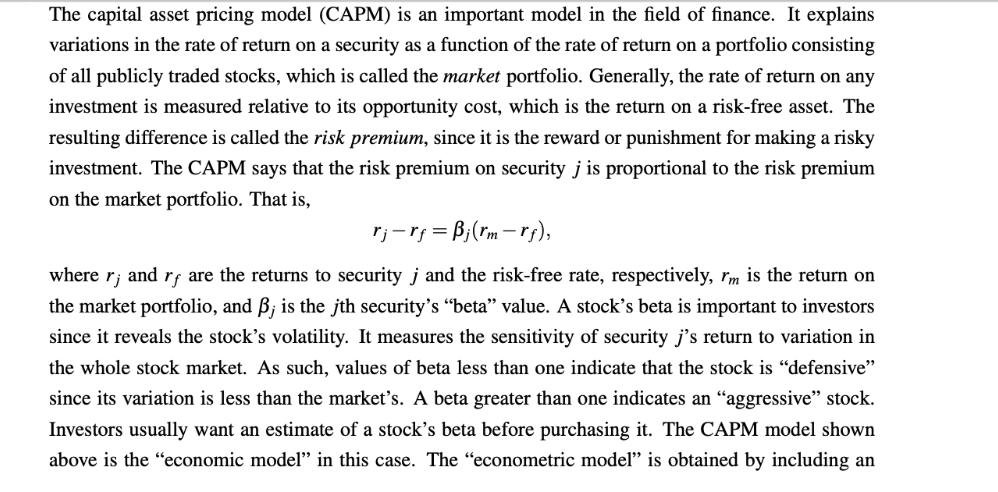
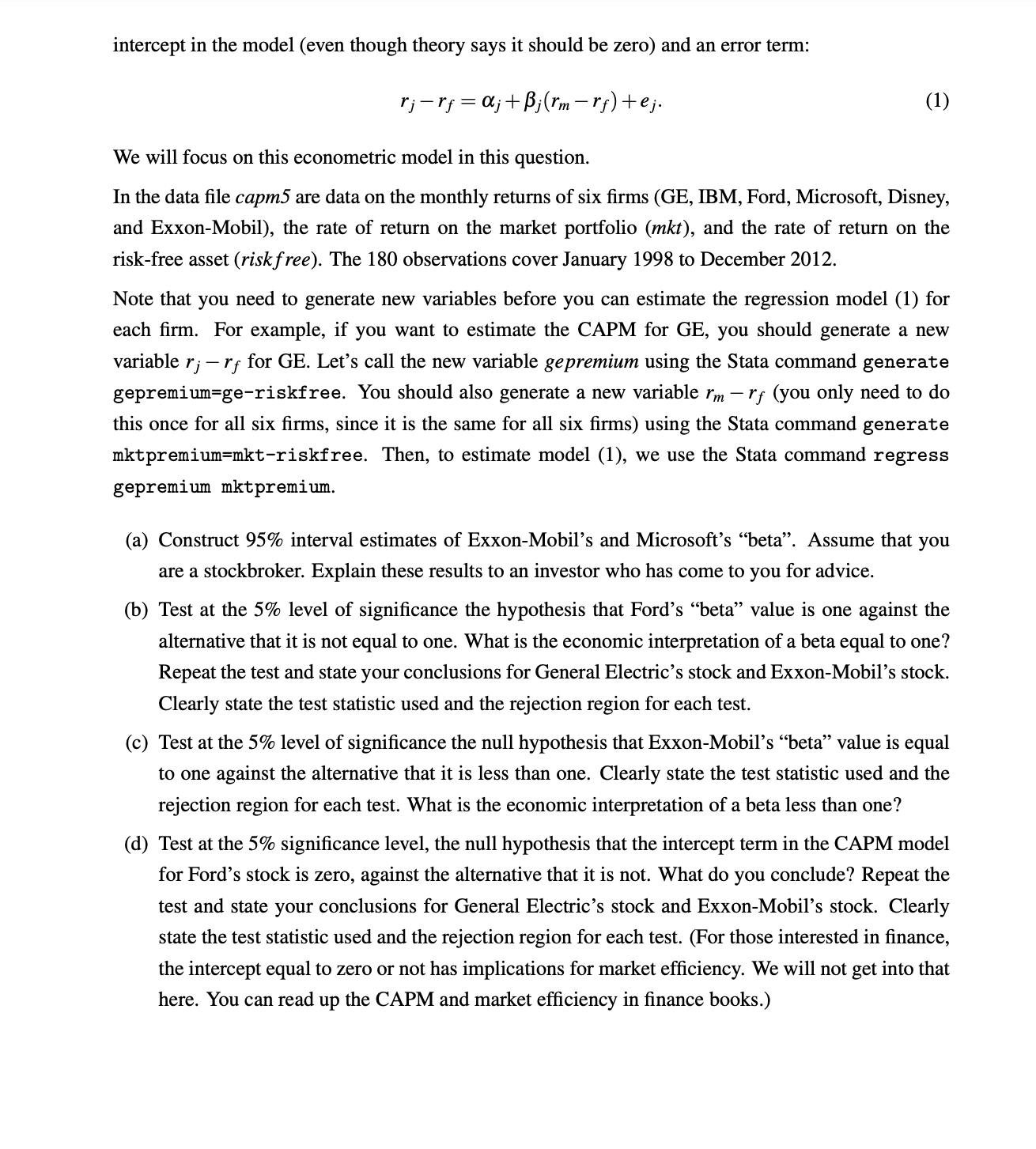
The capital asset pricing model (CAPM) is an important model in the field of finance. It explains variations in the rate of return on a security as a function of the rate of return on a portfolio consisting of all publicly traded stocks, which is called the market portfolio. Generally, the rate of return on any investment is measured relative to its opportunity cost, which is the return on a risk-free asset. The resulting difference is called the risk premium, since it is the reward or punishment for making a risky investment. The CAPM says that the risk premium on security j is proportional to the risk premium on the market portfolio. That is, r-r=Birm-rf), where rj and Irf are the returns to security j and the risk-free rate, respectively, rm is the return on the market portfolio, and ; is the jth security's "beta" value. A stock's beta is important to investors since it reveals the stock's volatility. It measures the sensitivity of security j's return to variation in the whole stock market. As such, values of beta less than one indicate that the stock is "defensive" since its variation is less than the market's. A beta greater than one indicates an aggressive" stock. Investors usually want an estimate of a stock's beta before purchasing it. The CAPM model shown above is the "economic model" in this case. The "econometric model" is obtained by including an intercept in the model (even though theory says it should be zero) and an error term: rjr = ;+j(rm r)+ej. We will focus on this econometric model in this question. (1) In the data file capm5 are data on the monthly returns of six firms (GE, IBM, Ford, Microsoft, Disney, and Exxon-Mobil), the rate of return on the market portfolio (mkt), and the rate of return on the risk-free asset (risk free). The 180 observations cover January 1998 to December 2012. Note that you need to generate new variables before you can estimate the regression model (1) for each firm. For example, if you want to estimate the CAPM for GE, you should generate a new variable rj-rf for GE. Let's call the new variable gepremium using the Stata command generate gepremium-ge-riskfree. You should also generate a new variable rm -rf (you only need to do this once for all six firms, since it is the same for all six firms) using the Stata command generate mktpremium=mkt-riskfree. Then, to estimate model (1), we use the Stata command regress gepremium mktpremium. (a) Construct 95% interval estimates of Exxon-Mobil's and Microsoft's "beta". Assume that you are a stockbroker. Explain these results to an investor who has come to you for advice. (b) Test at the 5% level of significance the hypothesis that Ford's beta value is one against the alternative that it is not equal to one. What is the economic interpretation of a beta equal to one? Repeat the test and state your conclusions for General Electric's stock and Exxon-Mobil's stock. Clearly state the test statistic used and the rejection region for each test. (c) Test at the 5% level of significance the null hypothesis that Exxon-Mobil's "beta" value is equal to one against the alternative that it is less than one. Clearly state the test statistic used and the rejection region for each test. What is the economic interpretation of a beta less than one? (d) Test at the 5% significance level, the null hypothesis that the intercept term in the CAPM model for Ford's stock is zero, against the alternative that it is not. What do you conclude? Repeat the test and state your conclusions for General Electric's stock and Exxon-Mobil's stock. Clearly state the test statistic used and the rejection region for each test. (For those interested in finance, the intercept equal to zero or not has implications for market efficiency. We will not get into that here. You can read up the CAPM and market efficiency in finance books.)
Step by Step Solution
There are 3 Steps involved in it

Get step-by-step solutions from verified subject matter experts
 Study Help