



Question: The CAPM model was adapted specifically into an insurance CAPM by several researchers in the 1970s. The model beings from an assumption that net
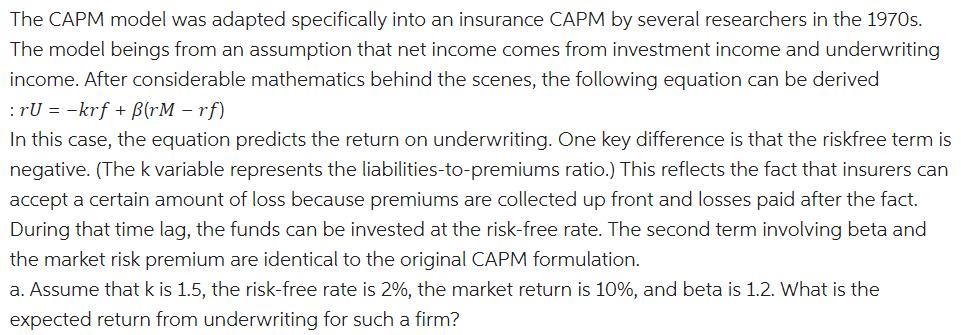
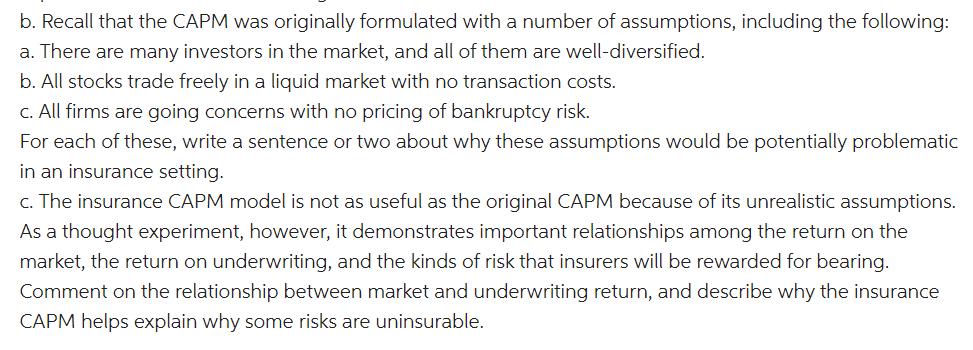
The CAPM model was adapted specifically into an insurance CAPM by several researchers in the 1970s. The model beings from an assumption that net income comes from investment income and underwriting income. After considerable mathematics behind the scenes, the following equation can be derived rU = -krf + (rM - rf) In this case, the equation predicts the return on underwriting. One key difference is that the riskfree term is negative. (The k variable represents the liabilities-to-premiums ratio.) This reflects the fact that insurers can accept a certain amount of loss because premiums are collected up front and losses paid after the fact. During that time lag, the funds can be invested at the risk-free rate. The second term involving beta and the market risk premium are identical to the original CAPM formulation. a. Assume that k is 1.5, the risk-free rate is 2%, the market return is 10%, and beta is 1.2. What is the expected return from underwriting for such a firm? b. Recall that the CAPM was originally formulated with a number of assumptions, including the following: a. There are many investors in the market, and all of them are well-diversified. b. All stocks trade freely in a liquid market with no transaction costs. c. All firms are going concerns with no pricing of bankruptcy risk. For each of these, write a sentence or two about why these assumptions would be potentially problematic in an insurance setting. c. The insurance CAPM model is not as useful as the original CAPM because of its unrealistic assumptions. As a thought experiment, however, it demonstrates important relationships among the return on the market, the return on underwriting, and the kinds of risk that insurers will be rewarded for bearing. Comment on the relationship between market and underwriting return, and describe why the insurance CAPM helps explain why some risks are uninsurable.
Step by Step Solution
3.46 Rating (153 Votes )
There are 3 Steps involved in it
a Assume that k is 15 the riskfree rate is 2 the market return is 10 and beta is 12 What is the expected return from underwriting for such a firm ANSW... View full answer

Get step-by-step solutions from verified subject matter experts