







Question: THE CASE FOR ANALYSIS After graduating with a double degree in engineering and commerce from a leading Australian university, Amy accepted a Perth - based
THE CASE FOR ANALYSIS
After graduating with a double degree in engineering and commerce from a leading Australian university, Amy accepted a Perthbased job in a large multinational professional services firm as an entrylevel consultant. She had received offers from several other firms, including a multinational mining company and a number of midsized engineering firms. The job she eventually took was not the highest paying one, but seemed to her to offer the greatest prospects for career development, and performing challenging work. Consistent with the results of tests conducted during the recruitment process, Amy describes herself as being extremely conscientious, slightly introverted, and eager to learn and experience new things. At the firm's encouragement, Amy enrolled parttime in a postgraduate degree program at a local university at the same time she started her new job.
During the first year, however, Amy began to have doubts about her choice of job and career. This is what her job looked like in her first months: Each day, her line manager would email her parts of a client file, with a list of assigned tasks for her to work on the next day. He instructed her exactly in what order to do the tasks and how to plan her day and work. She worked on these tasks, as directed, and understood that other parts of the client file were being worked on by the other junior consultants recruited at the same time as her. Her work comprised part of a large and complex multiyear project for a public service agency, although she only got to see the elements that she was sent and only had a rudimentary understanding of how tasks she performed fitted into the overall project. At the end of each day, she was expected to email her completed work back to her line manager. After checking it her manager would collate the work of all the other junior consultants into an overall client progress report. The line manager and a senior partner would then periodically meet with the client to discuss the project and review its progress against various milestones. Apart from an initial introductory meeting, the junior consultants had no direct interaction with the client organisation, and her manager never really talked about what went on in his meetings with the client and senior partner other than to say that they were generally happy with how things were going. As a junior consultant, Amy didn't have access to the overall project milestone reports, which were only shared with the firm's senior partners.
On a daily basis, Amy found that she had little need to consult with her colleagues, who had been assigned different aspects of the project to work on She found this a bit isolating, even though she rapidly found that she had little in common with her junior consultant cohort. While all had similar university backgrounds and were of a similar age, she though many of them were, not to put too fine a point on it a bit cliquey and distant. Some of them were already friends, either from school or university in Perth, whereas she had attended a country high school in New South Wales after her parents had emigrated to Australia from India. Believing that it would result in an early promotion and her being assigned more challenging work, Amy worked extremely hard on the tasks she was given even though the work seemed at times quite repetitive and didn't engage much of the knowledge or many of the skills she already possessed. The prospect of rapid promotion was something that the firm had stressed in its recruitment campaign, and this had been one of the main things that had attracted her. Following the pandemic, Amy continued to spend four days a week working from home rather than coming into the company's main office on St Georges Terrace, taking advantage of the firm's wellpublicised flexible working policy. This was something that all new recruits had been encouraged to do when Amy joined the firm, and this policy was described by the firm's Chief People Officer as a key component of the organisation's commitment to equal opportunity. That being said, she made sure that she always started work early long before standard office hours and she also invariably finished late, returning to her desk after dinner
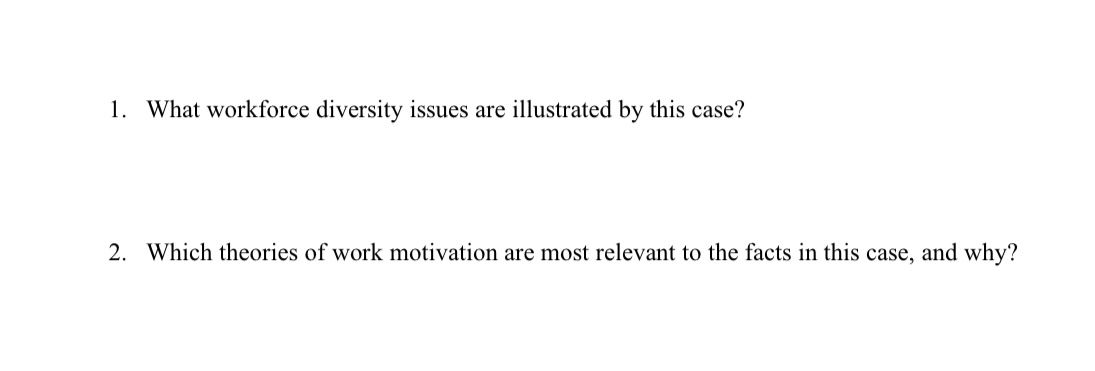
What workforce diversity issues are illustrated by this case?
Which theories of work motivation are most relevant to the facts in this case, and why?
Step by Step Solution
There are 3 Steps involved in it
1 Expert Approved Answer
Step: 1 Unlock

Question Has Been Solved by an Expert!
Get step-by-step solutions from verified subject matter experts
Step: 2 Unlock
Step: 3 Unlock
 Study Help