







Question: the case study called Sustaining Competitive Advantage: The Challenge for Belgiums Chocolate Cluster also sec artcical From Pralines to Multinationals The Economic History of Belgian
 the case study called Sustaining Competitive Advantage: The Challenge for Belgiums Chocolate Cluster also sec artcical From Pralines to Multinationals
The Economic History of Belgian Chocolate
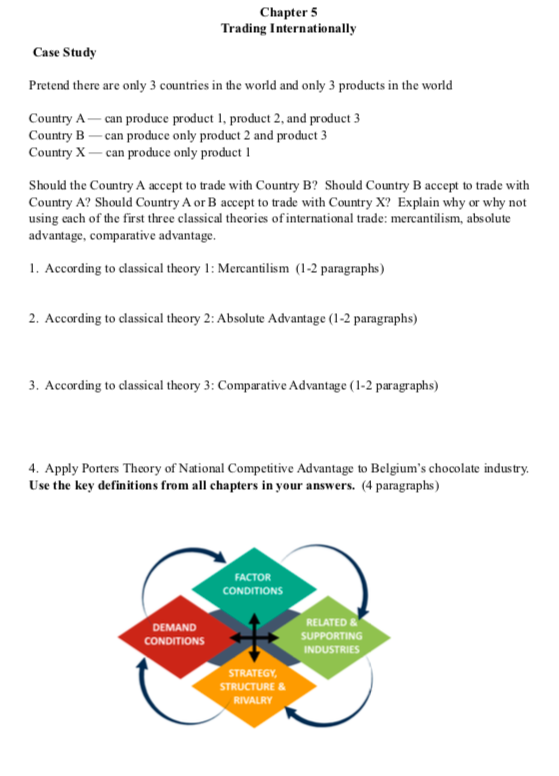
Chapter 5 Trading Internationally Case Study Pretend there are only 3 countries in the world and only 3 products in the world Country A - can produce product 1, product 2, and product 3 Country B --- can produce only product 2 and product 3 Country X - can produce only product 1 Should the Country A accept to trade with Country B? Should Country B accept to trade with Country A? Should Country A or B accept to trade with Country X? Explain why or why not using each of the first three classical theories of international trade: mercantilism, absolute advantage, comparative advantage. 1. According to classical theory 1: Mercantilism (1-2 paragraphs) 2. According to classical theory 2: Absolute Advantage (1-2 paragraphs) 3. According to classical theory 3: Comparative Advantage (1-2 paragraphs) 4. Apply Porters Theory of National Competitive Advantage to Belgium's chocolate industry. Use the key definitions from all chapters in your answers. (4 paragraphs) FACTOR CONDITIONS DEMAND CONDITIONS RELATED & SUPPORTING INDUSTRIES STRATEGY, STRUCTURE & RIVALRYStep by Step Solution
There are 3 Steps involved in it
1 Expert Approved Answer
Step: 1 Unlock

Question Has Been Solved by an Expert!
Get step-by-step solutions from verified subject matter experts
Step: 2 Unlock
Step: 3 Unlock
 Study Help