Question: The case study showed that Ms. Ferguson was not interested in comparing her clinic to others in the area when determining how to increase revenue.
The case study showed that Ms. Ferguson was not interested in comparing her clinic to others in the area when determining how to increase revenue.
1. Do you think this was a good decision? Explain your rationale.
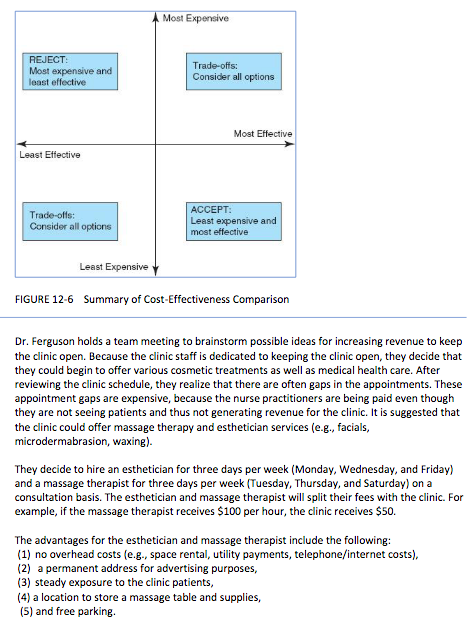
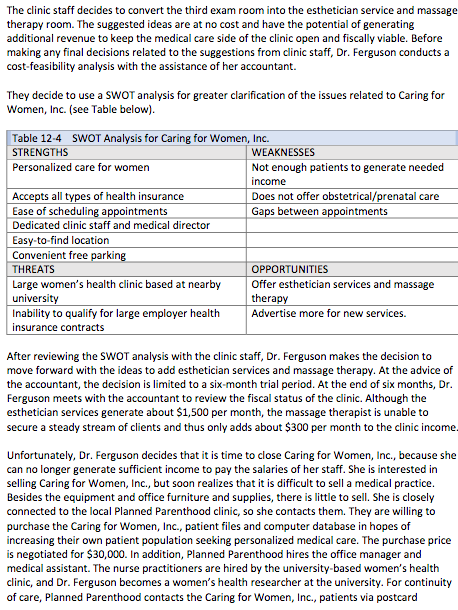

Case Study: Caring for Women, Inc. For the last 10 years, Ellen Ferguson has owned and directed Caring for Women, Inc., a small women's health clinic in lowa. The clinic provides well-women care, such as contraceptive services, preconception through menopause counseling, annual physical examinations, and routine medical services for minor healthcare needs such as urinary tract infections, sexually transmitted infections, and upper respiratory infections. Because the clinic is located near a local high school and a university, female students, staff, and faculty receive health care at the clinic. There are five employees: the director, the office manager, two nurse practitioners, and one medical assistant. Because the clinic is run by nurse practitioners, Dr. Ferguson pays a medical director a monthly stipend to serve as the medical backup for the nurse practitioners treating women in the clinic. After years of struggling to keep the clinic open, Dr. Ferguson decides to conduct a cost analysis to decide whether to close the clinic. She gets out her textbooks and reviews the various types of cost analysis techniques. She decides that cost-benefit analysis is inappropriate, because she is not interested in comparing her clinic with other clinics in the area and she is not allocating limited resources to different programs. She also determines that cost-utility analysis does not pertain to her clinic, because cost-utility analysis involves expected quantity and quality of life among her patients. The remaining two techniques are cost-effectiveness and cost-feasibility analyses. Dr. Ferguson decides to explore both techniques because she wants to ensure that all aspects are considered. After completing the cost-effectiveness summary, she realizes that the clinic must find a way to increase the number of patients coming through the door without increasing overhead costs, in other words, the most effective but least expensive solution (see Figure below). Most Expensive REJECT: Most expensive and least effective Trade-offs: Consider all options Most Effective Least Effective Trade-offs: Consider all options ACCEPT: : Least expensive and most effective Least Expensive FIGURE 12-6 Summary of Cost-Effectiveness Comparison Dr. Ferguson holds a team meeting to brainstorm possible ideas for increasing revenue to keep the clinic open. Because the clinic staff is dedicated to keeping the clinic open, they decide that they could begin to offer various cosmetic treatments as well as medical health care. After reviewing the clinic schedule, they realize that there are often gaps in the appointments. These appointment gaps are expensive, because the nurse practitioners are being paid even though they are not seeing patients and thus not generating revenue for the clinic. It is suggested that the clinic could offer massage therapy and esthetician services (e.g., facials, microdermabrasion, waxing). They decide to hire an esthetician for three days per week (Monday, Wednesday, and Friday) and a massage therapist for three days per week (Tuesday, Thursday, and Saturday) on a consultation basis. The esthetician and massage therapist will split their fees with the clinic. For example, if the massage therapist receives $100 per hour, the clinic receives $50. The advantages for the esthetician and massage therapist include the following: (1) no overhead costs (e.g., space rental, utility payments, telephone/internet costs), (2) a permanent address for advertising purposes, (3) steady exposure to the clinic patients, (4) a location to store a massage table and supplies, (5) and free parking. The clinic staff decides to convert the third exam room into the esthetician service and massage therapy room. The suggested ideas are at no cost and have the potential of generating additional revenue to keep the medical care side of the clinic open and fiscally viable. Before making any final decisions related to the suggestions from clinic staff, Dr. Ferguson conducts a cost-feasibility analysis with the assistance of her accountant. They decide to use a SWOT analysis for greater clarification of the issues related to Caring for Women, Inc. (see Table below). Table 12-4 SWOT Analysis for Caring for Women, Inc. STRENGTHS WEAKNESSES Personalized care for women Not enough patients to generate needed income Accepts all types of health insurance Does not offer obstetrical/prenatal care Ease of scheduling appointments Gaps between appointments Dedicated clinic staff and medical director Easy-to-find location Convenient free parking THREATS OPPORTUNITIES Large women's health clinic based at nearby Offer esthetician services and massage university therapy Inability to qualify for large employer health Advertise more for new services. insurance contracts After reviewing the SWOT analysis with the clinic staff, Dr. Ferguson makes the decision to move forward with the ideas to add esthetician services and massage therapy. At the advice of the accountant, the decision is limited to a six-month trial period. At the end of six months, Dr. Ferguson meets with the accountant to review the fiscal status of the clinic. Although the esthetician services generate about $1,500 per month, the massage therapist is unable to secure a steady stream of clients and thus Only adds about $300 per month to the clinic income Unfortunately, Dr. Ferguson decides that it is time to close Caring for Women, Inc., because she can no longer generate sufficient income to pay the salaries of her staff. She is interested in selling Caring for Women, Inc., but soon realizes that it is difficult to sell a medical practice. Besides the equipment and office furniture and supplies, there is little to sell. She is closely connected to the local Planned Parenthood clinic, so she contacts them. They are willing to purchase the Caring for Women, Inc., patient files and computer database in hopes of increasing their own patient population seeking personalized medical care. The purchase price is negotiated for $30,000. In addition, Planned Parenthood hires the office manager and medical assistant. The nurse practitioners are hired by the university-based women's health clinic, and Dr. Ferguson becomes a women's health researcher at the university. For continuity of care, Planned Parenthood contacts the Caring for Women, Inc., patients via postcard immediately after the sale is final. They are pleased to report that their clinic has seen an increase in revenue from the purchase of Caring for Women, Inc., after only 6 months









 Study Help