







Question: The code below creates a table for the outcomes when 4 dice are rolled, and stores them as a DataFrame. > four_dice = np.zeros([pow(6,4),5]) n
The code below creates a table for the outcomes when 4 dice are rolled, and stores them as a DataFrame.
>
four_dice = np.zeros([pow(6,4),5]) n = 0 outcomes = [1,2,3,4,5,6] for i in outcomes: for j in outcomes: for k in outcomes: for l in outcomes: four_dice[n,:] = [i,j,k,l,i+j+k+l] n +=1 four_dice_df = pd.DataFrame(four_dice,columns=('Dice 1','Dice 2','Dice 3','Dice 4','Total'))
>
Extend the code to compute the number of ways to obtain each unique result, i.e. the number of times each total appears. Print out the table of results ordered from lowest possible total (4) to highest possible total (24), as shown below.
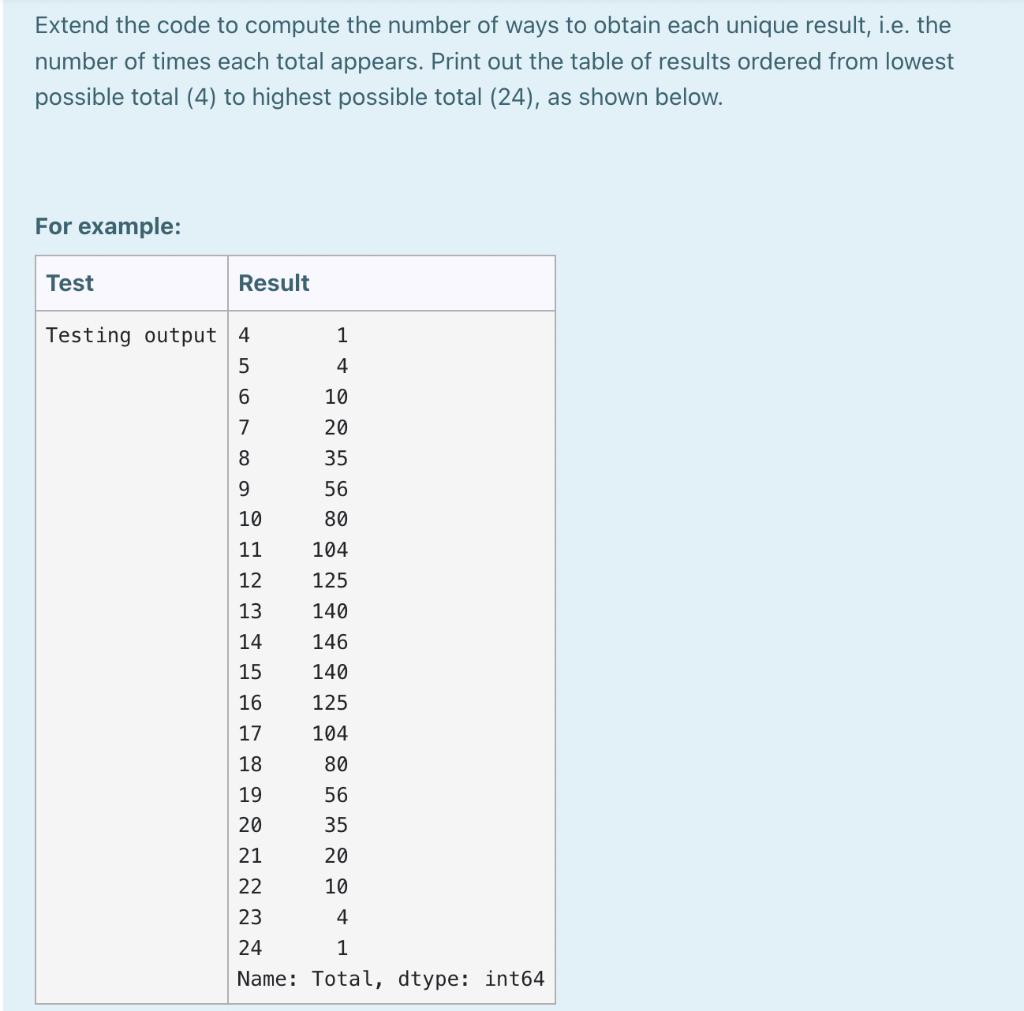
Extend the code to compute the number of ways to obtain each unique result, i.e. the number of times each total appears. Print out the table of results ordered from lowest possible total (4) to highest possible total (24), as shown below. For examnle
Step by Step Solution
There are 3 Steps involved in it

Get step-by-step solutions from verified subject matter experts
 Study Help