







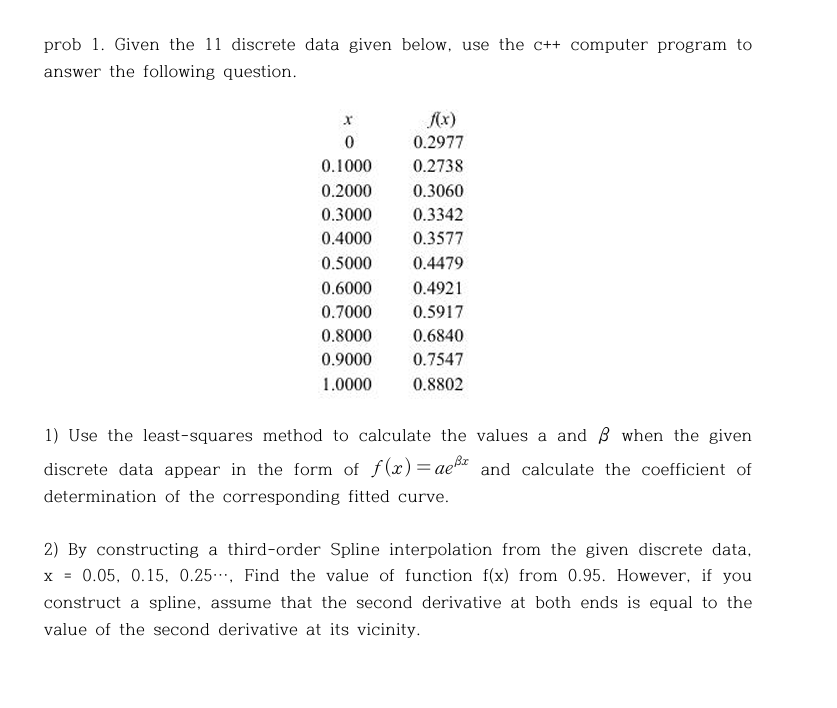
Question: The code I was provided seems to have a problem. The value of f ( 0 . 9 5 ) is incorrect. And the output
The code I was provided seems to have a problem.
The value of f is incorrect. And the output of the code of the solution provided is different from the output obtained by running c
I want to be provided with the correct code.
Code I was provided :
#include
#include
#include
#include
#include
#include
Function to perform linear regression using the leastsquares method
void linearRegressionconst std::vector& x const std::vector& y double& alpha, double& beta
int n xsize;
double sumX sumY sumXY sumXX ;
forint i ; i n; i
sumX xi;
sumY yi;
sumXY xi yi;
sumXX xi xi;
beta n sumXY sumX sumYn sumXX sumX sumX;
alpha sumY beta sumX n;
Function to calculate Rcoefficient of determination
double calculateRSquaredconst std::vector& y const std::vector& yfit
double meanY std::accumulateybegin yend ysize;
double ssTot ssRes ;
forsizet i ; i ysize; i
ssTot yi meanYyi meanY;
ssRes yi yfitiyi yfiti;
return ssRes ssTot;
Function to evaluate the spline at a given point x
double evaluateSplineconst std::vector& x const std::vector& y double xeval
int n xsize;
std::vector hn alphan ln mun zn cn bn dn ;
Calculate h and alpha
forint i ; i n ; i
hi xi xi;
alphai hiyi yi hi yi yi ;
Set boundary conditions
l;
mu;
z;
Solve the tridiagonal system
forint i ; i n ; i
lixi xi hi mui ;
mui hi li;
zialphai hi zi li;
Set boundary conditions
ln ;
zn ;
cn ;
Calculate the coefficients
forint j n ; j ; j
cj zj muj cj ;
bjyj yj hj hjcj cj;
djcj cj hj;
Evaluate the spline at xeval
int i std::lowerboundxbegin xend xeval xbegin;
double dx xeval xi;
double result yi bi dx ci dx dx di dx dx dx;
return result;
int main
Given data points
std::vector x ;
std::vector f ;
Part : Leastsquares method for exponential fitting
std::vector y;
fordouble val : f
ypushbacklogval; linearize
double alpha, beta;
linearRegressionx y alpha, beta;
double a expalpha;
std::vector ffit;
fordouble val : x
ffit.pushbacka expbeta val;
double rSquared calculateRSquaredf ffit;
std::cout "Leastsquares method results:" std::endl;
std::cout a a std::endl;
std::cout "beta beta std::endl;
std::cout "Coefficient of determination R rSquared std::endl;
Part : Thirdorder spline interpolation
double xeval ;
double feval evaluateSplinex f xeval;
std::cout
Spline interpolation result:" std::endl;
std::cout f xeval feval std::endl;
return ;
Step by Step Solution
There are 3 Steps involved in it
1 Expert Approved Answer
Step: 1 Unlock

Question Has Been Solved by an Expert!
Get step-by-step solutions from verified subject matter experts
Step: 2 Unlock
Step: 3 Unlock
 Study Help