







Question: The code is needed in python only AND must pass the following tests def test_number_number_to_string(): ''' This function runs a number of tests of the
The code is needed in python only
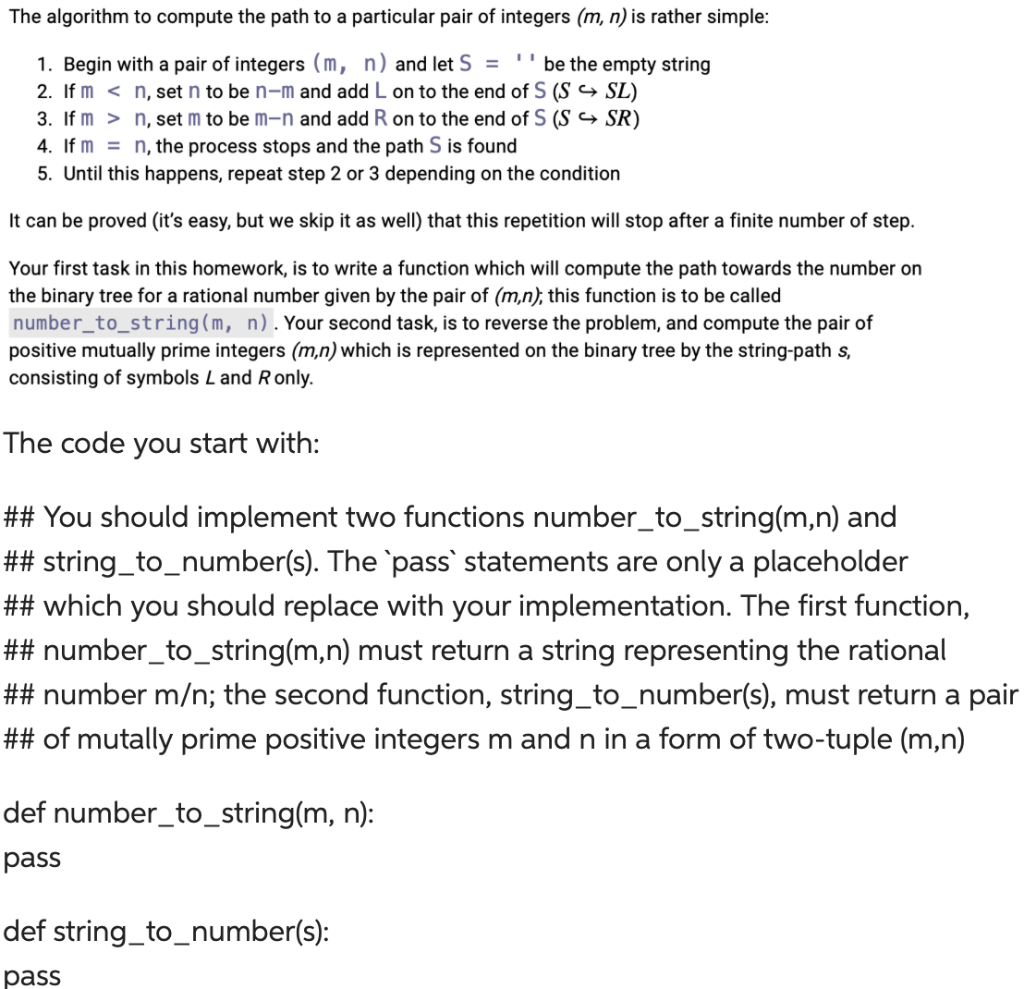
AND must pass the following tests
def test_number_number_to_string(): ''' This function runs a number of tests of the number_to_string function. If it works ok, you will just see the output ("all tests passed") at the end when you call this function; if some test fails, there will be an error message. ''' assert number_to_string(1, 1) == '' assert type(number_to_string(1, 1)) == str assert number_to_string(2, 1) == 'R' assert type(number_to_string(2, 1)) == str assert number_to_string(3, 1) == 'RR' assert type(number_to_string(3, 1)) == str assert number_to_string(4, 1) == 'R'*3 assert type(number_to_string(1, 4)) == str assert number_to_string(3,11) == 'LLLRL' assert type(number_to_string(89, 55)) == str assert number_to_string(89, 55) == 'RLRLRLRLR' assert type(number_to_string(8, 111)) == str assert number_to_string(144, 89) == 'RL' * 5 print("all tests passed")
def test_string_to_number(): ''' This function runs a number of tests of the string_to_number function. If it works ok, you will just see the output ("all tests passed") at the end when you call this function; if some test fails, there will be an error message. ''' assert string_to_number('') == (1,1) assert type(string_to_number('')) == tuple assert string_to_number('L') == (1,2) assert type(string_to_number('R')) == tuple assert string_to_number('LR') == (2,3) assert type(string_to_number('RL')) == tuple assert string_to_number('RL'*5) == (144,89) assert type(string_to_number('LR'*10)) == tuple assert string_to_number('LLLLLLLLLLL') == (1,12) assert string_to_number('RRRRRRRRRR') == (11,1) print("all tests passed")
The algorithm to compute the path to a particular pair of integers (m,n) is rather simple: 1. Begin with a pair of integers (m,n) and let S= ' be the empty string 2. If m
Step by Step Solution
There are 3 Steps involved in it

Get step-by-step solutions from verified subject matter experts
 Study Help