







Question: The coefficient of determination and the sample correlation coefficient Nambe manufactures a line of metal tableware called Nambeware. A piece of Nambeware is produced by
The coefficient of determination and the sample correlation coefficient
Nambe manufactures a line of metal tableware called Nambeware. A piece of Nambeware is produced by sand-casting a special alloy of several metals. After casting, the piece goes through a series of shaping, grinding, buffing, and polishing steps.
Nambe is analyzing how to adjust its production schedule to accommodate the polishing step of a new line of plates that it is adding to its product line. Nambe selects a random sample of its tableware pieces and collects data on the type of piece (tray, dish, bowl, plate, or casserole), its diameter (in inches), its polishing time (in minutes), and its price (in dollars). [Source: Data and Story Library (DASL).] The sample data are located in the data set Nambeware. Use the DataView tool to answer the following questions.
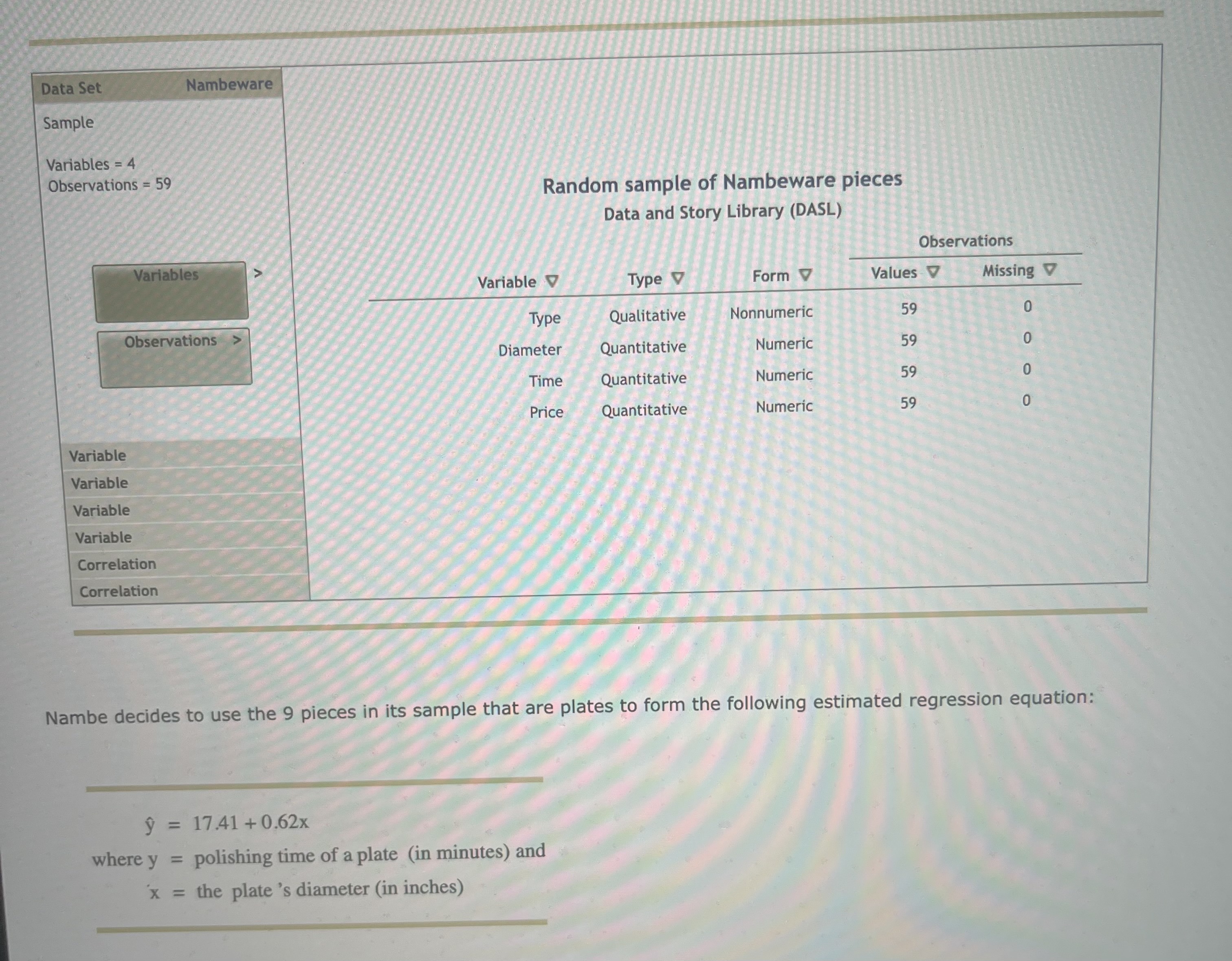
Data Set Nambeware Sample Variables = 4 Observations = 59 Random sample of Nambeware pieces Data and Story Library (DASL) Observations Variables Variable V Type V Form V Values V Missing V Type Qualitative Nonnumeric 59 Observations > Diameter Quantitative Numeric 59 59 ooo Time Quantitative Numeric Price Quantitative Numeric 59 Variable Variable Variable Variable Correlation Correlation Nambe decides to use the 9 pieces in its sample that are plates to form the following estimated regression equation: y = 17.41 + 0.62x where y = polishing time of a plate (in minutes) and x = the plate 's diameter (in inches)
Step by Step Solution
There are 3 Steps involved in it

Get step-by-step solutions from verified subject matter experts
 Study Help