







Question: The completed table shown below suggests that as x gets closer to 6 (while remaining less than 6 ), f(x) gets larger and larger without
The completed table shown below suggests that as
xgets closer to 6 (while remaining less than 6 ),
f(x)gets larger and larger without bound-that is for any number no matter how large,
f(x)will be even larger than that if
x(strictly less than 6 ) is sufficiently close to 6 .\ \\\\table[[
x,5.9,5.99,5.999,5.9999],[
f(x),3.1623,10.0000,31.6228,100.0000]]\ Because the tabulated values suggest that
f(x)is becoming arbitrarily large as
xapproaches 6 from the left, we say the following. (If an answer does not exist, enter DNE.)\
\\\\lim_(x->6^(-))((\\\\sqrt(6-x))/(6-x))= 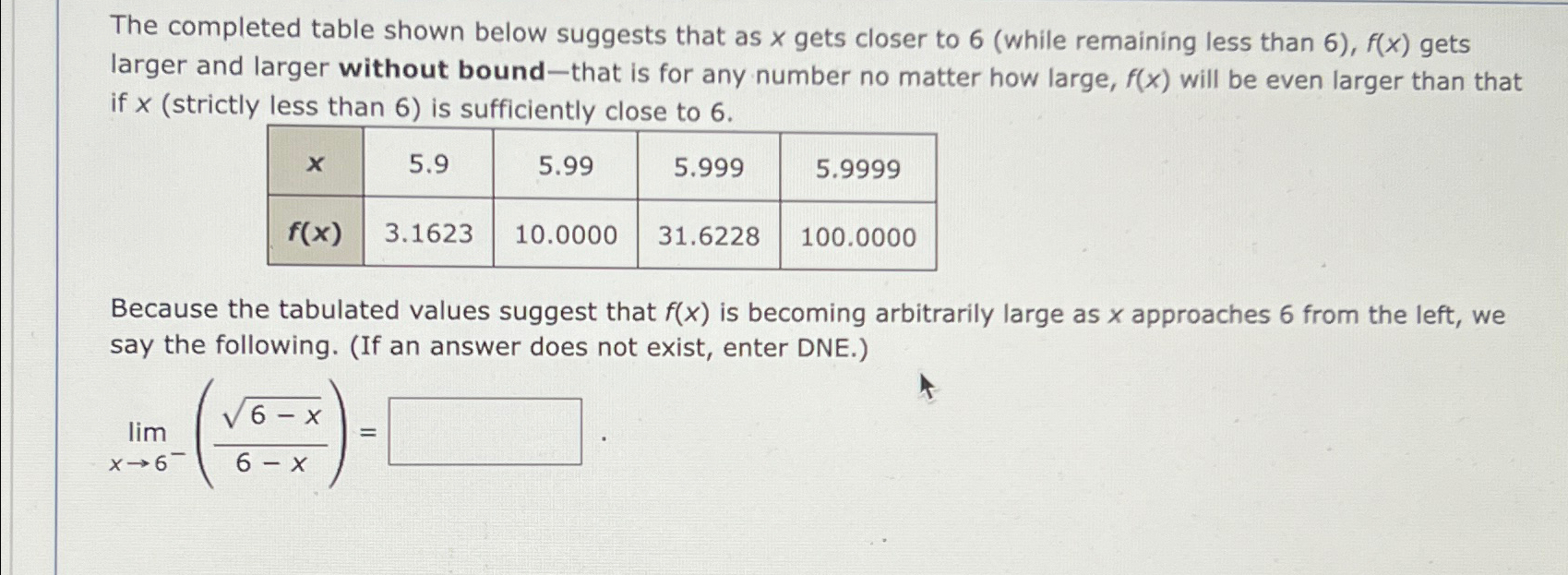
The completed table shown below suggests that as x gets closer to 6 (while remaining less than 6 ), f(x) gets larger and larger without bound-that is for any number no matter how large, f(x) will be even larger than that if x (strictly less than 6 ) is sufficiently close to 6 . Because the tabulated values suggest that f(x) is becoming arbitrarily large as x approaches 6 from the left, we say the following. (If an answer does not exist, enter DNE.) limx6(6x6x)=
Step by Step Solution
There are 3 Steps involved in it

Get step-by-step solutions from verified subject matter experts
 Study Help