







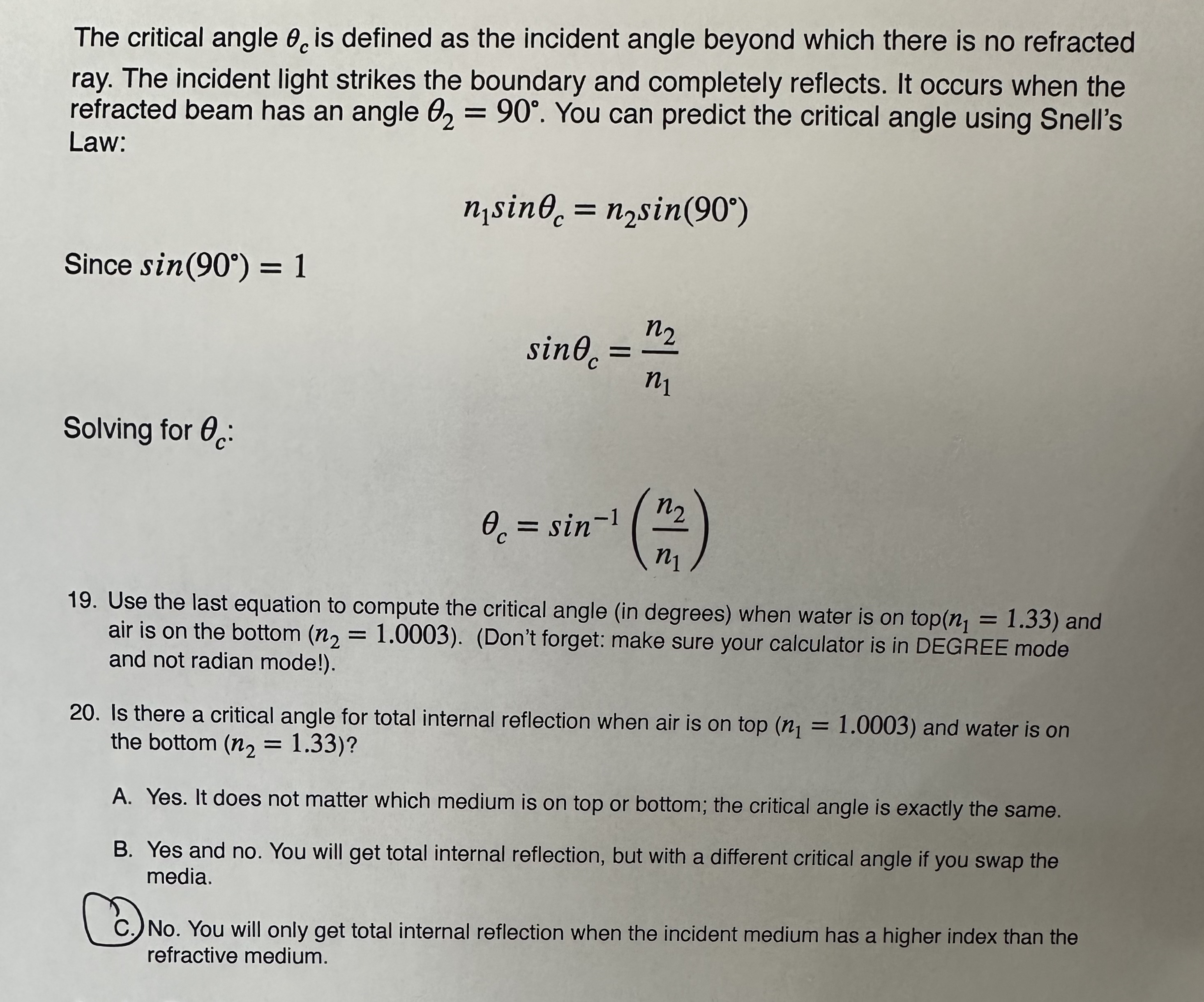
Question: The critical angle c is defined as the incident angle beyond which there is no refracted ray. The incident light strikes the boundary and completely
The critical angle is defined as the incident angle beyond which there is no refracted ray. The incident light strikes the boundary and completely reflects. It occurs when the refracted beam has an angle You can predict the critical angle using Snell's Law:
Since
Solving for :
Use the last equation to compute the critical angle in degrees when water is on and air is on the bottom Dont forget: make sure your calculator is in DEGREE mode and not radian mode!
Is there a critical angle for total internal reflection when air is on top and water is on the bottom
A Yes. It does not matter which medium is on top or bottom; the critical angle is exactly the same.
B Yes and no You will get total internal reflection, but with a different critical angle if you swap the media.
C No You will only get total internal reflection when the incident medium has a higher index than the refractive medium.
Step by Step Solution
There are 3 Steps involved in it
1 Expert Approved Answer
Step: 1 Unlock

Question Has Been Solved by an Expert!
Get step-by-step solutions from verified subject matter experts
Step: 2 Unlock
Step: 3 Unlock
 Study Help