



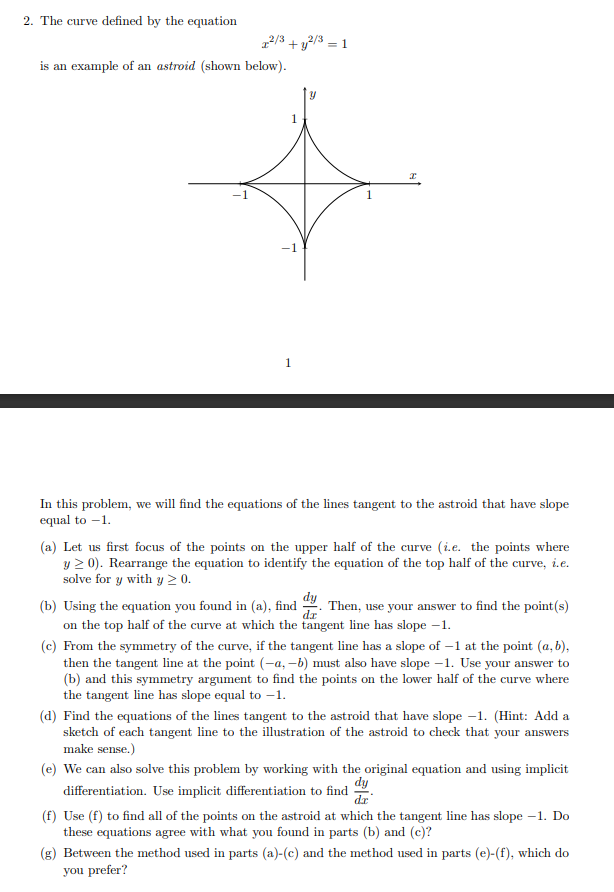
Question: The curve defined by the equation x^2/3+y^2/3=1 is an example of an astroid (shown below). 2. The curve defined by the equation 22/3 + y2/3
The curve defined by the equation
x^2/3+y^2/3=1
is an example of an astroid (shown below).
2. The curve defined by the equation 22/3 + y2/3 = 1 is an example of an astroid (shown below). y 1 1 In this problem, we will find the equations of the lines tangent to the astroid that have slope equal to -1. (a) Let us first focus of the points on the upper half of the curve (i.e. the points where y> 0). Rearrange the equation to identify the equation of the top half of the curve, i.e. solve for y with y 2 0. (b) Using the equation you found in (a), find dy dar Then, use your answer to find the point(s) on the top half of the curve at which the tangent line has slope - 1. (c) From the symmetry of the curve, if the tangent line has a slope of -1 at the point (a,b), then the tangent line at the point (-a, -b) must also have slope -1. Use your answer to (b) and this symmetry argument to find the points on the lower half of the curve where the tangent line has slope equal to -1. (d) Find the equations of the lines tangent to the astroid that have slope -1. (Hint: Add a sketch of each tangent line to the illustration of the astroid to check that your answers make sense.) (e) We can also solve this problem by working with the original equation and using implicit differentiation. Use implicit differentiation to find dy (f) Use (f) to find all of the points on the astroid at which the tangent line has slope -1. Do these equations agree with what you found in parts (b) and (c)? (8) Between the method used in parts (a)-(c) and the method used in parts (e)-(f), which do you prefer? 2. The curve defined by the equation 22/3 + y2/3 = 1 is an example of an astroid (shown below). y 1 1 In this problem, we will find the equations of the lines tangent to the astroid that have slope equal to -1. (a) Let us first focus of the points on the upper half of the curve (i.e. the points where y> 0). Rearrange the equation to identify the equation of the top half of the curve, i.e. solve for y with y 2 0. (b) Using the equation you found in (a), find dy dar Then, use your answer to find the point(s) on the top half of the curve at which the tangent line has slope - 1. (c) From the symmetry of the curve, if the tangent line has a slope of -1 at the point (a,b), then the tangent line at the point (-a, -b) must also have slope -1. Use your answer to (b) and this symmetry argument to find the points on the lower half of the curve where the tangent line has slope equal to -1. (d) Find the equations of the lines tangent to the astroid that have slope -1. (Hint: Add a sketch of each tangent line to the illustration of the astroid to check that your answers make sense.) (e) We can also solve this problem by working with the original equation and using implicit differentiation. Use implicit differentiation to find dy (f) Use (f) to find all of the points on the astroid at which the tangent line has slope -1. Do these equations agree with what you found in parts (b) and (c)? (8) Between the method used in parts (a)-(c) and the method used in parts (e)-(f), which do you prefer
Step by Step Solution
There are 3 Steps involved in it

Get step-by-step solutions from verified subject matter experts