







Question: The data below examine the relationship between two variables, the quality of marriage and the quality of parent-child relationships. You can use SPSS or excel
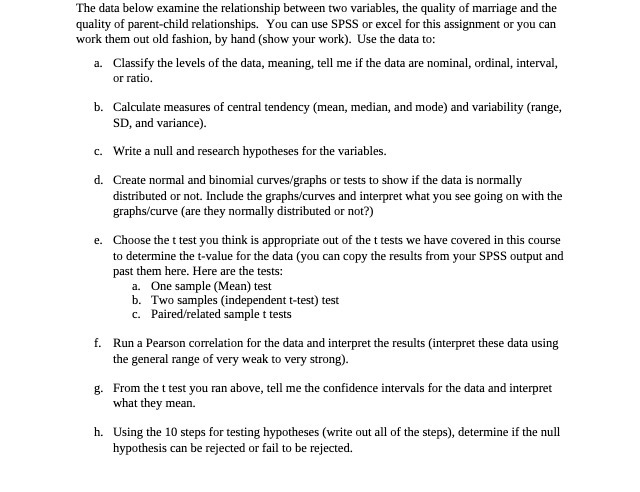
The data below examine the relationship between two variables, the quality of marriage and the quality of parent-child relationships. You can use SPSS or excel for this assignment or you can work them out old fashion, by hand (show your work). Use the data to: a. Classify the levels of the data, meaning, tell me if the data are nominal, ordinal, interval, or ratio. b. Calculate measures of central tendency (mean, median, and mode) and variability (range, SD, and variance). c. Write a null and research hypotheses for the variables. d. Create normal and binomial curves/graphs or tests to show if the data is normally distributed or not. Include the graphs/curves and interpret what you see going on with the graphs/curve (are they normally distributed or not?) e. Choose the t test you think is appropriate out of the t tests we have covered in this course to determine the t-value for the data (you can copy the results from your SPSS output and past them here. Here are the tests: a. One sample (Mean) test b. Two samples (independent t-test) test C. Paired/related sample t tests f. Run a Pearson correlation for the data and interpret the results (interpret these data using the general range of very weak to very strong). g. From the t test you ran above, tell me the confidence intervals for the data and interpret what they mean. h. Using the 10 steps for testing hypotheses (write out all of the steps), determine if the null hypothesis can be rejected or fail to be rejected
Step by Step Solution
There are 3 Steps involved in it

Get step-by-step solutions from verified subject matter experts
 Study Help