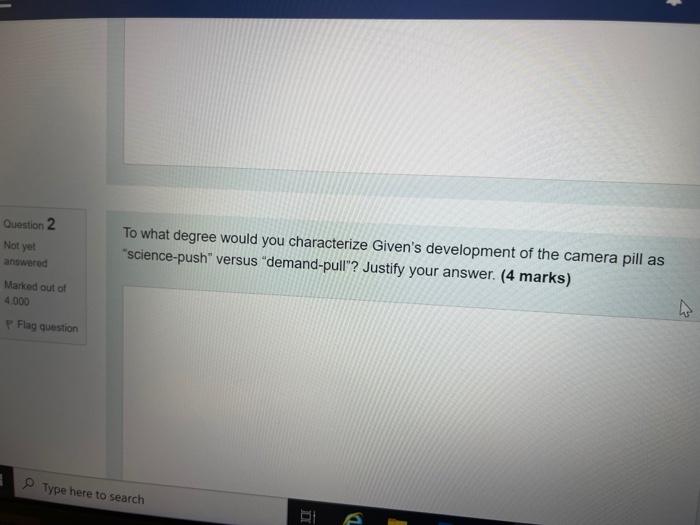
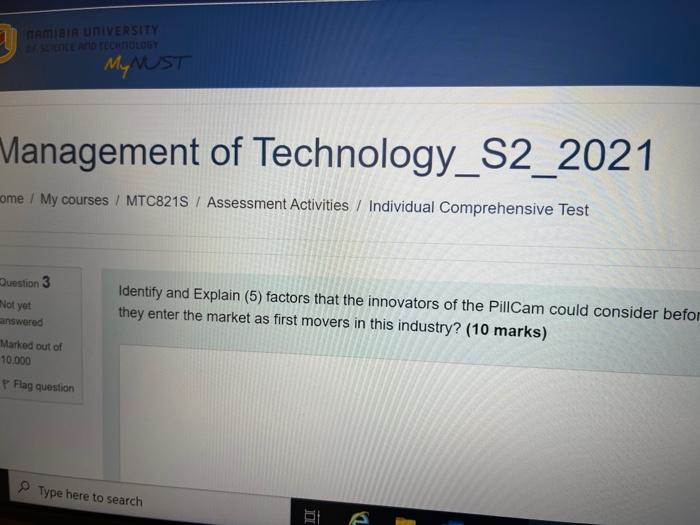
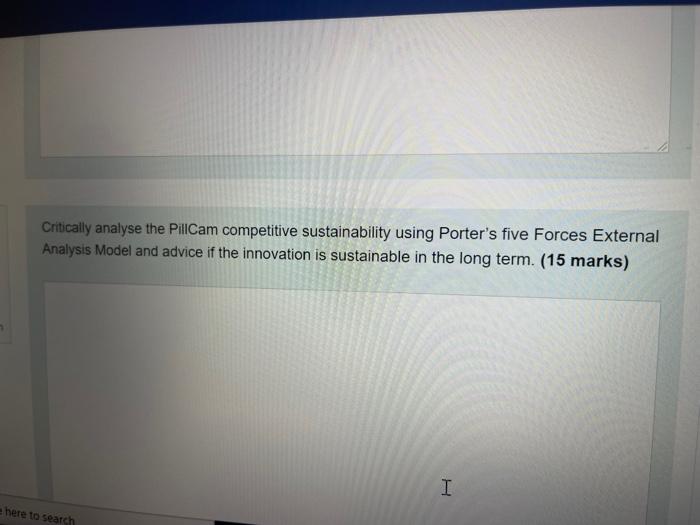
Question: THE DEVELOPMENT OF GIVEN CAMPILL Getting an Inside Look Given Imaging's Camera Pilla Gavriel Iddan was an electro-optical engineer at Israel's Rafael Armament Development Authority,
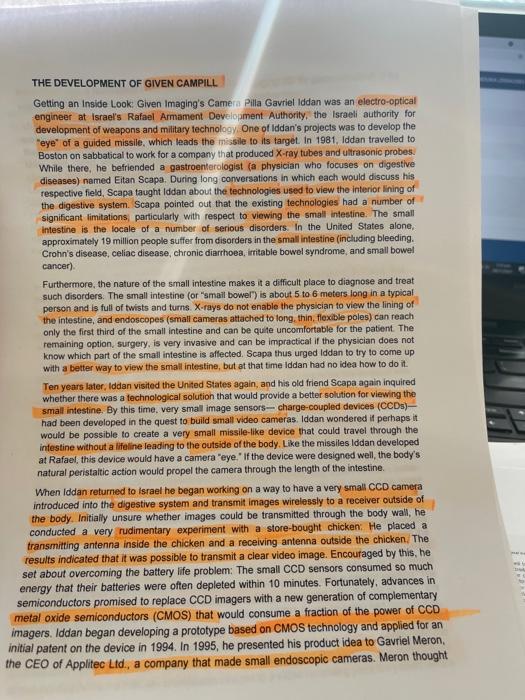
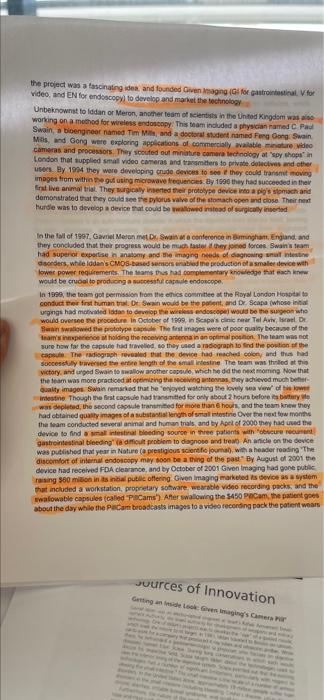
THE DEVELOPMENT OF GIVEN CAMPILL Getting an Inside Look Given Imaging's Camera Pilla Gavriel Iddan was an electro-optical engineer at Israel's Rafael Armament Development Authority, the Israeli authority for development of weapons and military technology. One of Iddan's projects was to develop the "eye of a guided missile, which leads the missile to its target. In 1981, Iddan travelled to Boston on sabbatical to work for a company that produced X-ray tubes and ultrasonic probes. While there, he befriended a gastroenterologist (a physician who focuses on digestive diseases) named Eitan Scapa. During long conversations in which each would discuss his respective field, Scapa taught Iddan about the technologies used to view the interior lining of the digestive system. Scapa pointed out that the existing technologies had a number of significant limitations particularly with respect to viewing the small intestine. The small intestine is the locale of a number of serious disorders. In the United States alone, approximately 19 million people suffer from disorders in the small intestine (including bleeding. Crohn's disease, celiac disease, chronic diarrhoea, irritable bowel syndrome, and small bowel cancer) Furthermore, the nature of the small intestine makes it a difficult place to diagnose and treat such disorders. The small intestine (or "small bowel") is about 5 to 6 meters long in a typical person and is full of twists and turns. X-rays do not enable the physician to view the lining of the intestine, and endoscopes (small cameras attached to long, thin, flexible poles) can reach only the first third of the small intestine and can be quite uncomfortable for the patient. The remaining option, surgery, is very invasive and can be impractical if the physician does not know which part of the small intestine is affected. Scapa thus urged Iddan to try to come up with a better way to view the small intestine, but at that time Iddan had no idea how to do it. Ten years later, Iddan visited the United States again, and his old friend Scapa again inquired whether there was a technological solution that would provide a better solution for viewing the small intestine. By this time, very small image sensors charge-coupled devices (CCDs) - had been developed in the quest to build small video cameras. Iddan wondered if perhaps it would be possible to create a very small missile-like device that could travel through the intestine without a lifeline leading to the outside of the body. Like the missiles Iddan developed at Rafael, this device would have a camera "eye." If the device were designed well, the body's natural peristaltic action would propel the camera through the length of the intestine When Iddan returned to Israel he began working on a way to have a very small CCD camera introduced into the digestive system and transmit images wirelessly to a receiver outside of the body. Initially unsure whether images could be transmitted through the body wall, he conducted a very rudimentary experiment with a store-bought chicken: He placed a transmitting antenna inside the chicken and a receiving antenna outside the chicken, The results indicated that it was possible to transmit a clear video image. Encouraged by this, he set about overcoming the battery life problem: The small CCD sensors consumed so much energy that their batteries were often depleted within 10 minutes. Fortunately, advances in semiconductors promised to replace CCD imagers with a new generation of complementary metal oxide semiconductors (CMOS) that would consume a fraction of the power of CCD imagers. Iddan began developing a prototype based on CMOS technology and applied for an initial patent on the device in 1994. In 1995, he presented his product idea to Gavriel Meron, the CEO of Applitec Ltd., a company that made small endoscopic cameras. Meron thought HH the project was a fascinating idea and founded Given for gastrointestinal or video, and EN for endoscopy to develop and market the technology Unbeknownst tolddan or Meron another team of scientists in the United Kingdom was working on a method for wireless endoscopy This team included a physician named C Pad Swain, bioengineer named Tim M, and a doctoral student named Feng Gong Swain Mals, and Gong were exploring applications of commercially available in video cameras and processors. They scouted out miniature camera technology at spy shop in London that supplied small video cameras and transmitters to private detectives and other Us By 1994 they were developing crudo devices to see they could transmit moving images from within gut using microwave frequencies. By 1990 they had succeeded in the first live animal trial. They surgical inserted the prototype device into a los macharid demonstrated that they could see the pylorus valve of the stomach open and close. Their hurdle was to develop a device that could be walked instead of surgicaled In the fall of 1997. Gavriel Meron Di Swin a conference in mngham, England, and they concluded that their progress would be much as they for Swain team had superior expertise anatomy and imaging needs of diagnosing sunet disorders, while Iddan's CMOS-based morebied the production of a smaller device with lower power requirements. The maths had commentary Rhodesign that each would be crudel to producing a successful caule endoscope In 1999, the team got permission from the ethics committee at the Royal London Hot conduct their first human train would be the point and Dr. Scapa (whosen urgings had moved to develop the wees endoscopes would be the surgeon who would oversee procedure in October of 1999. in Seapa's cinc Tel Aviv, Israel Swalowed the prototype The test nages were of poor quality because of the Inapene holding the receiving area in an optimal potion. The team was not sure how far the capsule had travelled, so they cand a radiograph to find the position of the capsule Theradiographed that the device and reached color and this had successfully traversed the length of the small intestine The team was that this victory and urged Swain to swallow another capsule, which he did the next morning Now that the team was more practiced at optimizing thing as they achieved much better Gualty Images Swain remated that he enjoyed watching the lovely sea view of the intestine Though the first cap dad transmited for only about 2 hours before buy was depleted, the wood capsule traited for more than hour, and the team now they had obtained quality images of a substantength of malestine Over the next the team conducted several animal and human trials and by Apel of 2000 they had uued the device to find all intestinal bleeding source in the patients with cerca gastrointestinal bleeding out problem to diagnostrew An atlice on the device was published that year in Nature la prestigious scientific jou with a header reading The discomfort of internal endoscopy may soon be a thing of the past By August of 2001 the device had received FDA clearance, and by October of 2001 Given imaging had gone public raising 500 milions public offering Given imaging marketed vice as a system that included a workstation proprietary software, wearable video recording packs, and the swalowable capsules (caled "Cams') After swallowing the 5450 Pacam, the patients about the day while the Pacam broadcast images to a video recording pack the patient wears sources of innovation Getting and Green Camera he was gende wie den forbedre Unbeknown Meron en for wey This daten Sabonete de and songs of commercial w wydecanders Landheden ersten her en te werden wollentowe Images tomes Dy100 dedin for the prototype device and demoned that they are of the wood cow The hurdle was to desde haber Is the tal of 1907. Gwelerometer the conduced to the progreso had perfetto the has the forces disorders when CMOS basen werden lower power met Thethadonary would be reproduced and In 1998 the team got permission from the whiccome the Royal London Hospit Conduct the start one patent and Dr Shoe urgingshadow to deve the window would over the procedure is Other of Swe's din nou, Swain wallowed the othecae The festges we of poor cause of the Banding reception the warm was not ure how the cape had oled, so they too difend e poi case. The value and that Traves the delen of te www. The team was the victory, and we want to waliowapi which is the meaning Now them was more practiced at optage eingehed much beter quality image womand terecht zowever tee Though the state and for only about 2 hours before before w they was depleted the second capsule and for montanhound War had obtained wity images of assignatura intestine Over the next few months the team conducted ever maand human tras and by Apof2009 they have device to find a wall Winding out in three with current gastrointestinal bleeding out problem to do and beat An article on the device was published that year in concomitang "The discomfort of we endoscopy may soon be a wing of the past y August of 2001 the device had received FDA clearance, and by October of 2001 Given imaging has gone public raising 300 million in a publering Given imaging med devices That included a won station proprietary software able video recording pics and the waliowable capsules capacams") After allowing 3450 Pucam, the patient goes about the day while the Cambrosas images to a video recording pack the patient wa Sources of innovation Getting an evening Camera Question 2 Not you To what degree would you characterize Given's development of the camera pill as "science-push versus "demand-pull"? Justify your answer. (4 marks) answered Marked out of 4.000 Flag question Type here to search I CAMIBIR UNIVERSITY My NST Management of Technology_S2_2021 home / My courses / MTC8215 / Assessment Activities / Individual Comprehensive Test Question 3 Not yet Identify and Explain (5) factors that the innovators of the PillCam could consider befor they enter the market as first movers in this industry? (10 marks) answered Marked out of 10.000 Flag question Type here to search Critically analyse the PillCam competitive sustainability using Porter's five Forces External Analysis Model and advice if the innovation is sustainable in the long term. (15 marks) I here to search