







Question: The Dining Philosophers Problem Problem Description The Dining Philosophers Problem is a classic synchronization problem. It involves five philosophers sitting at a table, each alternating
The Dining Philosophers Problem
Problem Description
The Dining Philosophers Problem is a classic synchronization problem. It involves five philosophers sitting at a table, each alternating between thinking and eating. There are five forks, one between each pair of philosophers. A philosopher needs both forks to pick up the noodles from the main plate and place the serving on his plate to eat. However, philosophers can only pick up one fork at a time.
Each philosopher eats and thinks alternatively. There are the following conditions followed by each philosopher:
A philosopher must use both forks right and left to pick up the noodles.
The remaining fork may be picked up by any one of its adjacent philosophers but not both.
A philosopher may have noodles if both forks are available.
After eating, a philosopher must put down both forks and starts thinking again.
Those forks can be picked by the other philosophers who will repeat the same process.Solution Using Mutexes
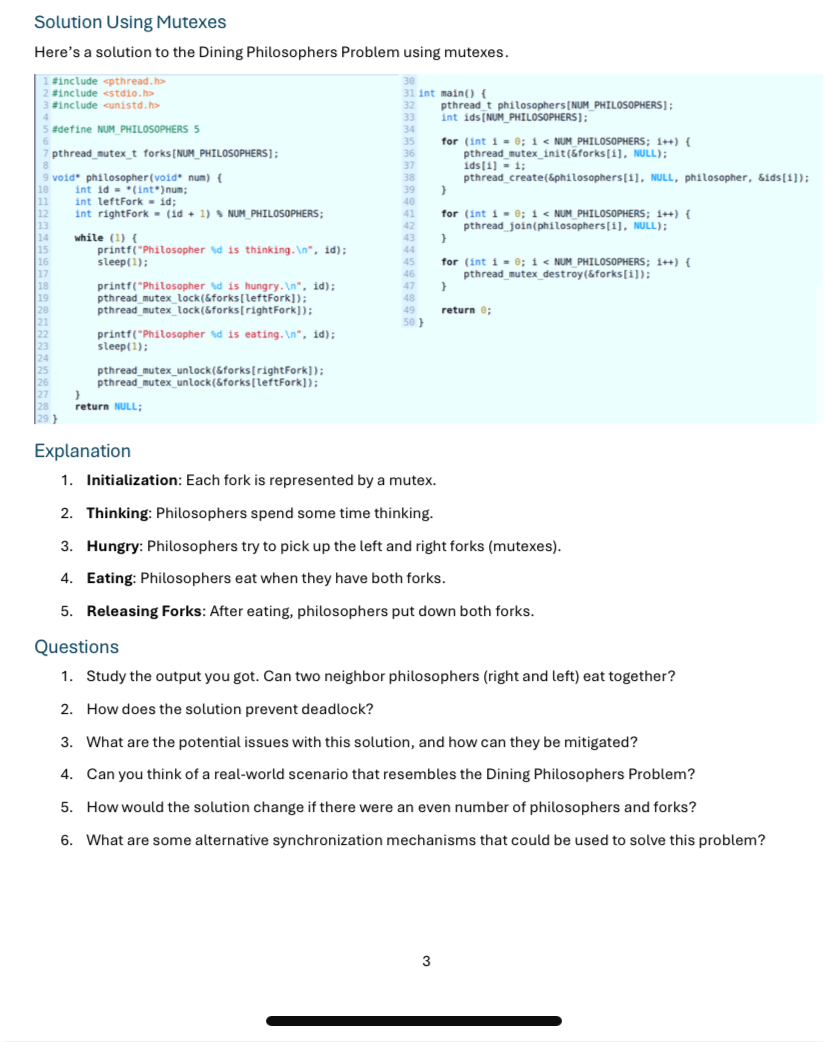
Here's a solution to the Dining Philosophers Problem using mutexes.int main pthreadt philosophersMUM PHILOSOPHERS; int idsMUMPHILOSOPHERS; for int i ; NUM PHILOSOPHERS; pthreadmutexinit&forksi NULL; ids; pthreadcreate&philosophersi MULL, philosopher, &idsi; for int i ; MUMPHILOSOPHERS; i pthread joinphilosophersi NULL; for int i ; i NUM PHILOSOPHERS; i pthreadmutexdestroy&forksi; return ;
Explanation
Initialization: Each fork is represented by a mutex.
Thinking: Philosophers spend some time thinking.
Hungry: Philosophers try to pick up the left and right forks mutexes
Eating: Philosophers eat when they have both forks.
Releasing Forks: After eating, philosophers put down both forks.
Questions
Study the output you got. Can two neighbor philosophers right and left eat together?
How does the solution prevent deadlock?
What are the potential issues with this solution, and how can they be mitigated?
Can you think of a realworld scenario that resembles the Dining Philosophers Problem?
How would the solution change if there were an even number of philosophers and forks?
What are some alternative synchronization mechanisms that could be used to solve this problem?
Step by Step Solution
There are 3 Steps involved in it
1 Expert Approved Answer
Step: 1 Unlock

Question Has Been Solved by an Expert!
Get step-by-step solutions from verified subject matter experts
Step: 2 Unlock
Step: 3 Unlock
 Study Help