







Question: The dispersion relationship for internal gravity waves is: Nk v = == Ncosa. (k2+m2)1/2 (1) In class, I drew the picture for the phase
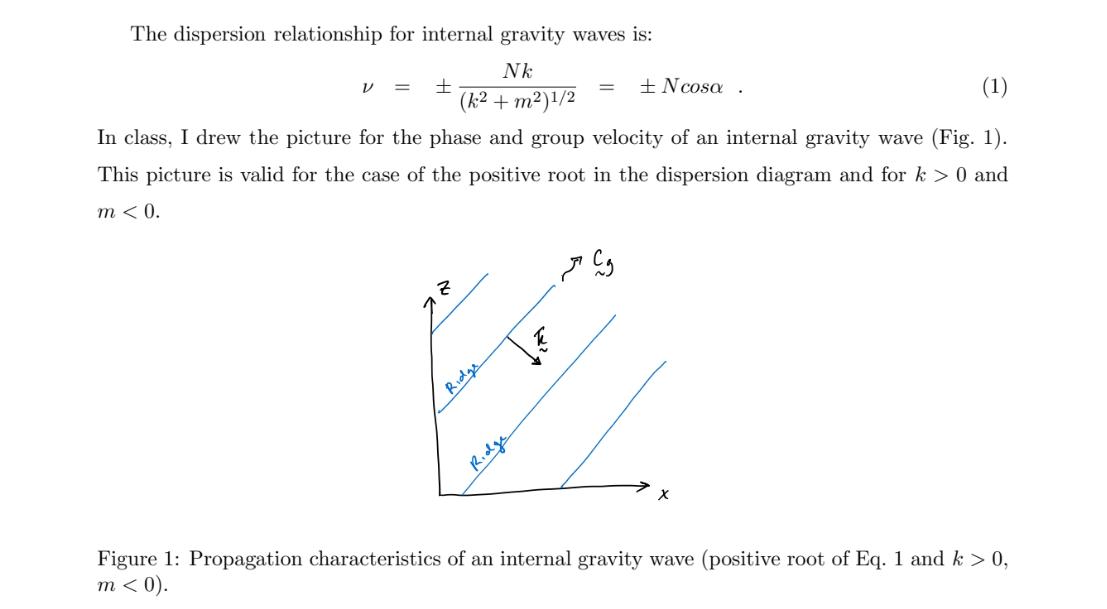
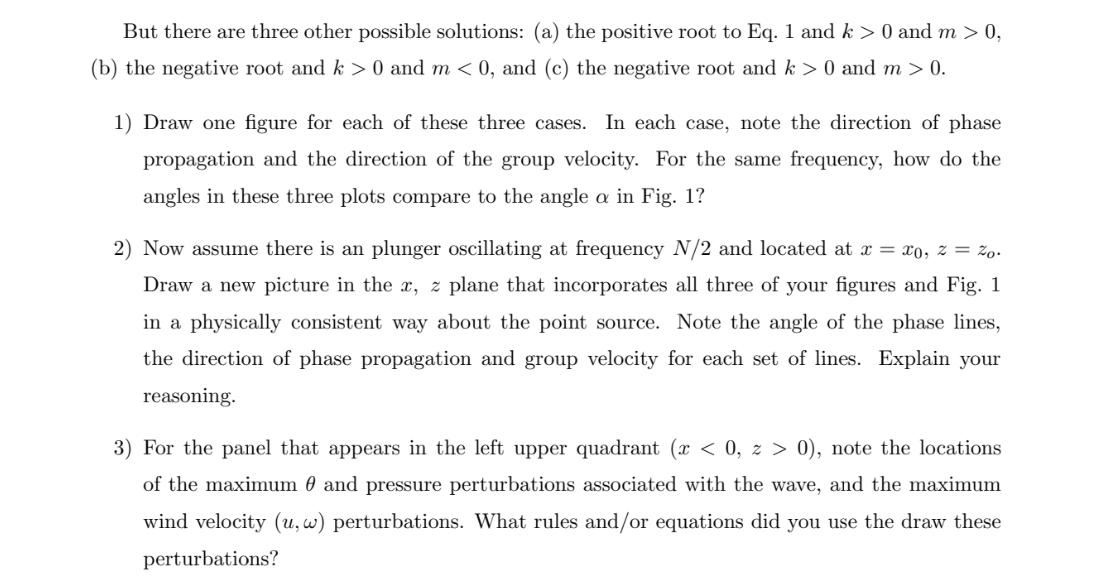
The dispersion relationship for internal gravity waves is: Nk v = == Ncosa. (k2+m2)1/2 (1) In class, I drew the picture for the phase and group velocity of an internal gravity wave (Fig. 1). This picture is valid for the case of the positive root in the dispersion diagram and for k > 0 and m < 0. Ridge Ridge Cg x Figure 1: Propagation characteristics of an internal gravity wave (positive root of Eq. 1 and k> 0, m < 0). But there are three other possible solutions: (a) the positive root to Eq. 1 and k > 0 and m > 0, (b) the negative root and k > 0 and m < 0, and (c) the negative root and k> 0 and m > 0. 1) Draw one figure for each of these three cases. In each case, note the direction of phase propagation and the direction of the group velocity. For the same frequency, how do the angles in these three plots compare to the angle a in Fig. 1? 2) Now assume there is an plunger oscillating at frequency N/2 and located at x = x0, % = %0. Draw a new picture in the x, z plane that incorporates all three of your figures and Fig. 1 in a physically consistent way about the point source. Note the angle of the phase lines, the direction of phase propagation and group velocity for each set of lines. Explain your reasoning. 3) For the panel that appears in the left upper quadrant (x < 0, z > 0), note the locations of the maximum 0 and pressure perturbations associated with the wave, and the maximum wind velocity (u, w) perturbations. What rules and/or equations did you use the draw these perturbations?
Step by Step Solution
There are 3 Steps involved in it

Get step-by-step solutions from verified subject matter experts
 Study Help