







Question: The Duffing Oscillator is a mass - spring system with non - linear restoring force F r e s t o r i n g
The Duffing Oscillator is a massspring system with nonlinear restoring force
Assuming a mass of kilogram, its motion can be described by
a second order ODE derived from Newton's second law of motion. Taking into account
damping, and an oscillatory driving term, the equation of motion is
where is the distance from equilibrium, and and are treated as parameters
of the model.
The ODE is nonlinear and thus difficult to solve analytically. Numerical techniques
however, are well suited to analysing the system.
a Setting rewrite the ODE as a system of first order ODEs of the
form:
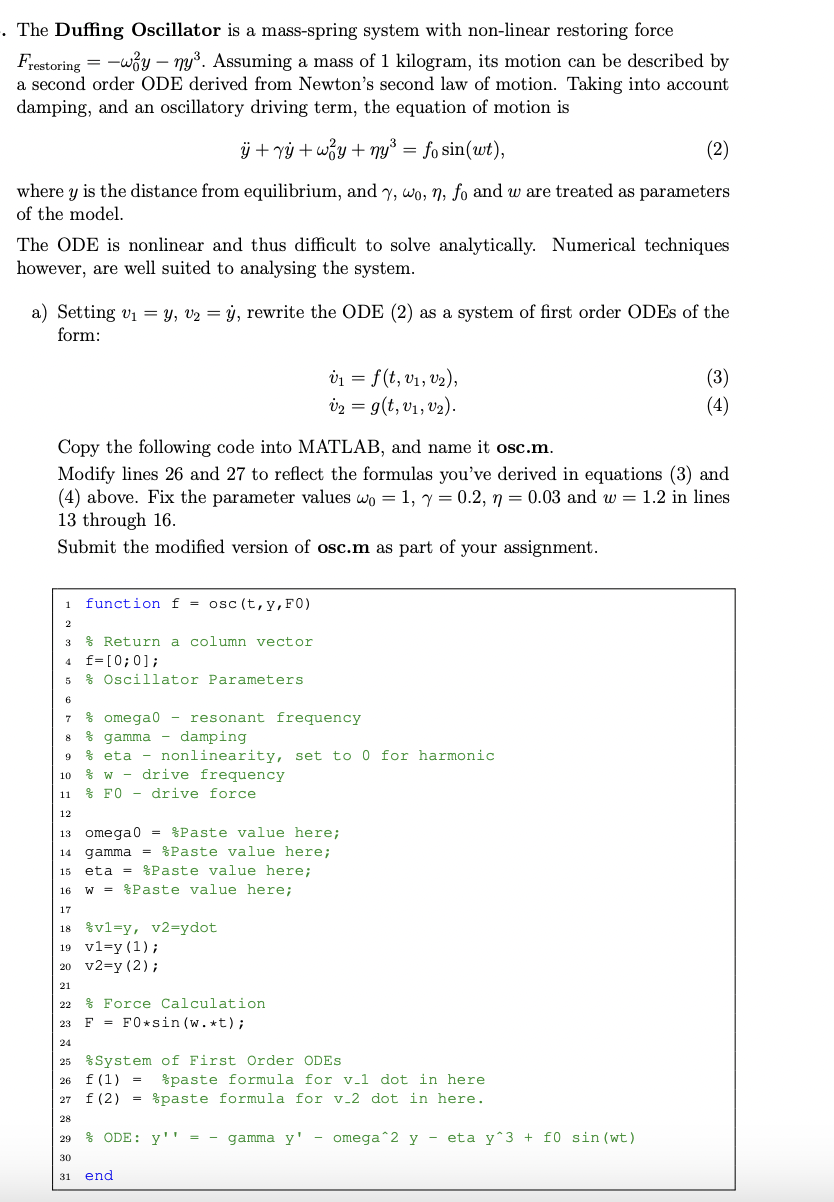
Copy the following code into MATLAB, and name it osc.m
Modify lines and to reflect the formulas you've derived in equations and
above. Fix the parameter values and in lines
through
Submit the modified version of osc.m as part of your assignment.
function osc
Return a column vector
;;
Oscillator Parameters
omega resonant frequency
gamma damping
eta nonlinearity, set to for harmonic
w drive frequency
FO drive force
omega Paste value here;
gamma opaste value here;
eta Paste value here;
oraste value here;
ydot
;
;
Force Calculation
;
system of First Order ODEs
opaste formula for dot in here
opaste formula for dot in here.
end b Lets consider the following two driving amplitudes:
i f
ii f
Create an mfile to produce plots of solution curves to the two driving amplitudes.
Your code should call osc.m found in part a and ode
Set initial conditions to be yy
The domain of t should be
Name the mfile you used plotsoln.m and submit it as part of your assignment.
In both cases, your solution should be oscillatory and should settle down into its
final rhythm after about t or so
What is the approximate amplitude of the solutions final waveform for the two
driving amplitudes well call this the final amplitude
For each value of f submit plots of the solution curves.
c We now investigate the relationship between f and the waveforms final amplitude.
Write another program called drive.m This code should find the waveforms final
amplitude for different values of f between and
Submit a plot which summarises this data. How does the final amplitude respond
to changes in f
Submit the plot, and drive.m as part of your assignment.
Step by Step Solution
There are 3 Steps involved in it
1 Expert Approved Answer
Step: 1 Unlock

Question Has Been Solved by an Expert!
Get step-by-step solutions from verified subject matter experts
Step: 2 Unlock
Step: 3 Unlock
 Study Help