



Question: The dynamics of a single-input single-output control system are described by the following transfer function model: G(s)=(s1)(s+7)(s3) a) Using direct synthesis, synthesize a biproper controller
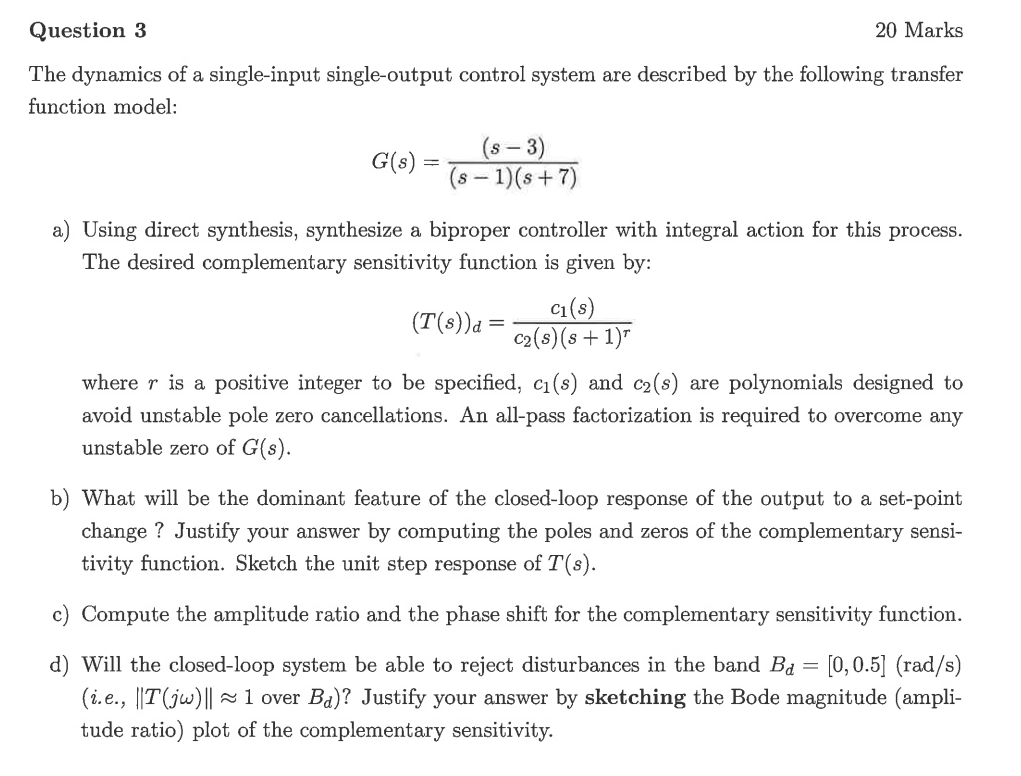
The dynamics of a single-input single-output control system are described by the following transfer function model: G(s)=(s1)(s+7)(s3) a) Using direct synthesis, synthesize a biproper controller with integral action for this process. The desired complementary sensitivity function is given by: (T(s))d=c2(s)(s+1)rc1(s) where r is a positive integer to be specified, c1(s) and c2(s) are polynomials designed to avoid unstable pole zero cancellations. An all-pass factorization is required to overcome any unstable zero of G(s). b) What will be the dominant feature of the closed-loop response of the output to a set-point change ? Justify your answer by computing the poles and zeros of the complementary sensitivity function. Sketch the unit step response of T(s). c) Compute the amplitude ratio and the phase shift for the complementary sensitivity function. d) Will the closed-loop system be able to reject disturbances in the band Bd=[0,0.5](rad/s) (i.e., T(j)1 over Bd )? Justify your answer by sketching the Bode magnitude (amplitude ratio) plot of the complementary sensitivity
Step by Step Solution
There are 3 Steps involved in it

Get step-by-step solutions from verified subject matter experts