


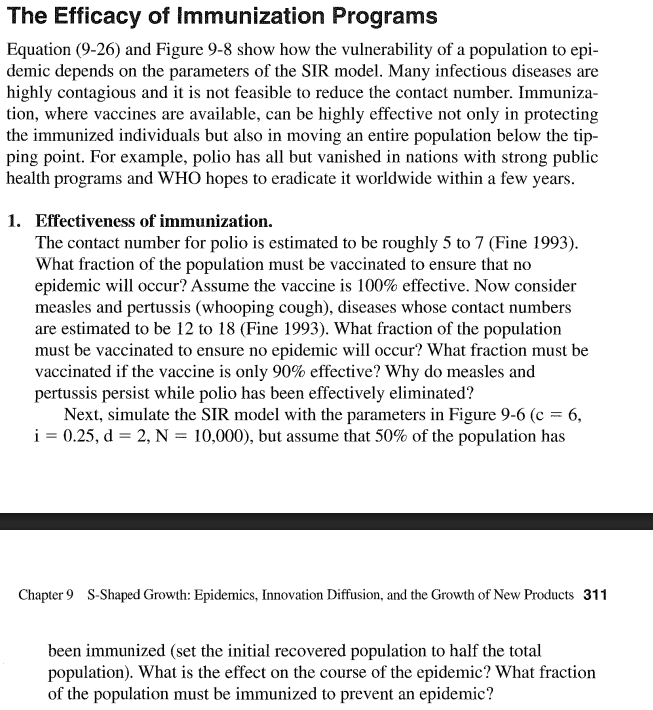
Question: The Efficacy of Immunization Programs Equation (9-26) and Figure 9-8 show how the vulnerability of a population to epi- demic depends on the parameters of

The Efficacy of Immunization Programs EquationThe Efficacy of Immunization Programs EquationThe Efficacy of Immunization Programs Equation
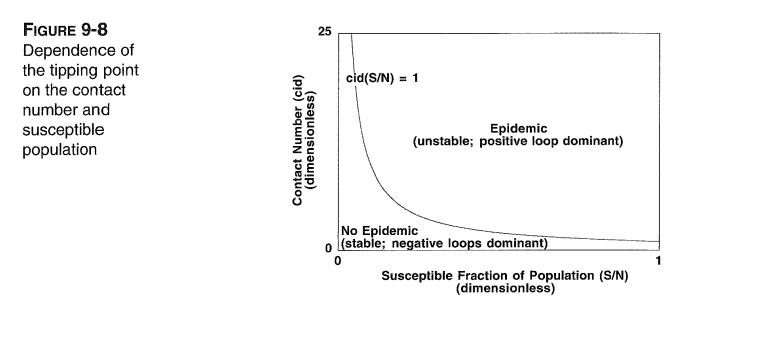
The Efficacy of Immunization Programs Equation (9-26) and Figure 9-8 show how the vulnerability of a population to epi- demic depends on the parameters of the SIR model. Many infectious diseases are highly contagious and it is not feasible to reduce the contact number. Immuniza- tion, where vaccines are available, can be highly effective not only in protecting the immunized individuals but also in moving an entire population below the tip- ping point. For example, polio has all but vanished in nations with strong public health programs and WHO hopes to eradicate it worldwide within a few years. 1. Effectiveness of immunization. The contact number for polio is estimated to be roughly 5 to 7 (Fine 1993), What fraction of the population must be vaccinated to ensure that no epidemic will occur? Assume the vaccine Is 100% effective. Now consider measles and pertussis (whooping cough), diseases whose contact numbers are estimated to be 12 to 18 (Fine 1993), What fraction of the population must be vaccinated to ensure no epidemic will occur? What fraction must be vaccinated if the vaccine is only 90% effective? Why do measles and pertussis persist while polio has been effectively eliminated? Next, simulate the SIR model with the parameters in Figure 9-6 (c = 6, i = 0.25, d = 2, N = 10,000), but assume that 50% of the population has Chapter9 5-Shaped Growth: Epidemics, Innovation Diffusion, and the Growth of New Products 311 been immunized (set the initial recovered population to half the total population). What is the effect on the course of the epidemic'? What fraction of the population must be immunized to prevent an epidemic? cid >1 (9-26)FIGURE 9-8 Dependence of the tipping point on the contact number and susceptible population Contact Number (cid) (dimensionless) | cid(S/N) = 1 | Epidemic \\ (unstable; positive loop dominant) i No Epidemic p [{stable; negative 0 Susceptible Fraction of Population (S/N) (dimensionless) loops dominant)
Step by Step Solution

There are 3 Steps involved in it

1 Expert Approved Answer
Step: 1 Unlock blur-text-image

Question Has Been Solved by an Expert!

Get step-by-step solutions from verified subject matter experts

Step: 2 Unlock
Step: 3 Unlock

Students Have Also Explored These Related Accounting Questions!