







Question: The equation is a circular helix. In my understanding, if a particle moving along the helix, its direction of tangent should be changing. For example,
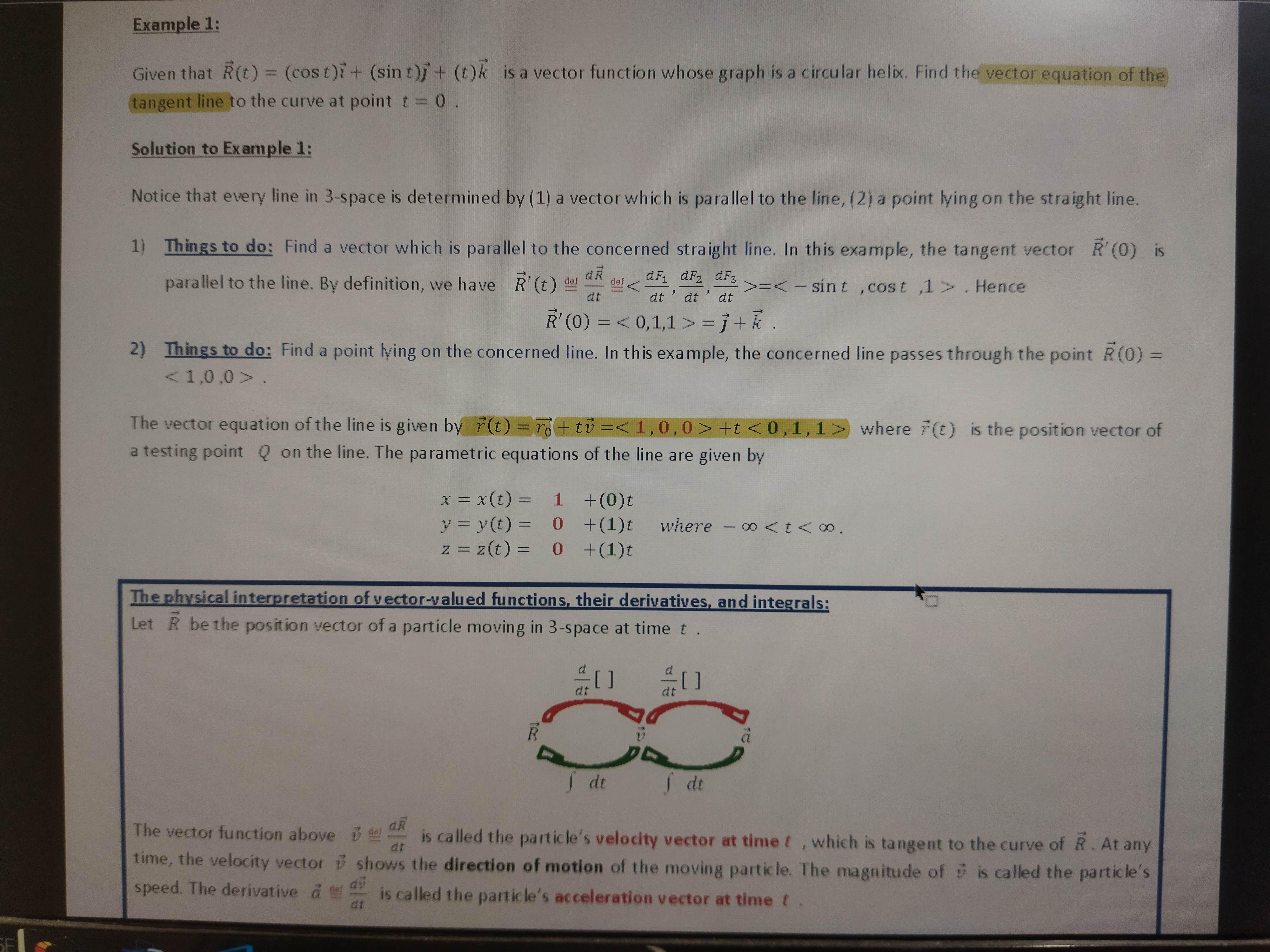
The equation is a circular helix. In my understanding, if a particle moving along the helix, its direction of tangent should be changing.
For example, the tangent vector v should not be <0,1,1> if time is not 0.
So, what is the meaning of r(t)? Why it uses t<0,1,1>?
It said that r(t) is the position vector of a testing point Q one the line, but I don't understand which line it refers to.
Example 1: Given that R(t) = (cost)i+ (sin t)j+ (t)k is a vector function whose graph is a circular helix. Find the vector equation of the %3D tangent line to the curve at point t = 0. Solution to Example 1: Notice that every line in 3-space is determined by (1) a vector which is parallel to the line, (2) a point lying on the straight line. 1) Things to do: Find a vector which is parallel to the concerned straight line. In this example, the tangent vector R'(0) is parallel to the line. By definition, we have R'(t) dF dF, dFz del del >= . Hence dt dt dt dt R' (0) = =j+k. 2) Ihings to do: Find a point lying on the concerned line. In this example, the concerned line passes through the point R(0) = = = . The vector equation of the line is given by 7(t) = r+ tu = +t where 7(t) is the position vector of %3D a testing point Q on the line. The parametric equations of the line are given by x = x(t) 3D y = y(t) = 0 +(1)t where z = z(t) = 0 +(1)t 1 +(0)t %3D -o
Step by Step Solution
3.38 Rating (154 Votes )
There are 3 Steps involved in it
pages 2 of t in will be repeated Again So for other time instants we have to fi... View full answer

Get step-by-step solutions from verified subject matter experts
 Study Help