



Question: The figure below shows a motion diagram for a certain object. (A grid is also shown to facilitate quantitative analysis). 8 7 6 5
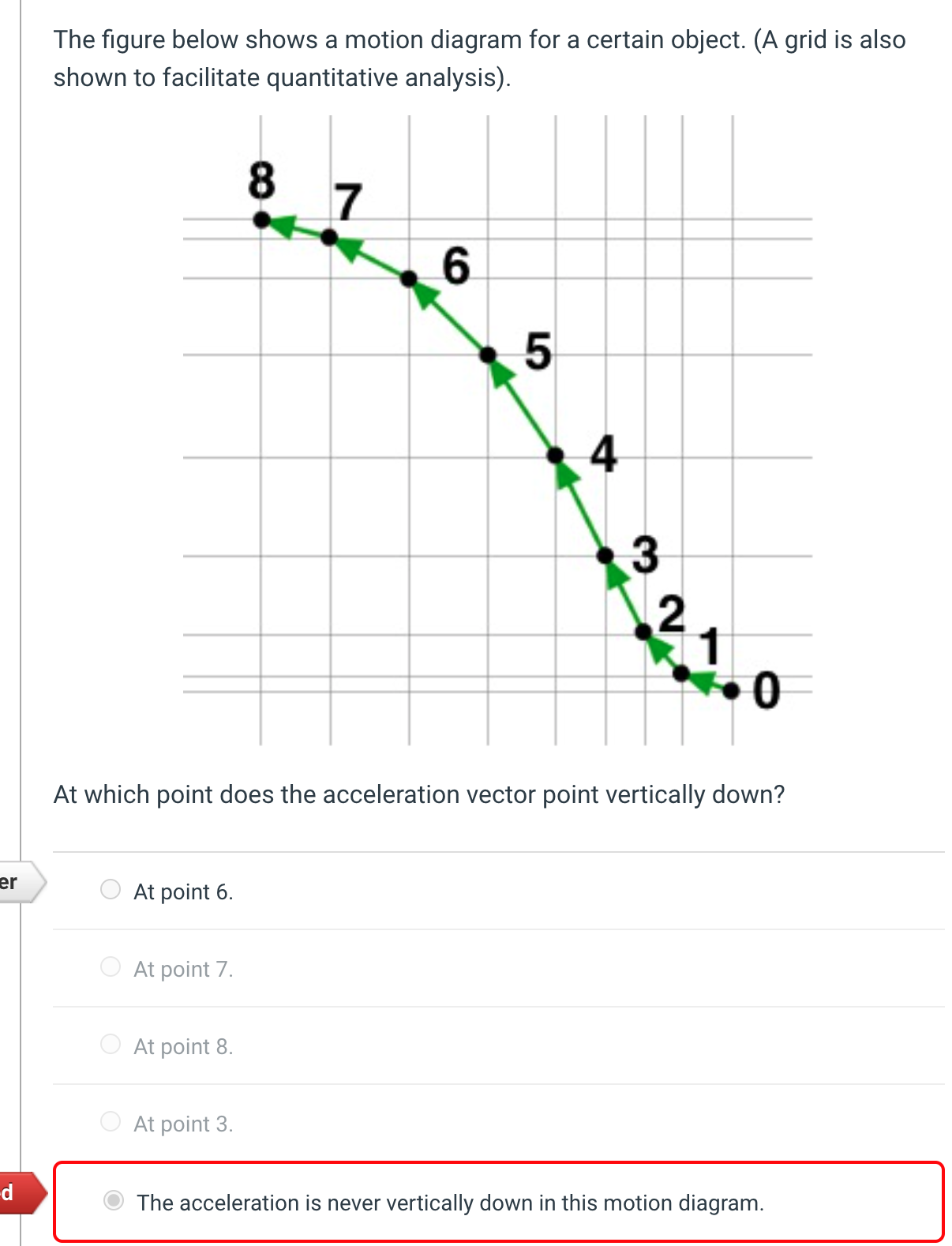
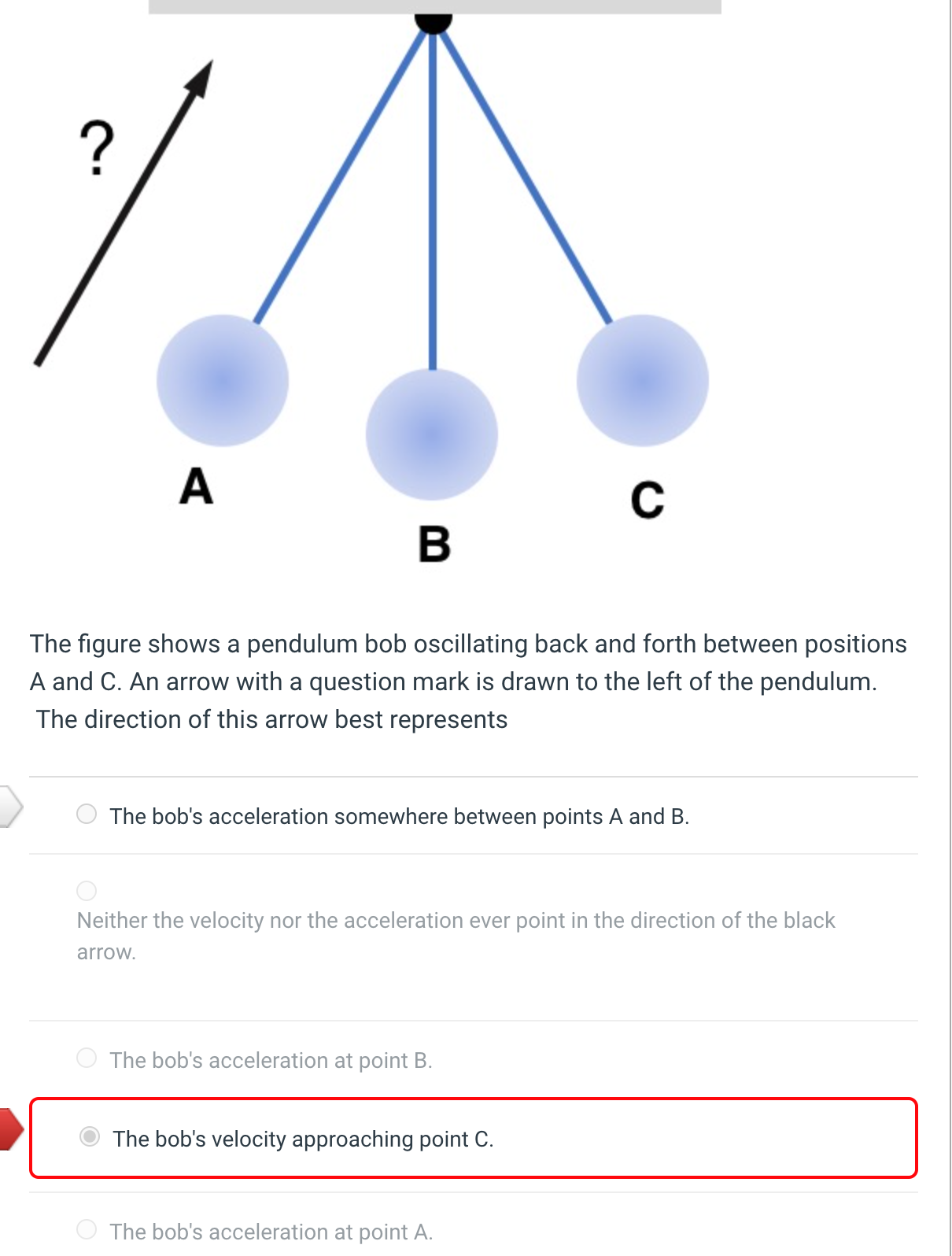
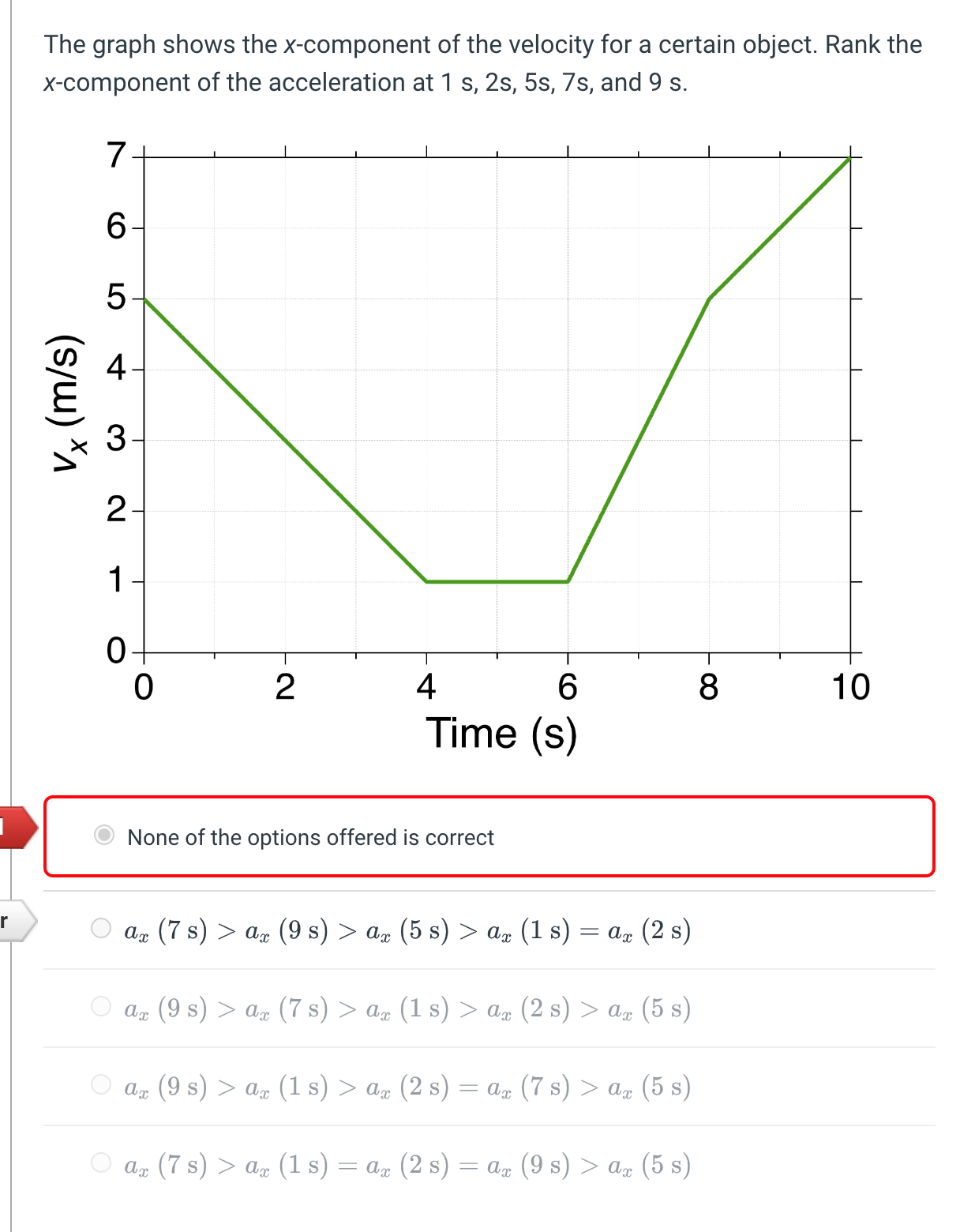
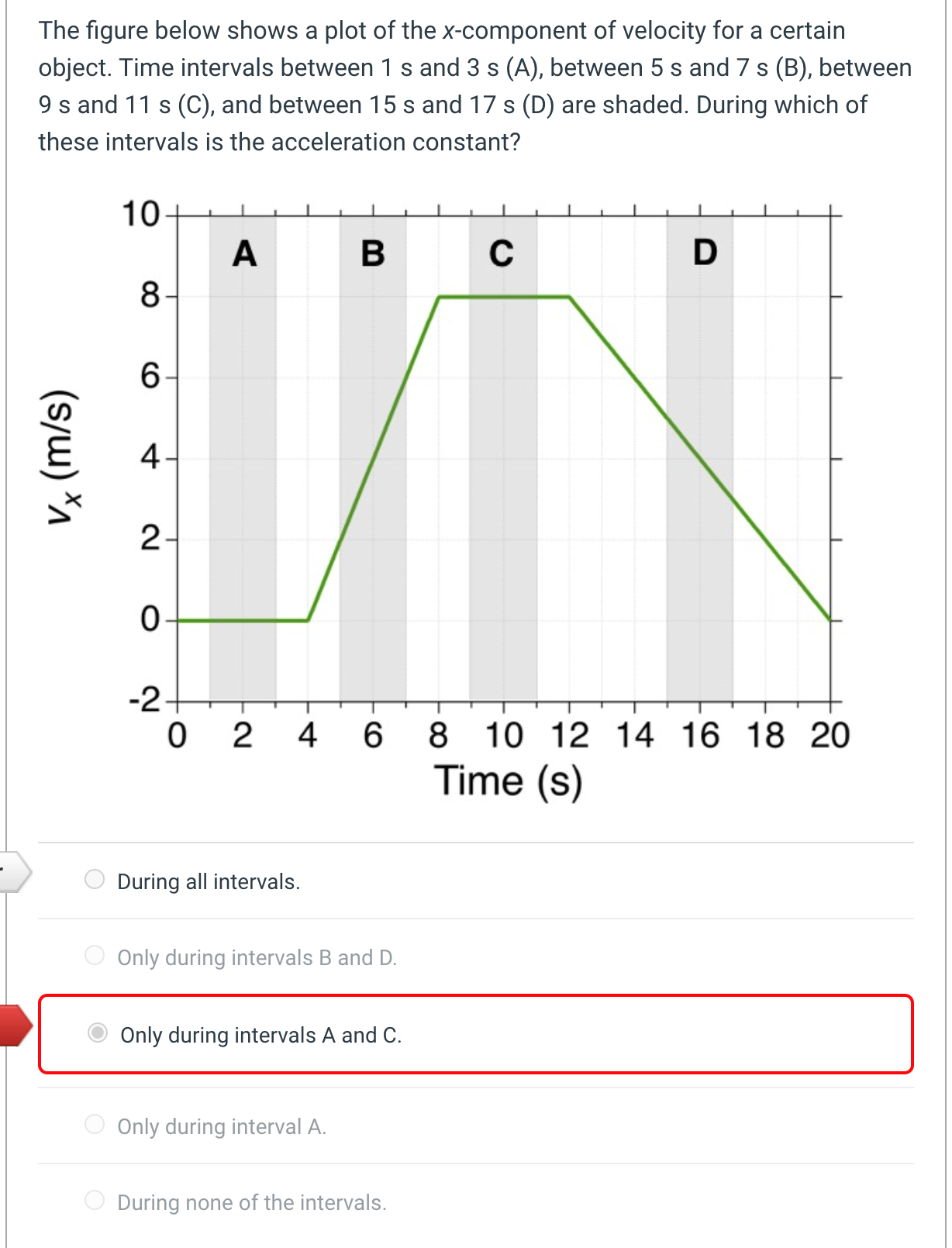
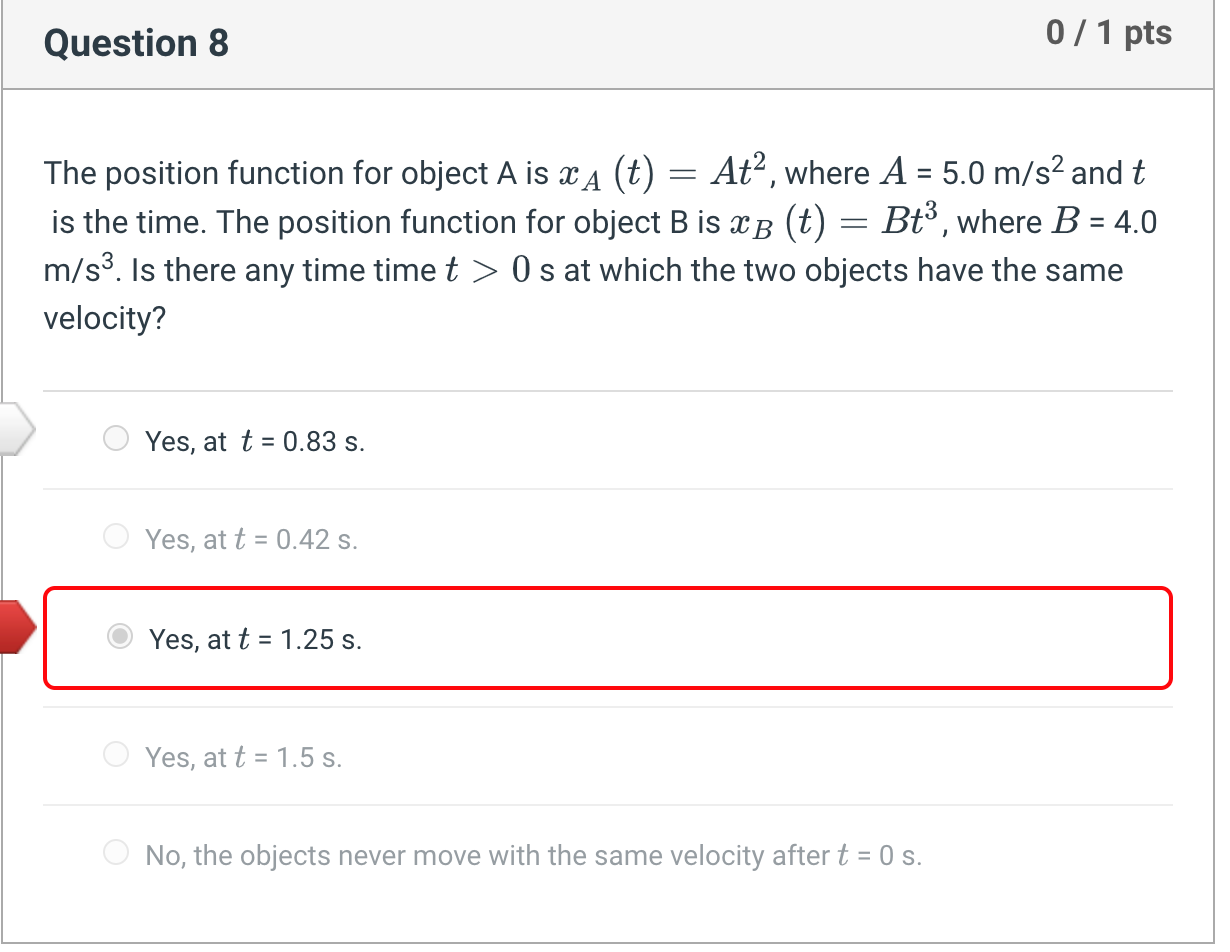
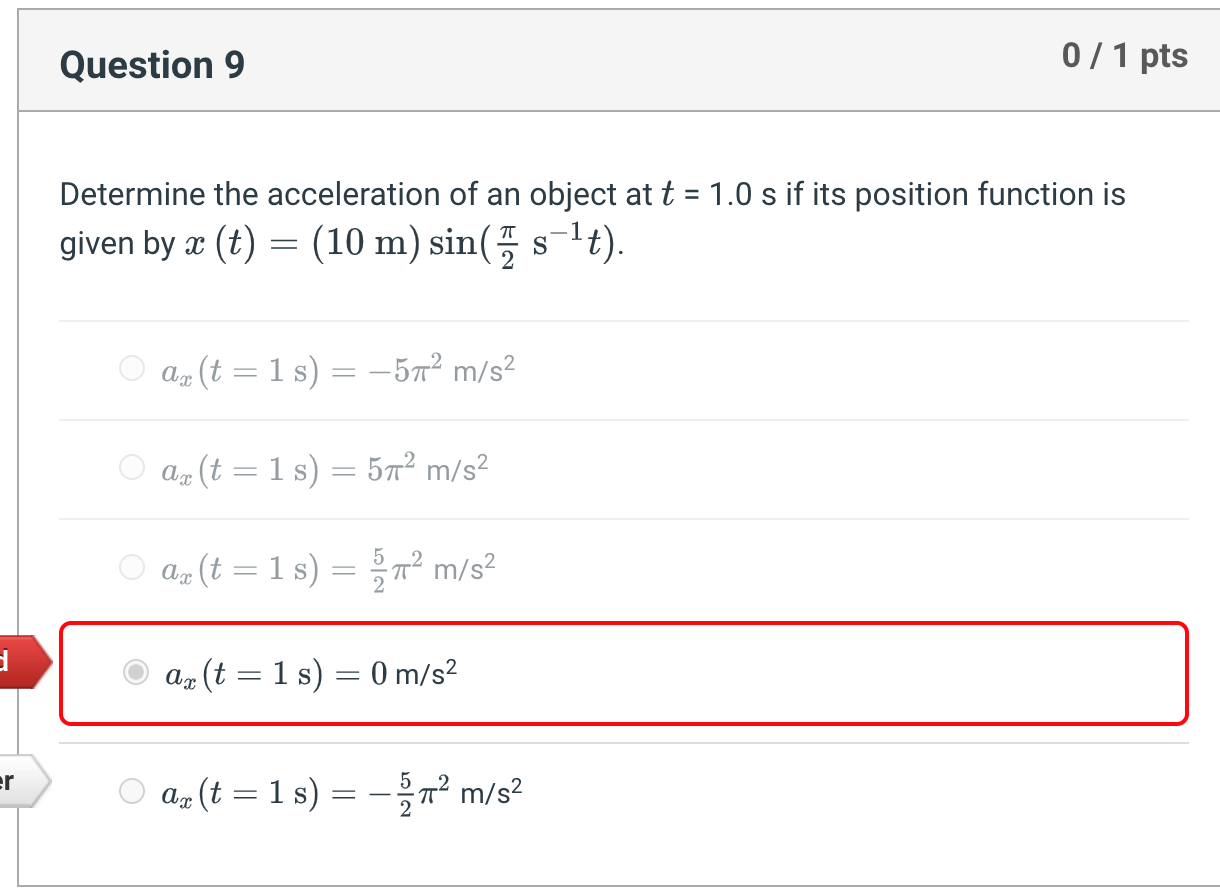
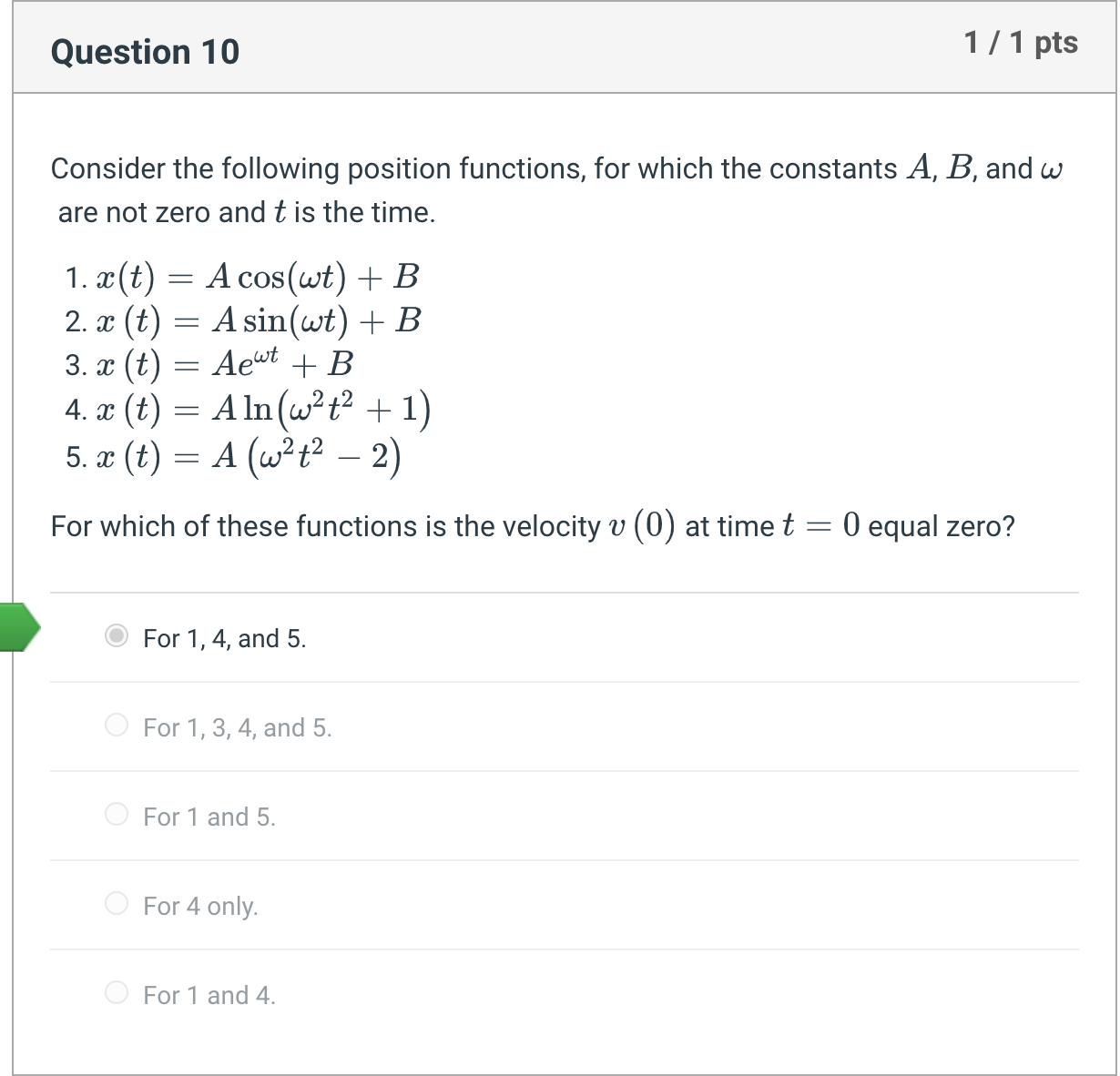
The figure below shows a motion diagram for a certain object. (A grid is also shown to facilitate quantitative analysis). 8 7 6 5 3 2 0 At which point does the acceleration vector point vertically down? er At point 6. d At point 7. At point 8. At point 3. The acceleration is never vertically down in this motion diagram. ? A C B The figure shows a pendulum bob oscillating back and forth between positions A and C. An arrow with a question mark is drawn to the left of the pendulum. The direction of this arrow best represents The bob's acceleration somewhere between points A and B. Neither the velocity nor the acceleration ever point in the direction of the black arrow. The bob's acceleration at point B. The bob's velocity approaching point C. The bob's acceleration at point A. The graph shows the x-component of the velocity for a certain object. Rank the x-component of the acceleration at 1 s, 2s, 5s, 7s, and 9 s. 7 6. 5 Vx (m/s) + 3 2- 1 0 0 2 4 6 8 10 Time (s) None of the options offered is correct r (7s) > ax (9 s) > ax (5 s) > ax (1 s) = ax (2 s) Oax (9s)>ax (7s) > ax (1 s) > ax (2s) > ax (5 s) Oax (9s)>ax (1 s) > ax (2s) = ax (7s) > ax (5 s) Oax (7s)>ax (1 s) = ax (2 s) = ax (9s) > ax (5 s) - Vx (m/s) The figure below shows a plot of the x-component of velocity for a certain object. Time intervals between 1 s and 3 s (A), between 5 s and 7 s (B), between 9s and 11 s (C), and between 15 s and 17 s (D) are shaded. During which of these intervals is the acceleration constant? 10 A B C D 8- 6 4- 2- 0 -2. 02 4 6 During all intervals. Only during intervals B and D. Only during intervals A and C. Only during interval A. During none of the intervals. 8 10 12 14 16 18 20 Time (s) Question 8 0/1 pts The position function for object A is x (t) = At, where A = 5.0 m/s and t is the time. The position function for object B is x (t) = Bt, where B = 4.0 m/s. Is there any time time t > 0 s at which the two objects have the same velocity? Yes, at t=0.83 s. Yes, at t = 0.42 s. Yes, att 1.25 s. = Yes, at t = 1.5 s. No, the objects never move with the same velocity after t = 0 s. Question 9 0/1 pts Determine the acceleration of an object at t = 1.0 s if its position function is given by x (t) (10 m) sin(st). = bx (t = 1 s) -5 m/s ax == c(t = 1 s) = 5 m/s Oax (t = 1 s) = m/s d ax (t = 1 s) = 0 m/s er 5 ax (t = 1s) = m/s Question 10 1/1 pts Consider the following position functions, for which the constants A, B, and w are not zero and t is the time. 1. x(t) = A cos(wt) + B 2. x(t) = Asin(wt) + B 3. x (t) = Aet +B 4. x (t) = Aln (w +2 +1) - 5. x (t) = A (w 2) For which of these functions is the velocity v (0) at time t For 1, 4, and 5. For 1, 3, 4, and 5. For 1 and 5. For 4 only. For 1 and 4. = O equal zero?
Step by Step Solution
There are 3 Steps involved in it

Get step-by-step solutions from verified subject matter experts