







Question: The figure shows a wave pulse on a string. The pulse is traveling to the right at 1 cm/s. This figure is a snapshot at
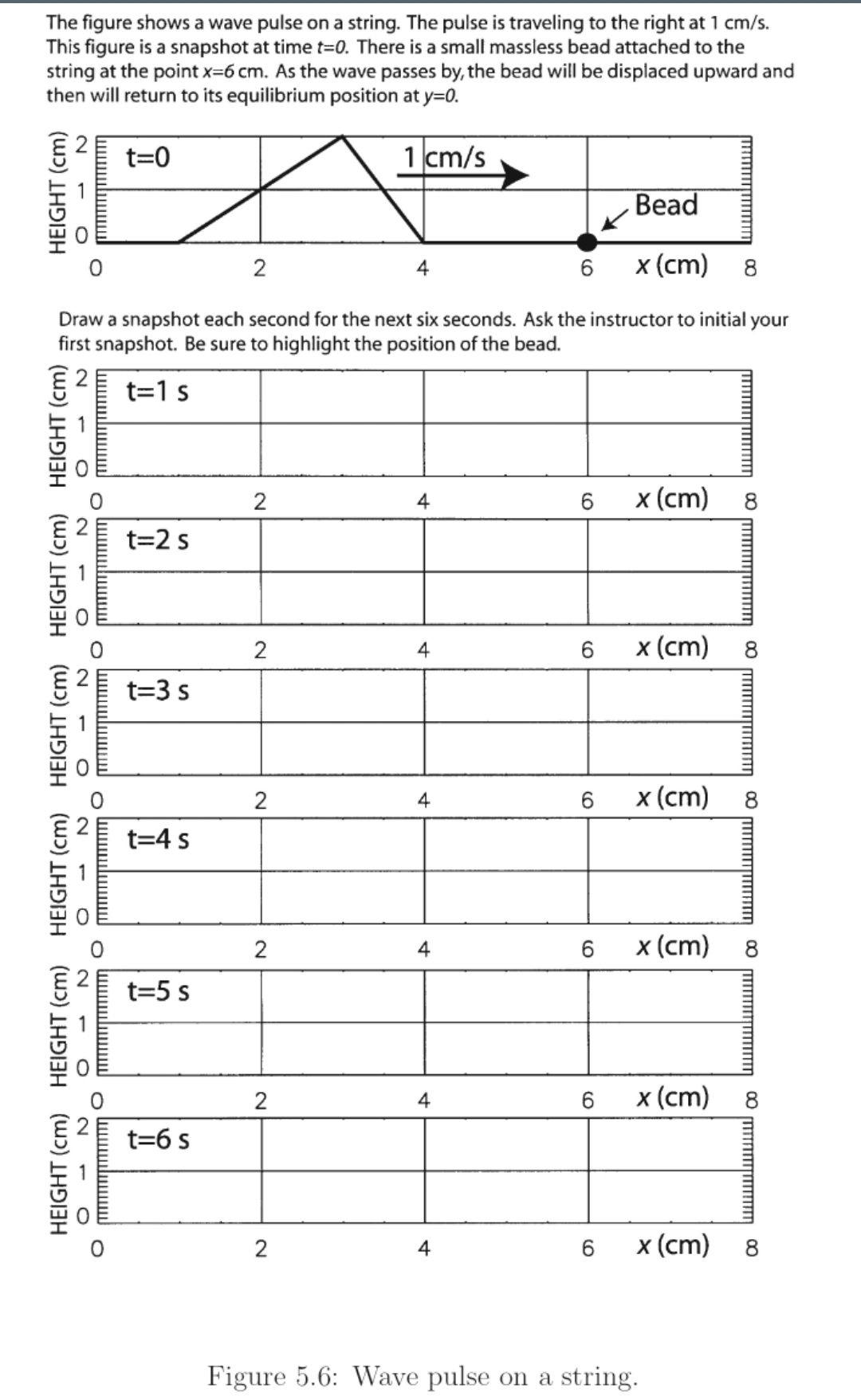
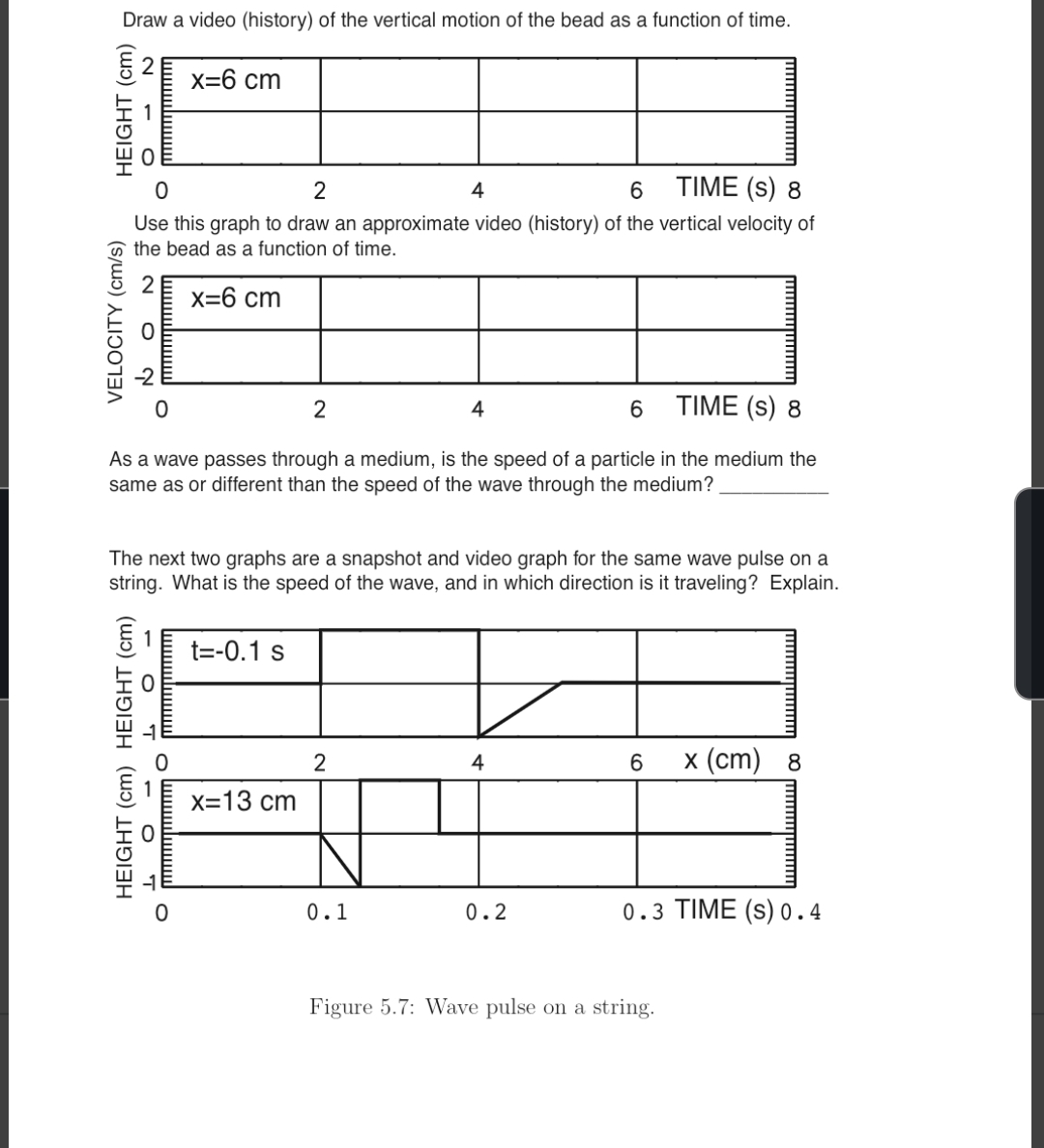
The figure shows a wave pulse on a string. The pulse is traveling to the right at 1 cm/s. This figure is a snapshot at time t=0. There is a small massless bead attached to the string at the point x=6 cm. As the wave passes by, the bead will be displaced upward and then will return to its equilibrium position at y=0. 2 t=0 1 cm/s HEIGHT (cm) Bead 0 O 2 4 6 x (cm) 8 Draw a snapshot each second for the next six seconds. Ask the instructor to initial your first snapshot. Be sure to highlight the position of the bead. 2 t=1 s HEIGHT (cm) O 0 2 4 6 x (cm) N t=2 s - O O 2 4 6 x (cm) N t=3 s - HEIGHT (cm) HEIGHT (cm) HEIGHT (cm) O 2 4 6 x(cm) 00 N t=4 s O 0 2 4 6 x (cm) N t=5 s O HEIGHT (cm) HEIGHT (cm) 0 2 4 6 x (cm) N t=6 s O 0 2 4 6 x (cm) 8 Figure 5.6: Wave pulse on a string.Draw a video (history) of the vertical motion of the bead as a function of time. N X=6 cm HEIGHT (cm) O 2 4 6 TIME (S) 8 Use this graph to draw an approximate video (history) of the vertical velocity of the bead as a function of time. N X=6 cm VELOCITY (cm/s) O -2 0 2 6 TIME (S) 8 As a wave passes through a medium, is the speed of a particle in the medium the same as or different than the speed of the wave through the medium? The next two graphs are a snapshot and video graph for the same wave pulse on a string. What is the speed of the wave, and in which direction is it traveling? Explain. t=-0.1 s 0 HEIGHT (cm) HEIGHT (cm) O 2 6 x (cm) 8 X=13 cm TTTTTTTT TTTTTTTTT O L 0 0.1 0.2 0. 3 TIME (S) 0 . 4 Figure 5.7: Wave pulse on a string
Step by Step Solution
There are 3 Steps involved in it

Get step-by-step solutions from verified subject matter experts
 Study Help