







Question: The first image is from homework 1. The second image is based of the first image. I do not understand these problems. O_'r____d '__'
The first image is from homework 1. The second image is based of the first image. I do not understand these problems.
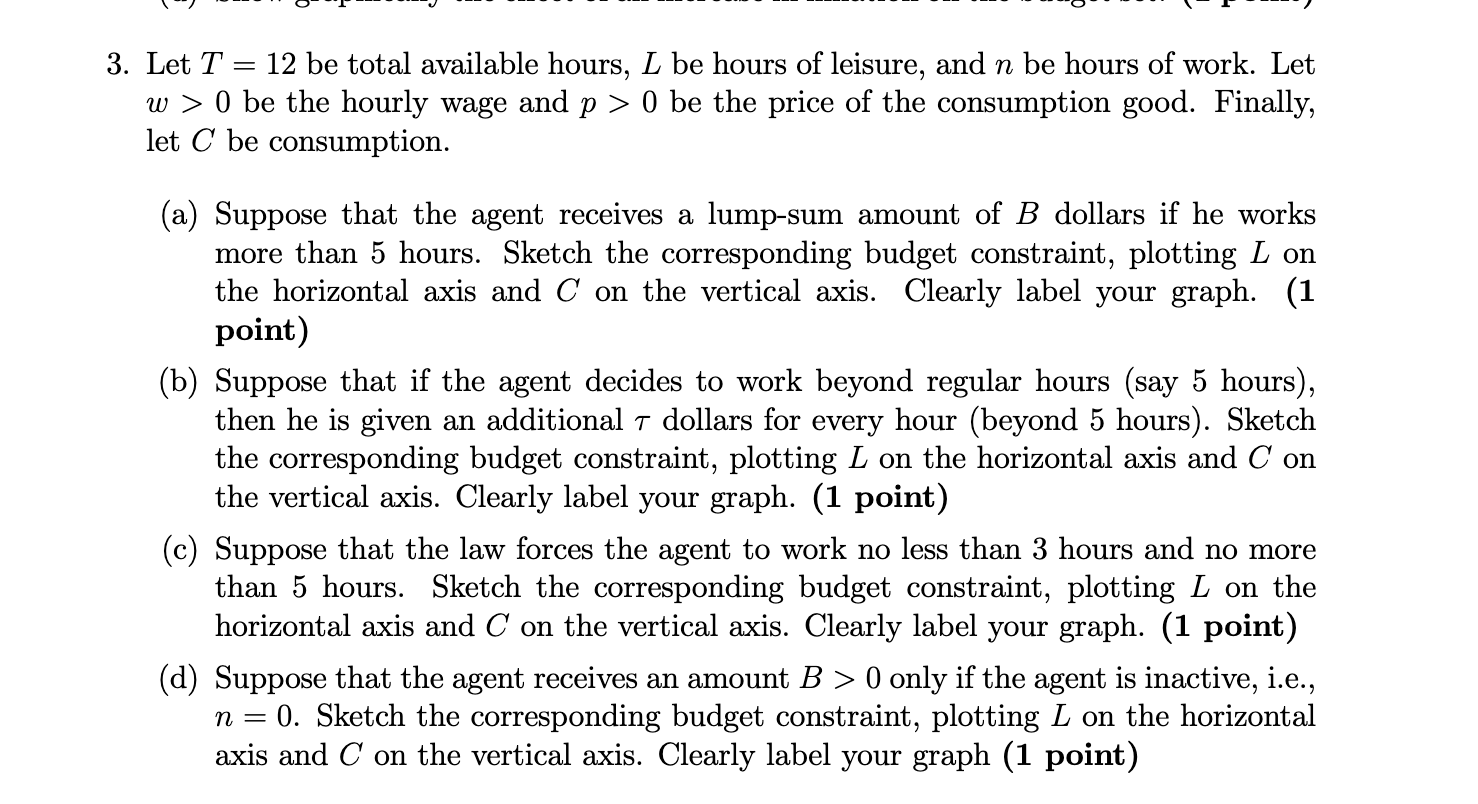
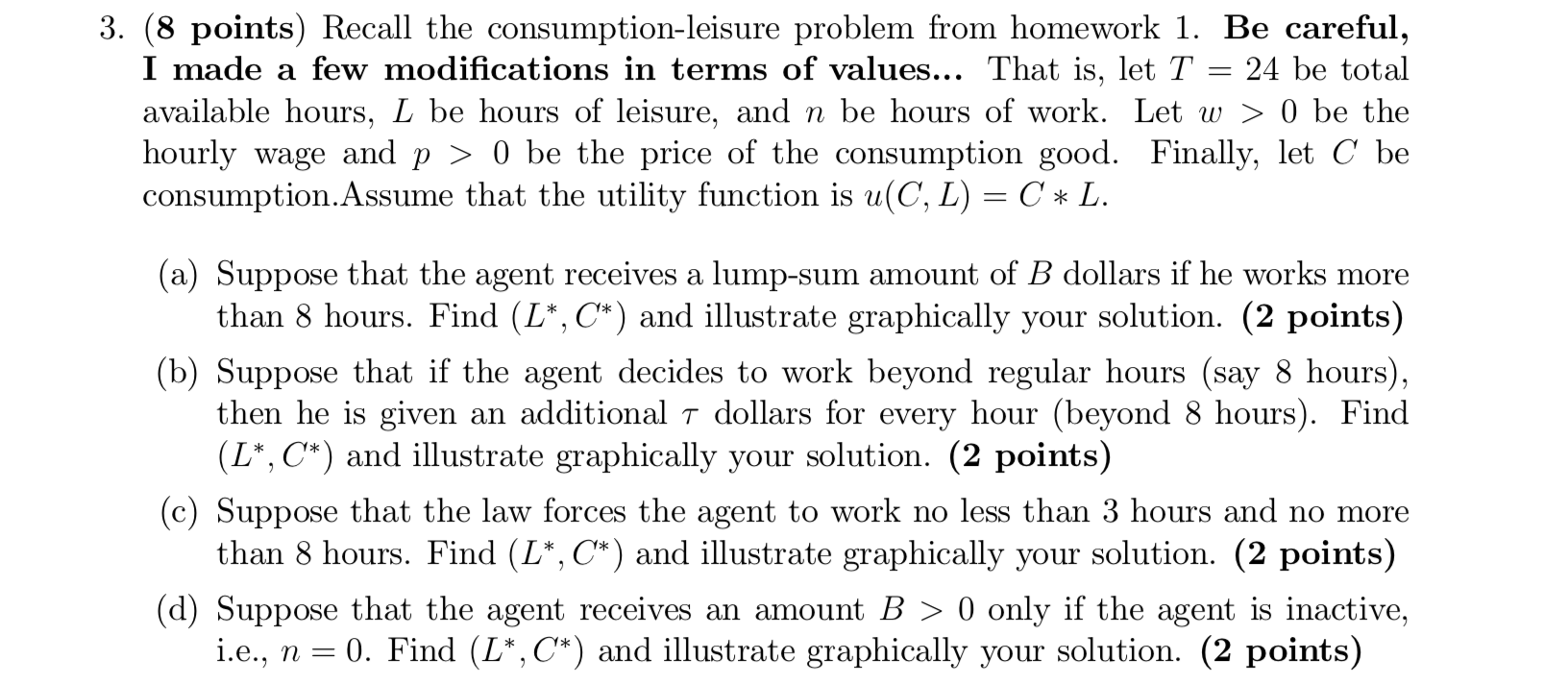
"""" O_'r__"__d '__' '__'' '_ "__ ___'_ "'' ___ ____"'_'__ '_ "" " \"'13" "" \\_ l. ____'I 3. Let T = 12 be total available hours, L be hours of leisure, and n be hours of work. Let w > 0 be the hourly wage and p > 0 be the price of the consumption good. Finally, let C be consumption. (a) (b) (d) Suppose that the agent receives a lump-sum amount of B dollars if he works more than 5 hours. Sketch the corresponding budget constraint, plotting L on the horizontal axis and C on the vertical axis. Clearly label your graph. (1 point) Suppose that if the agent decides to work beyond regular hours (say 5 hours), then he is given an additional T dollars for every hour (beyond 5 hours). Sketch the corresponding budget constraint, plotting L on the horizontal axis and C on the vertical axis. Clearly label your graph. (1 point) Suppose that the law forces the agent to work no less than 3 hours and no more than 5 hours. Sketch the corresponding budget constraint, plotting L on the horizontal axis and C on the vertical axis. Clearly label your graph. (1 point) Suppose that the agent receives an amount B > 0 only if the agent is inactive, i.e., n = 0. Sketch the corresponding budget constraint, plotting L on the horizontal axis and C on the vertical axis. Clearly label your graph (1 point) 3. (8 points) Recall the consumption-leisure problem from homework 1. Be careful, I made a few modications in terms of values... That is, let T = 24 be total available hours, L be hours of leisure, and n be hours of work. Let w > 0 be the hourly wage and p > 0 be the price of the consumption good. Finally, let G be consumption.Assume that the utility function is u(0, L) = C =o 0 only if the agent is inactive, i.e., n = 0. Find (L*, 0*) and illustrate graphically your solution. (2 points)
Step by Step Solution
There are 3 Steps involved in it

Get step-by-step solutions from verified subject matter experts
 Study Help