







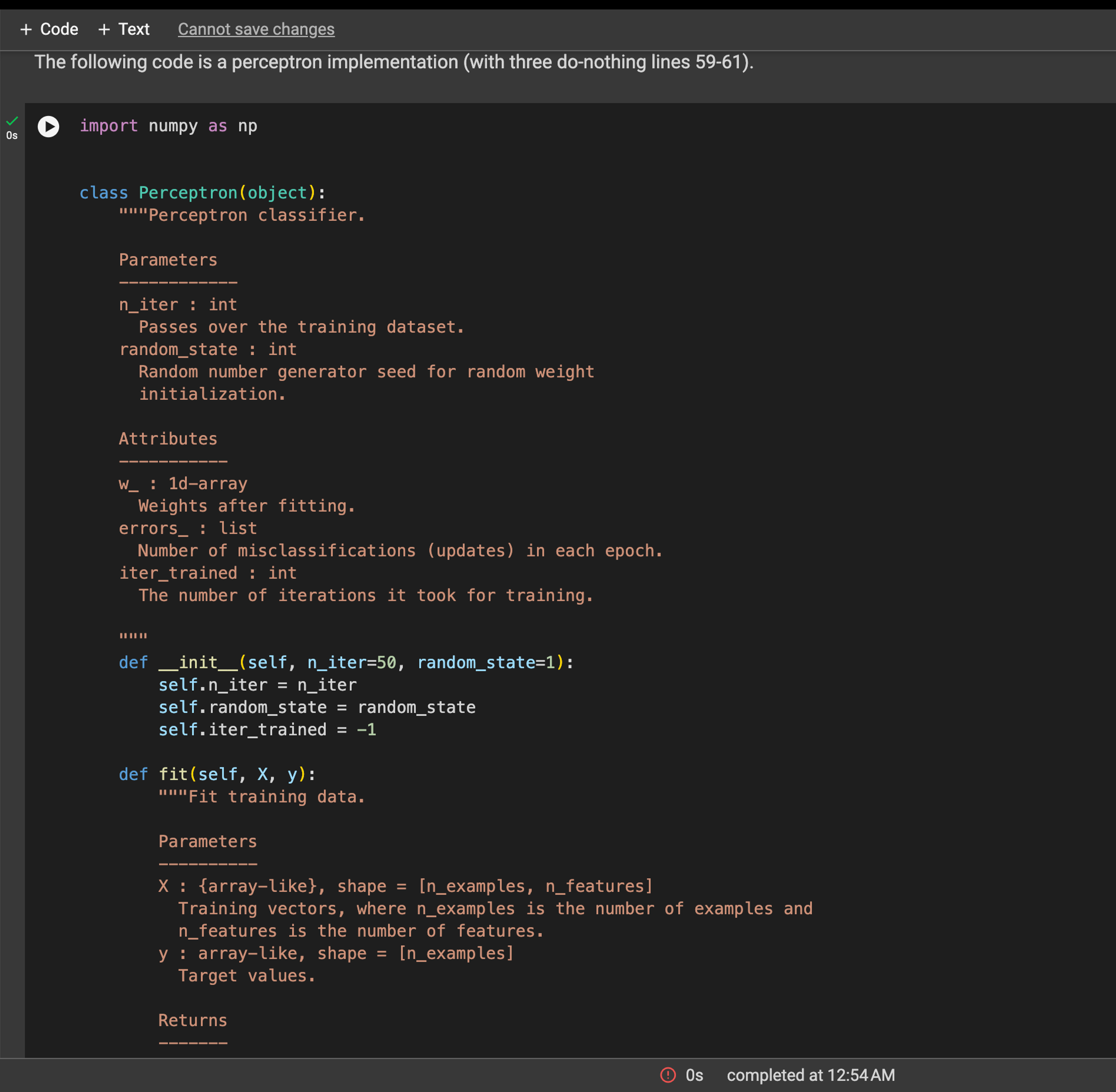
Question: The following code is a perceptron implementation ( with three do - nothing lines 5 9 - 6 1 ) . import numpy as np
The following code is a perceptron implementation with three donothing lines
import numpy as np
class Perceptronobject:
Perceptron classifier.
Parameters
niter : int
Passes over the training dataset.
randomstate : int
Random number generator seed for random weight
initialization.
Attributes
w : darray
Weights after fitting.
errors : list
Number of misclassifications updates in each epoch.
itertrained : int
The number of iterations it took for training.
def self niter randomstate:
self.niter niter
self.randomstate randomstate
self.itertrained
def fitself X y:
Fit training data.
Parameters
X : arraylike shape nexamples, nfeatures
Training vectors, where nexamples is the number of examples and
nfeatures is the number of features.
y : arraylike, shape nexamples
Target values.
Returns Returns
self : object
prime
rgen nprandom.RandomStateselfrandomstate
self.w rgen.normalloc scale size Xshape
self.errors
for in rangeselfniter:
errors
for xi target in zipX y:
update self.predictxi target
self.w: update xi
self.w update
errors intupdate
self.errorsappenderrors
####### New code for doing nothing. MEH
thiscodedoesnothing Truereturn self
def netinputself X:
Calculate net input"""
return npdotX self.w: self.w
def predictself X:
Return class label after unit step"""
return npwhereselfnetinputX
There are significant errors and omissions in the above perceptron implementation. Work on the above cell and modify the code so that:
i The lines containing errors are commented out, and new lines are added with corrected code.
ii The omissions are corrected.
iii The fit function stops when no more iterations are necessary, and stores the number of iterations required for the training.
iv The perceptron maintains a history of its weights, ie the set of weights after each point is processed.
At each place where you have modified the code, please add clear comments surrounding it similarly to the donothing" code. Make sure you
evaluate the cell again, so that following cells will be using the modified perceptron. Question : Experimenting with hyperparameters
ppn Perceptroneta n iter randomstate
ppnfitX y
pltplotrange lenppnerrors ppnerrors markero
pltxticksrange # Set integer xaxis labels
pltxlabelEpochs
pltylabelNumber of updates'
pltshow
Show hidden output
Next steps:
Explain error
Running the above code, you can verify whether your modification in Question works correctly. The point of this question is to experiment with
the hyperparameter the learning rate. Here are some specific questions:
i Find values of for which the process requires and iterations to converge.
ii Is it always the case that raising leads to a reduced or equal number of iterations? Explain with examples.
iii Find two different settings for the random state, that give different convergence patterns for the same value of
iv Based on your experiences in parts iiii would binary search be an appropriate strategy for determining values of for which the
perceptron converges within a desired number of iterations?
Please give your answers in the cell below.
Step by Step Solution
There are 3 Steps involved in it
1 Expert Approved Answer
Step: 1 Unlock

Question Has Been Solved by an Expert!
Get step-by-step solutions from verified subject matter experts
Step: 2 Unlock
Step: 3 Unlock
 Study Help