







Question: The following is a Wireless Networking objective. Your primary focus is on the SEVEN OBJECTIVE ACHEIVEMENT STEPS of the following objective ONLY. DO NOT simply
The following is a Wireless Networking objective. Your primary focus is on the SEVEN OBJECTIVE ACHEIVEMENT STEPS of the following objective ONLY. DO NOT simply say which antenna position should be used or if two 802.11AC wireless routers will be able to communicate with each other in multiple locations. I need a step-by-step soution in great, complete detail, featuring the answers to EACH AND EVERY STEP in the objective. PLEASE do the math and create the tables for EACH AND EVERY step where those necessities are required. PLEASE EXPLAIN EVERY STEP and SHOW YOUR WORK!! I need 100% complete/genuine help and a definitive solution to my problem.
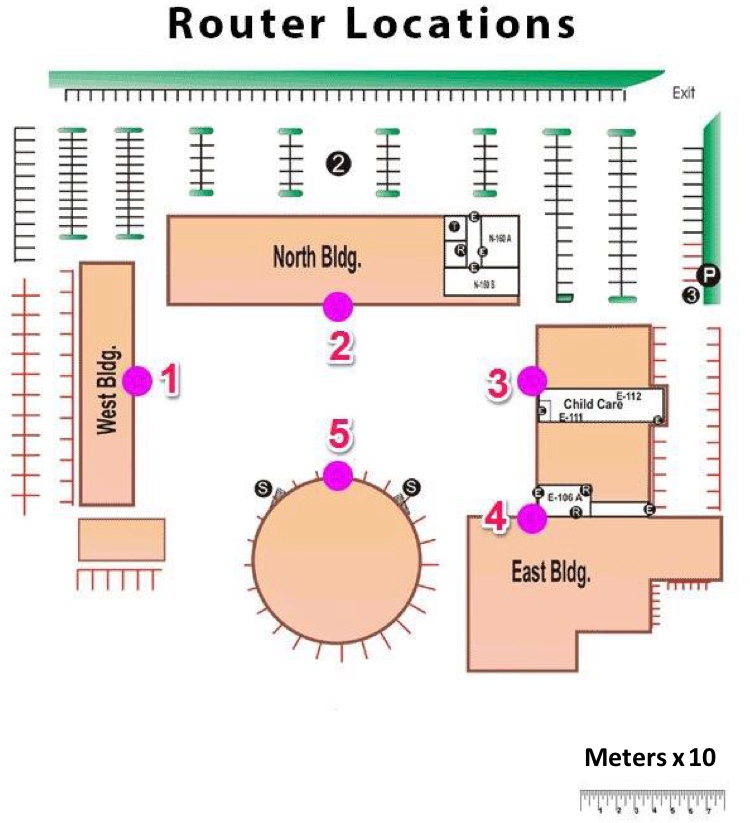
Objective: Using the provided manufacturer specification sheets, determine if two 802.11AC wireless routers will be able to communicate with each other in multiple locations, and if so, which antenna should be used and why. The table below shows the distances between router locations shown in the diagram.
| Position 1 | Position 2 | Position 3 | Position 4 | Position 5 |
| 0 meters | 120 meters | 215 meters | 215 meters | 120 meters |
| 0 meters | 100 meters | 160 meters | 100 meters | |
| 0 meters | 70 meters | 100 meters | ||
| 0 meters | 90 meters |
Objective Achievement Steps:
Step 1: Below is the Cisco specifications manual link for an Aeronet Access Point, that includes the minimum receive level for an 802.11n (-75dBm is more received power than -90 dBm), identify the transmit (again using 802.11n output power (here, the greater the positive number, the greater the transmit power), and a list of compatible antennas. Use an antenna gain of 2 dBi (both transmit and receive), with a dipole radiation pattern, and 802.11n frequency range (both 2.5 GHz and 5 GHz). Ignore any transmission line loss. Assume that your system uses a Modulation and Coding Scheme #5 (MCS5) and transmits with an HT20 (4 antennas) at max power for 2.4 GHZ and HT40 (4 antennas) at max power for 5 GHz.
Provide separate results for the 2.4 GHz frequency and the 5 GHz frequency.
https://www.cisco.com/c/en/us/products/collateral/wireless/aironet-3600-series/data_sheet_c78-686782.html
Step 2: Using the presented building layout, the objective is to determine whether or not the link can be closed between two access points (APs) identified in the specification sheet. The diagram shows the possible locations for the WiFi Aps.
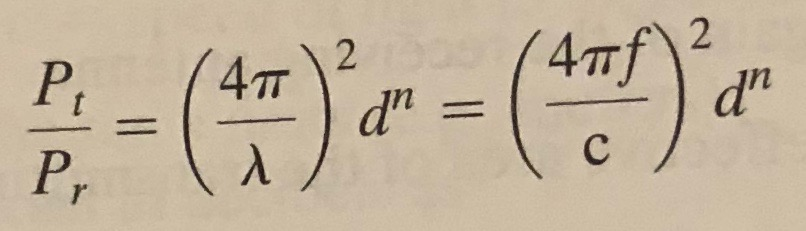
Step 3: Using the presented equation and assuming isotropic antennas in an obstructed factory (n=3), compute the path loss that will occur between the possible router positions. Add another column to the table above and list the path loss between each of the potential locations.
Step 4: Using the stock MIMO antenna (4 antennas) with 2 dBi gain, will all the APs be able to communicate directly? Calculate the receive signal level (RSL) between each of the potential locations. Create another table showing the RSL between each of the stations. Compare the RSL values with the minimum required power levels shown in the data sheet for each of the frequency ranges.
Step 5: Compare the RSL values with the minimum required power levels shown in the data sheet. Create another table indicting whether the two APs will be able to communicate. If the links cannot be closed between two locations, identify which locations cannot communicate directly. Does it make a difference whether you are communicating at 2.4 GHz or 5 GHz? Explain.
Step 6: How much antenna gain is required to close the link between the router positions that currently cannot communicate? Is this a practical antenna?
Step 7/conclusion: Complete a practical discussion on the amount of overhead/headroom that should be left when designing real wireless systems. This should be an analysis that includes critical thinking about real world problems with simple models.
Again, I cannot stress this enough. Your primary focus is on the SEVEN OBJECTIVE ACHEIVEMENT STEPS of the assignment ONLY, and NOT THE OVERALL OBJECTIVE. DO NOT simply say which antenna position should be used or if two 802.11AC wireless routers will be able to communicate with each other in multiple locations. I need a step-by-step soution in great, complete detail, featuring the answers to EACH AND EVERY STEP in the objective. I need 100% complete/genuine help and a definitive solution to my problem.
Router Locations Exit North Bldg. 3 E-112 Child Care E-106 4 East Bldg. Meters x10
Step by Step Solution
There are 3 Steps involved in it

Get step-by-step solutions from verified subject matter experts
 Study Help