







Question: The following is the complete Bounded Buffer program for multiple producers and consumers based on the semaphores. Rewrite the program to solve the bounded-buffer problem
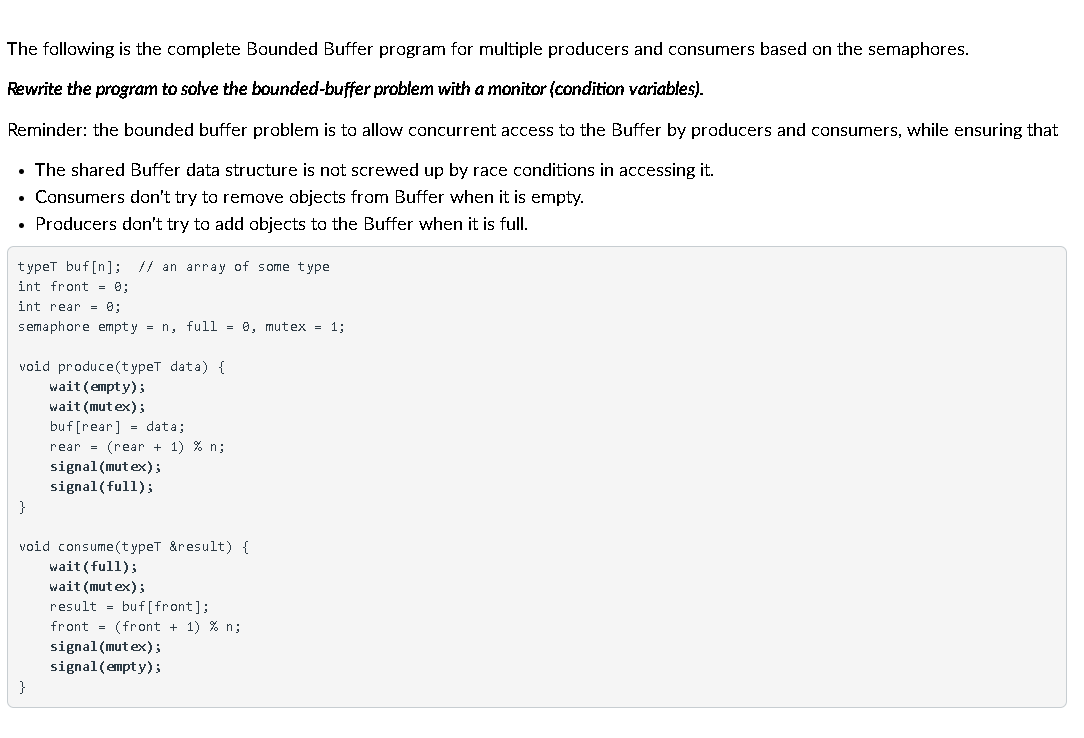
The following is the complete Bounded Buffer program for multiple producers and consumers based on the semaphores. Rewrite the program to solve the bounded-buffer problem with a monitor (condition variables). Reminder: the bounded buffer problem is to allow concurrent access to the Buffer by producers and consumers, while ensuring that . The shared Buffer data structure is not screwed up by race conditions in accessing it. Consumers don't try to remove objects from Buffer when it is empty. Producers don't try to add objects to the Buffer when it is full. typet buf[n]; // an array of some type int front - @; int rear = 0; semaphore empty = n, full = 0, mutex - 1; void produce(typeT data) { wait (empty); wait (mutex); buf[rear] = data; rear = (rear + 1) % n; signal(mut ex); signal(full); } void consume(typet &result) { wait(full); wait (mut ex); result = buf[front]; front = (front + 1) % n; signal(mut ex); signal(empty); }
Step by Step Solution
There are 3 Steps involved in it

Get step-by-step solutions from verified subject matter experts
 Study Help