







Question: The following links are to the code the assignment is referring to. Thanks so much in advanced. https://github.com/cmu15418/assignment1/blob/master/prog1_mandelbrot_threads/main.cpp https://github.com/cmu15418/assignment1/blob/master/prog3_mandelbrot_ispc/mandelbrot.ispc https://github.com/cmu15418/assignment1/blob/master/prog3_mandelbrot_ispc/mandelbrotSerial.cpp Program 1- Part 1. A
The following links are to the code the assignment is referring to. Thanks so much in advanced.
https://github.com/cmu15418/assignment1/blob/master/prog1_mandelbrot_threads/main.cpp
https://github.com/cmu15418/assignment1/blob/master/prog3_mandelbrot_ispc/mandelbrot.ispc
https://github.com/cmu15418/assignment1/blob/master/prog3_mandelbrot_ispc/mandelbrotSerial.cpp
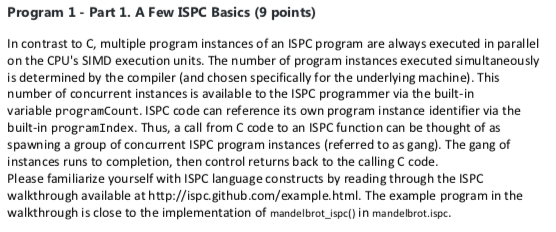
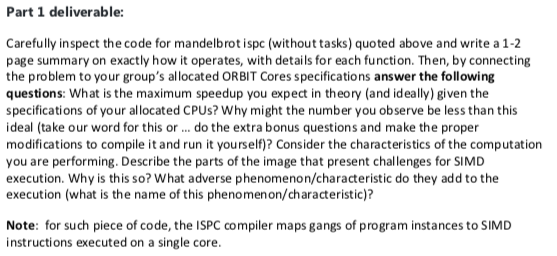
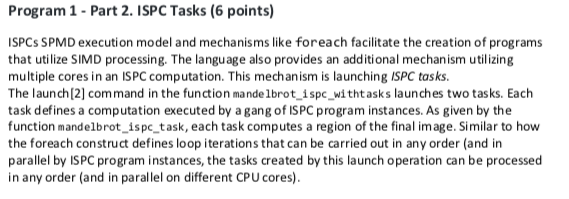
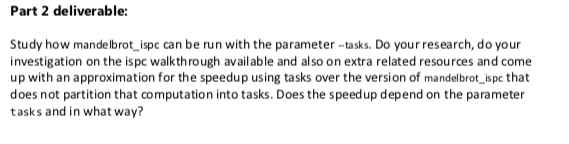

Program 1- Part 1. A Few ISPC Basics (9 points) In contrast to C, multiple program instances of an ISPC program are always executed in parallel on the CPU's SIMD execution units. The number of program instances executed simultaneously is determined by the compiler (and chosen specifically for the underlying machine). This number of concurrent instances is available to the ISPC programmer via the built-in variable programCount. ISPC code can reference its own program instance identifier via the built-in programIndex. Thus, a call from C code to an ISPC function can be thought of as spawning a group of concurrent ISPC program instances (referred to as gang). The gang of instances runs to completion, then control returns back to the calling C code Please familiarize yourself with ISPC language constructs by reading through the ISPC walkthrough available at http://ispc.github.com/example.html. The example program in the walkthrough is close to the implementation of mandelbrot ispc() in mandelbrot.ispc. Program 1- Part 1. A Few ISPC Basics (9 points) In contrast to C, multiple program instances of an ISPC program are always executed in parallel on the CPU's SIMD execution units. The number of program instances executed simultaneously is determined by the compiler (and chosen specifically for the underlying machine). This number of concurrent instances is available to the ISPC programmer via the built-in variable programCount. ISPC code can reference its own program instance identifier via the built-in programIndex. Thus, a call from C code to an ISPC function can be thought of as spawning a group of concurrent ISPC program instances (referred to as gang). The gang of instances runs to completion, then control returns back to the calling C code Please familiarize yourself with ISPC language constructs by reading through the ISPC walkthrough available at http://ispc.github.com/example.html. The example program in the walkthrough is close to the implementation of mandelbrot ispc() in mandelbrot.ispc
Step by Step Solution
There are 3 Steps involved in it

Get step-by-step solutions from verified subject matter experts
 Study Help