







Question: The following problem should be implemented in MATLAB or Python and submitted to the Canvas website of the class for evaluation. Write a summary of
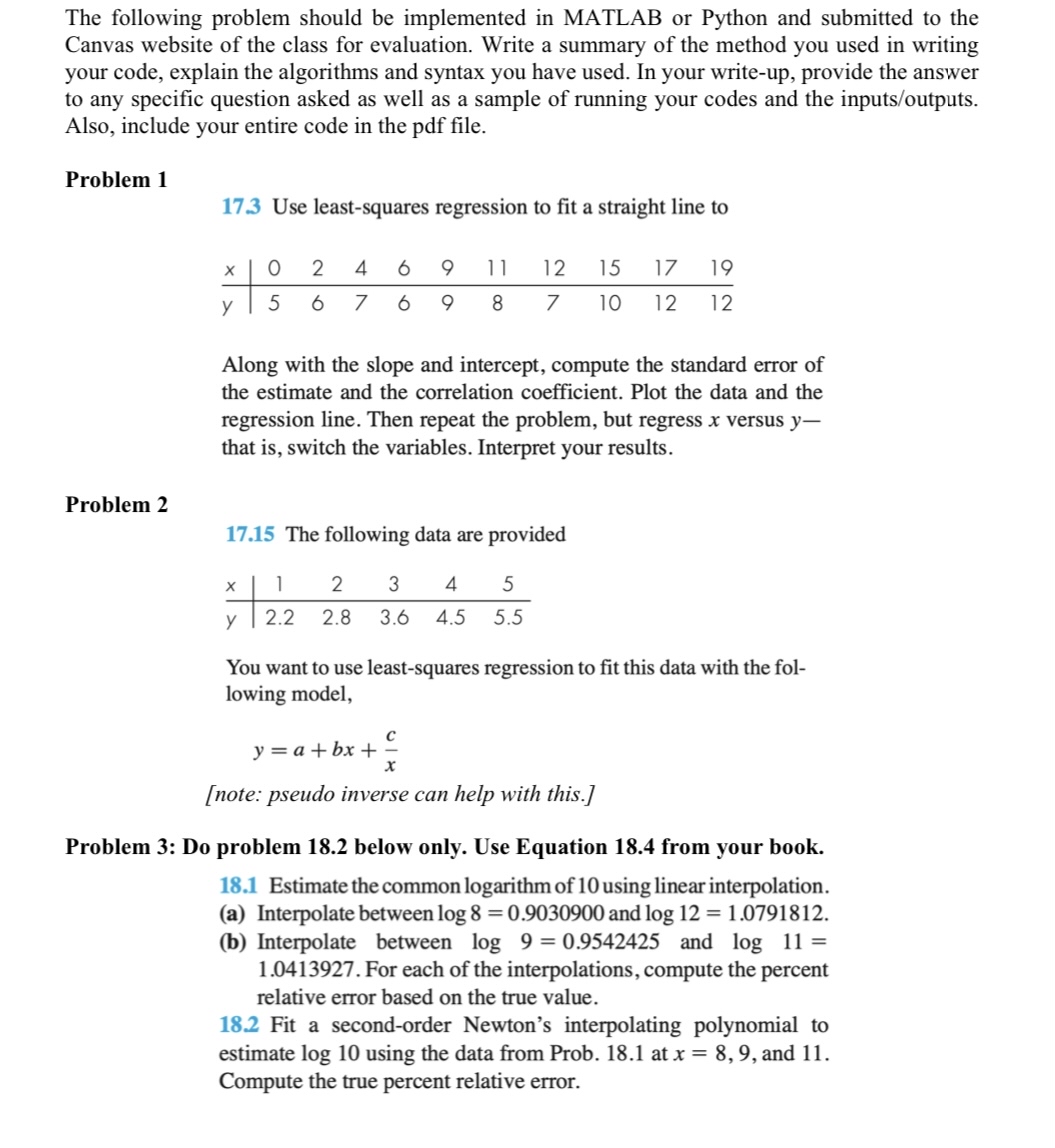
The following problem should be implemented in MATLAB or Python and submitted to the Canvas website of the class for evaluation. Write a summary of the method you used in writing your code, explain the algorithms and syntax you have used. In your writeup provide the answer to any specific question asked as well as a sample of running your codes and the inputsoutputs Also, include your entire code in the pdf file.
Problem
Use leastsquares regression to fit a straight line to
table
Along with the slope and intercept, compute the standard error of the estimate and the correlation coefficient. Plot the data and the regression line. Then repeat the problem, but regress versus that is switch the variables. Interpret your results.
Problem
The following data are provided
table
You want to use leastsquares regression to fit this data with the following model,
note: pseudo inverse can help with this.
Problem : Do problem below only. Use Equation from your book.
Estimate the common logarithm of using linear interpolation.
a Interpolate between and
b Interpolate between and For each of the interpolations, compute the percent relative error based on the true value.
Fit a secondorder Newton's interpolating polynomial to estimate using the data from Prob. at and Compute the true percent relative error.
Can you please create a Matlab code for these problem plz
Step by Step Solution
There are 3 Steps involved in it
1 Expert Approved Answer
Step: 1 Unlock

Question Has Been Solved by an Expert!
Get step-by-step solutions from verified subject matter experts
Step: 2 Unlock
Step: 3 Unlock
 Study Help