







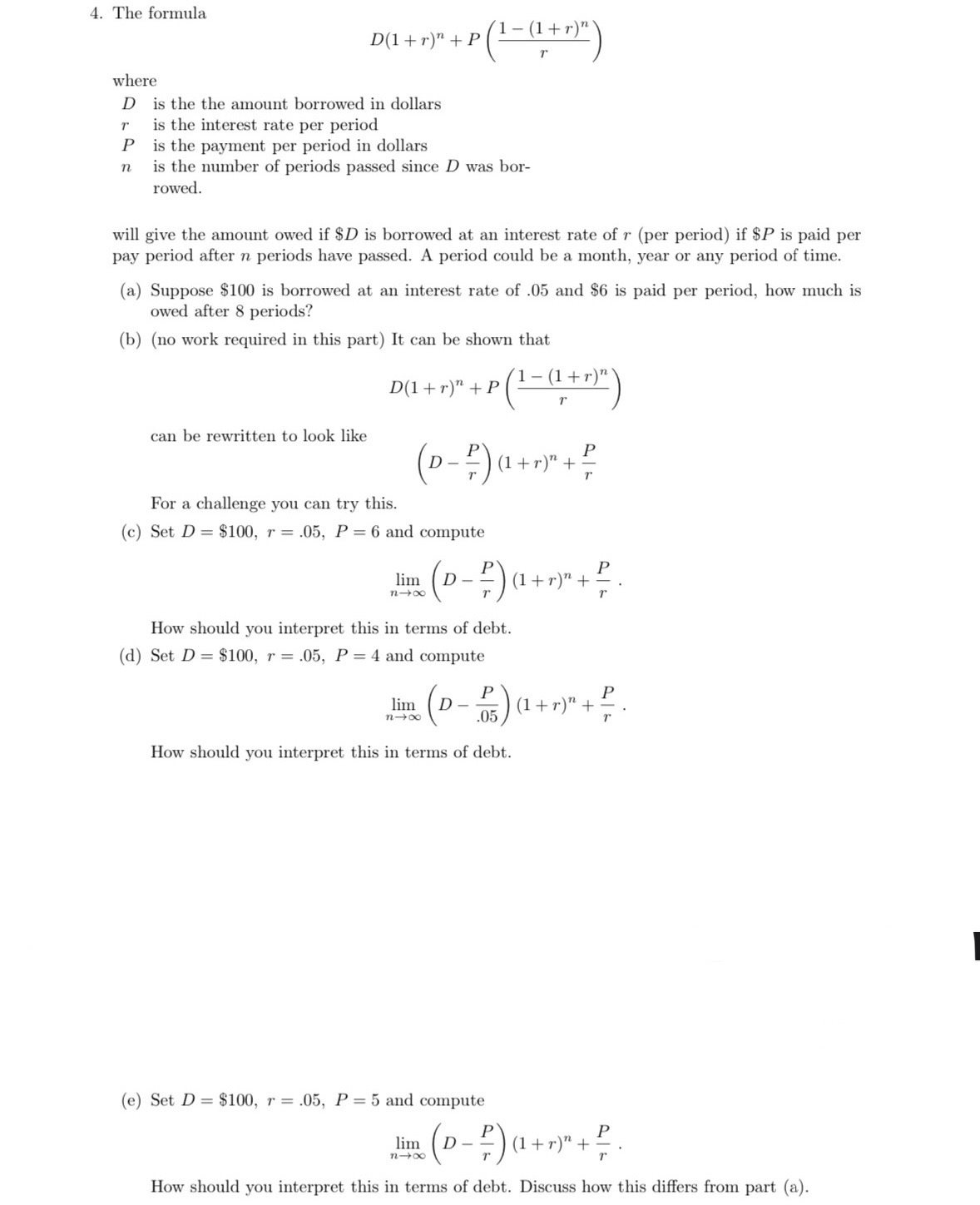
Question: The formula D ( 1 r ) n P ( 1 - ( 1 r ) n r ) where D is the the amount
The formula
where
is the the amount borrowed in dollars
is the interest rate per period
is the payment per period in dollars
is the number of periods passed since was borrowed.
will give the amount owed if $ is borrowed at an interest rate of per period if $ is paid per pay period after periods have passed. A period could be a month, year or any period of time.
a Suppose $ is borrowed at an interest rate of and $ is paid per period, how much is owed after periods?
bno work required in this part It can be shown that
can be rewritten to look like
For a challenge you can try this.
c Set $ and compute
How should you interpret this in terms of debt.
d Set $ and compute
How should you interpret this in terms of debt.
e Set $ and compute
How should you interpret this in terms of debt. Discuss how this differs from part a
Step by Step Solution
There are 3 Steps involved in it
1 Expert Approved Answer
Step: 1 Unlock

Question Has Been Solved by an Expert!
Get step-by-step solutions from verified subject matter experts
Step: 2 Unlock
Step: 3 Unlock
 Study Help