







Question: The formula for calculating standard cell potential is: Et = E . Note: For this equation, E values are for the reduction half reactions,
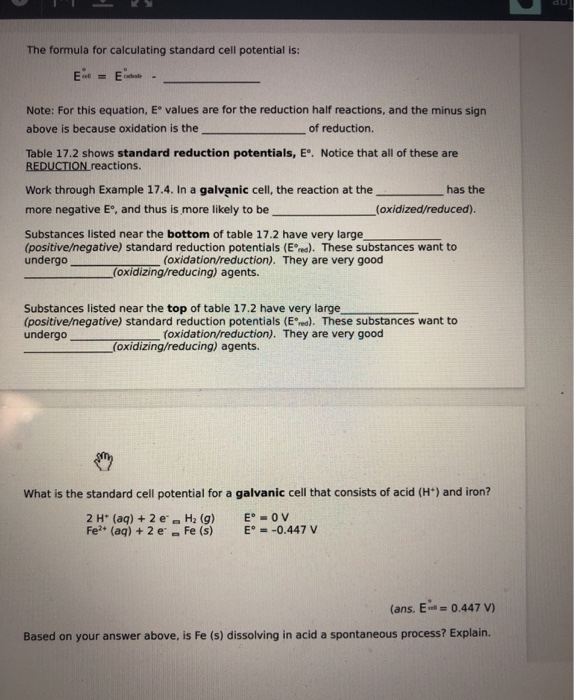
The formula for calculating standard cell potential is: Et = E . Note: For this equation, E values are for the reduction half reactions, and the minus sign above is because oxidation is the of reduction. Table 17.2 shows standard reduction potentials, E. Notice that all of these are REDUCTION reactions. Work through Example 17.4. In a galvanic cell, the reaction at the more negative E, and thus is more likely to be has the (oxidized/reduced). Substances listed near the bottom of table 17.2 have very large, (positive/negative) standard reduction potentials (Ered). These substances want to undergo (oxidation/reduction). They are very good (oxidizing/reducing) agents. Substances listed near the top of table 17.2 have very large (positive/negative) standard reduction potentials (Ered). These substances want to undergo (oxidation/reduction). They are very good (oxidizing/reducing) agents. a What is the standard cell potential for a galvanic cell that consists of acid (H*) and iron? E = OV 2 H+ (aq) + 2 e Fe+ (aq) + 2 e H (g) Fe (s) E = -0.447 V (ans. E= 0.447 V) Based on your answer above, is Fe (s) dissolving in acid a spontaneous process? Explain.
Step by Step Solution
3.38 Rating (145 Votes )
There are 3 Steps involved in it
In an electrochemical cell the half cell with higher reduction potential always acts as a cathode undergoes reduction and oxidizes the reductant The h... View full answer

Get step-by-step solutions from verified subject matter experts
 Study Help