



Question: The formula is in the question! = 4. (20 points) Assume there is a fish farm on a river bank. The cost function for the

The formula is in the question!
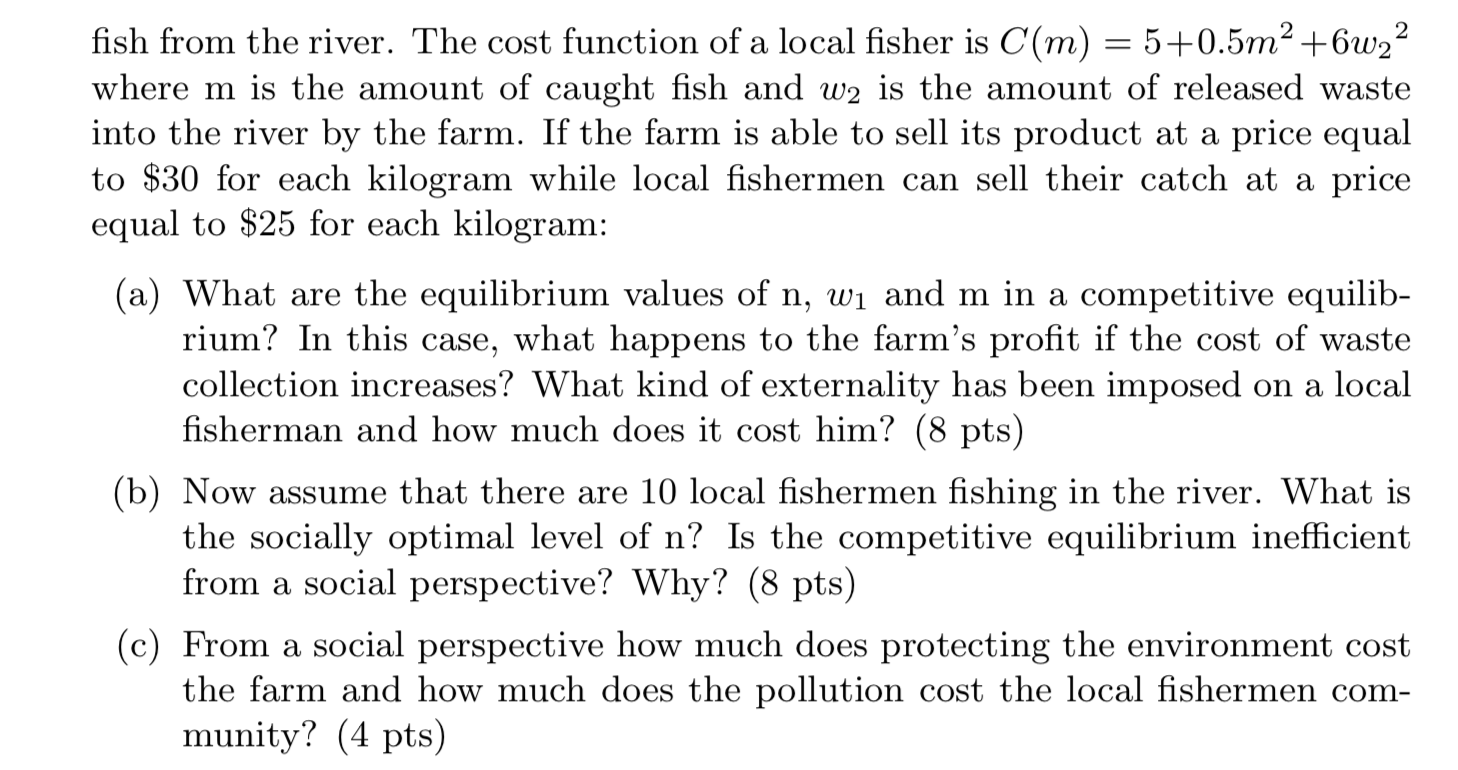
= 4. (20 points) Assume there is a fish farm on a river bank. The cost function for the farm is C(n) = 10+1.5n+7w1, where n is the amount of the product (fish) and wi is the amount of the collected waste both in kilogram. For each kilogram of fish, the farm produces 0.1 kilogram of waste. If they do not collect the waste and instead release it into the river, it will affect the local fishers who catch the = fish from the river. The cost function of a local fisher is C(m) = 5+0.5m2 +6w22 where m is the amount of caught fish and W2 is the amount of released waste into the river by the farm. If the farm is able to sell its product at a price equal to $30 for each kilogram while local fishermen can sell their catch at a price equal to $25 for each kilogram: (a) What are the equilibrium values of n, wi and m in a competitive equilib- rium? In this case, what happens to the farm's profit if the cost of waste collection increases? What kind of externality has been imposed on a local fisherman and how much does it cost him? (8 pts) (b) Now assume that there are 10 local fishermen fishing in the river. What is the socially optimal level of n? Is the competitive equilibrium inefficient from a social perspective? Why? (8 pts) (c) From a social perspective how much does protecting the environment cost the farm and how much does the pollution cost the local fishermen com- munity? (4 pts) = 4. (20 points) Assume there is a fish farm on a river bank. The cost function for the farm is C(n) = 10+1.5n+7w1, where n is the amount of the product (fish) and wi is the amount of the collected waste both in kilogram. For each kilogram of fish, the farm produces 0.1 kilogram of waste. If they do not collect the waste and instead release it into the river, it will affect the local fishers who catch the = fish from the river. The cost function of a local fisher is C(m) = 5+0.5m2 +6w22 where m is the amount of caught fish and W2 is the amount of released waste into the river by the farm. If the farm is able to sell its product at a price equal to $30 for each kilogram while local fishermen can sell their catch at a price equal to $25 for each kilogram: (a) What are the equilibrium values of n, wi and m in a competitive equilib- rium? In this case, what happens to the farm's profit if the cost of waste collection increases? What kind of externality has been imposed on a local fisherman and how much does it cost him? (8 pts) (b) Now assume that there are 10 local fishermen fishing in the river. What is the socially optimal level of n? Is the competitive equilibrium inefficient from a social perspective? Why? (8 pts) (c) From a social perspective how much does protecting the environment cost the farm and how much does the pollution cost the local fishermen com- munity? (4 pts)
Step by Step Solution
There are 3 Steps involved in it

Get step-by-step solutions from verified subject matter experts