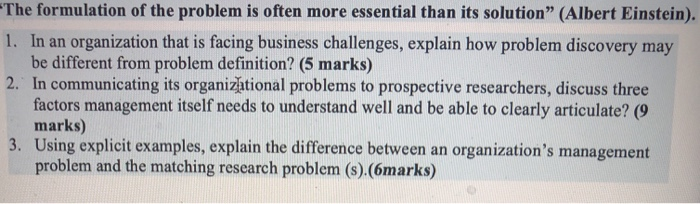
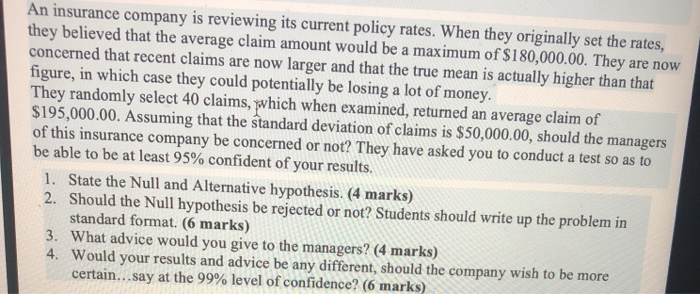
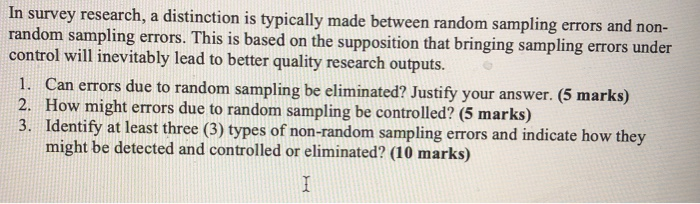
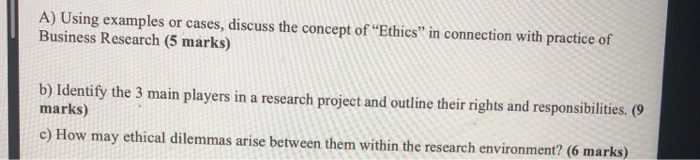
-The formulation of the problem is often more essential than its solution" (Albert Einstein). 1. In an organization that is facing business challenges, explain how problem discovery may be different from problem definition? (5 marks) 2. In communicating its organizational problems to prospective researchers, discuss three factors management itself needs to understand well and be able to clearly articulate? (9 marks) 3. Using explicit examples, explain the difference between an organization's management problem and the matching research problem (s).(6marks) An insurance company is reviewing its current policy rates. When they originally set the rates, they believed that the average claim amount would be a maximum of $180,000.00. They are now concerned that recent claims are now larger and that the true mean is actually higher than that figure, in which case they could potentially be losing a lot of money. They randomly select 40 claims, which when examined, returned an average claim of $195,000.00. Assuming that the standard deviation of claims is $50,000.00, should the managers of this insurance company be concerned or not? They have asked you to conduct a test so as to be able to be at least 95% confident of your results. 1. State the Null and Alternative hypothesis. (4 marks) 2. Should the Null hypothesis be rejected or not? Students should write up the problem in standard format. (6 marks) 3. What advice would you give to the managers? (4 marks) 4. Would your results and advice be any different, should the company wish to be more certain...say at the 99% level of confidence? (6 marks) In survey research, a distinction is typically made between random sampling errors and non- random sampling errors. This is based on the supposition that bringing sampling errors under control will inevitably lead to better quality research outputs. 1. Can errors due to random sampling be eliminated? Justify your answer. (5 marks) 2. How might errors due to random sampling be controlled? (5 marks) 3. Identify at least three (3) types of non-random sampling errors and indicate how they might be detected and controlled or eliminated? (10 marks) 1 A) Using examples or cases, discuss the concept of "Ethics" in connection with practice of Business Research (5 marks) b) Identify the 3 main players in a research project and outline their rights and responsibilities. (9 marks) c) How may ethical dilemmas arise between them within the research environment? (6 marks) -The formulation of the problem is often more essential than its solution" (Albert Einstein). 1. In an organization that is facing business challenges, explain how problem discovery may be different from problem definition? (5 marks) 2. In communicating its organizational problems to prospective researchers, discuss three factors management itself needs to understand well and be able to clearly articulate? (9 marks) 3. Using explicit examples, explain the difference between an organization's management problem and the matching research problem (s).(6marks) An insurance company is reviewing its current policy rates. When they originally set the rates, they believed that the average claim amount would be a maximum of $180,000.00. They are now concerned that recent claims are now larger and that the true mean is actually higher than that figure, in which case they could potentially be losing a lot of money. They randomly select 40 claims, which when examined, returned an average claim of $195,000.00. Assuming that the standard deviation of claims is $50,000.00, should the managers of this insurance company be concerned or not? They have asked you to conduct a test so as to be able to be at least 95% confident of your results. 1. State the Null and Alternative hypothesis. (4 marks) 2. Should the Null hypothesis be rejected or not? Students should write up the problem in standard format. (6 marks) 3. What advice would you give to the managers? (4 marks) 4. Would your results and advice be any different, should the company wish to be more certain...say at the 99% level of confidence? (6 marks) In survey research, a distinction is typically made between random sampling errors and non- random sampling errors. This is based on the supposition that bringing sampling errors under control will inevitably lead to better quality research outputs. 1. Can errors due to random sampling be eliminated? Justify your answer. (5 marks) 2. How might errors due to random sampling be controlled? (5 marks) 3. Identify at least three (3) types of non-random sampling errors and indicate how they might be detected and controlled or eliminated? (10 marks) 1 A) Using examples or cases, discuss the concept of "Ethics" in connection with practice of Business Research (5 marks) b) Identify the 3 main players in a research project and outline their rights and responsibilities. (9 marks) c) How may ethical dilemmas arise between them within the research environment? (6 marks)