







Question: The four ex - workers whose rights the EEOC said BMO Harris violated were: Regina Sanders, a senior administrative assistant who took medical leave to
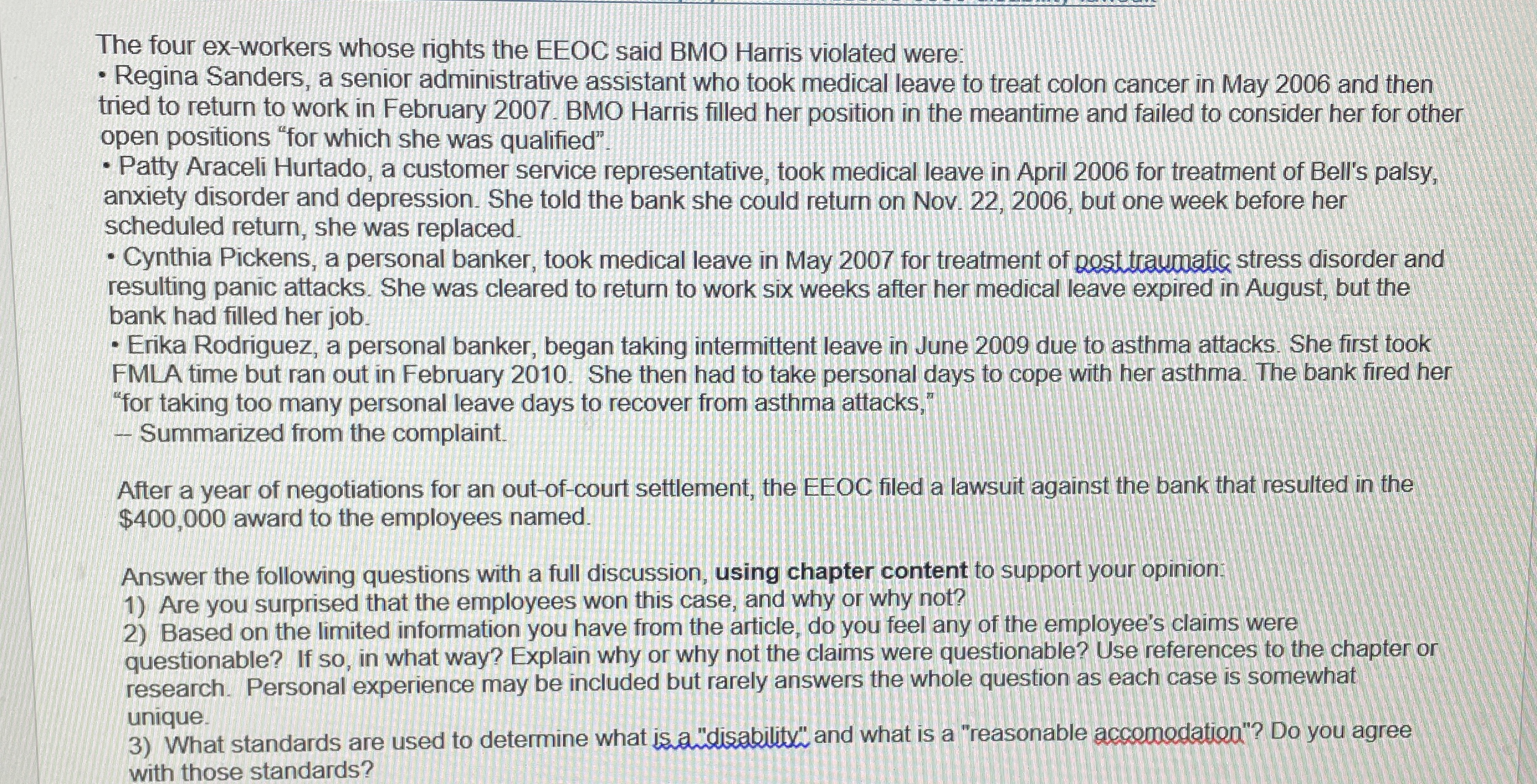
The four exworkers whose rights the EEOC said BMO Harris violated were:
Regina Sanders, a senior administrative assistant who took medical leave to treat colon cancer in May and then tried to return to work in February BMO Harris filled her position in the meantime and failed to consider her for other open positions "for which she was qualified".
Patty Araceli Hurtado, a customer service representative, took medical leave in April for treatment of Bell's palsy, anxiety disorder and depression. She told the bank she could return on Nov. but one week before her scheduled return, she was replaced.
Cynthia Pickens, a personal banker, took medical leave in May for treatment of qQsthraumatic stress disorder and resulting panic attacks. She was cleared to return to work six weeks after her medical leave expired in August, but the bank had filled her job.
Erika Rodriguez, a personal banker, began taking intermittent leave in June due to asthma attacks. She first took FMLA time but ran out in February She then had to take personal days to cope with her asthma. The bank fired her "for taking too many personal leave days to recover from asthma attacks,"
Summarized from the complaint.
After a year of negotiations for an outofcourt settlement, the EEOC filed a lawsuit against the bank that resulted in the $ award to the employees named.
Answer the following questions with a full discussion, using chapter content to support your opinion:
Are you surprised that the employees won this case, and why or why not?
Based on the limited information you have from the article, do you feel any of the employee's claims were questionable? If so in what way? Explain why or why not the claims were questionable? Use references to the chapter or research. Personal experience may be included but rarely answers the whole question as each case is somewhat unique.
What standards are used to determine what is adisability and what is a "reasonable accomodation"? Do you agree with those standards?The four exworkers whose rights the EEOC said BMO Harris violated were:
Regina Sanders, a senior administrative assistant who took medical leave to treat colon cancer in May and then tried to return to work in February BMO Harris filled her position in the meantime and failed to consider her for other open positions "for which she was qualified".
Patty Araceli Hurtado, a customer service representative, took medical leave in April for treatment of Bell's palsy, anxiety disorder and depression. She told the bank she could return on Nov. but one week before her scheduled return, she was replaced.
Cynthia Pickens, a personal banker, took medical leave in May for treatment of pesttraumatic stress disorder and resulting panic attacks. She was cleared to return to work six weeks after her medical leave expired in August, but the bank had filled her job.
Erika Rodriguez, a personal banker, began taking intermittent leave in June due to asthma attacks. She first took FMLA time but ran out in February She then had to take personal days to cope with her asthma. The bank fired her "for taking too many personal leave days to recover from asthma attacks,"
Summarized from the complaint.
After a year of negotiations for an outofcourt settlement, the EEOC filed a lawsuit against the bank that resulted in the $ award to the employees named.
Answer the following questions with a full discussion, using chapter content to support your opinion:
Are you surprised that the employees won this case, and why or why not?
Based on the limited information you have from the article, do you feel any of the employee's claims were questionable? If so in what way? Explain why or why not the claims were questionable? Use references to the chapter or research. Personal experience may be included but rarely answers the whole question as each case is somewhat unique
What standards are used to determine what is a "disability"" and what is a "reasonable accomodation"? Do you agree with those standards?
Without including chapter content and a discussion of your answers, do not expect to receive full credit. No responsive posts are required, but I encourage you to read a few of your colleagues' ideas and feel free to reply to them.
Step by Step Solution
There are 3 Steps involved in it
1 Expert Approved Answer
Step: 1 Unlock

Question Has Been Solved by an Expert!
Get step-by-step solutions from verified subject matter experts
Step: 2 Unlock
Step: 3 Unlock
 Study Help